
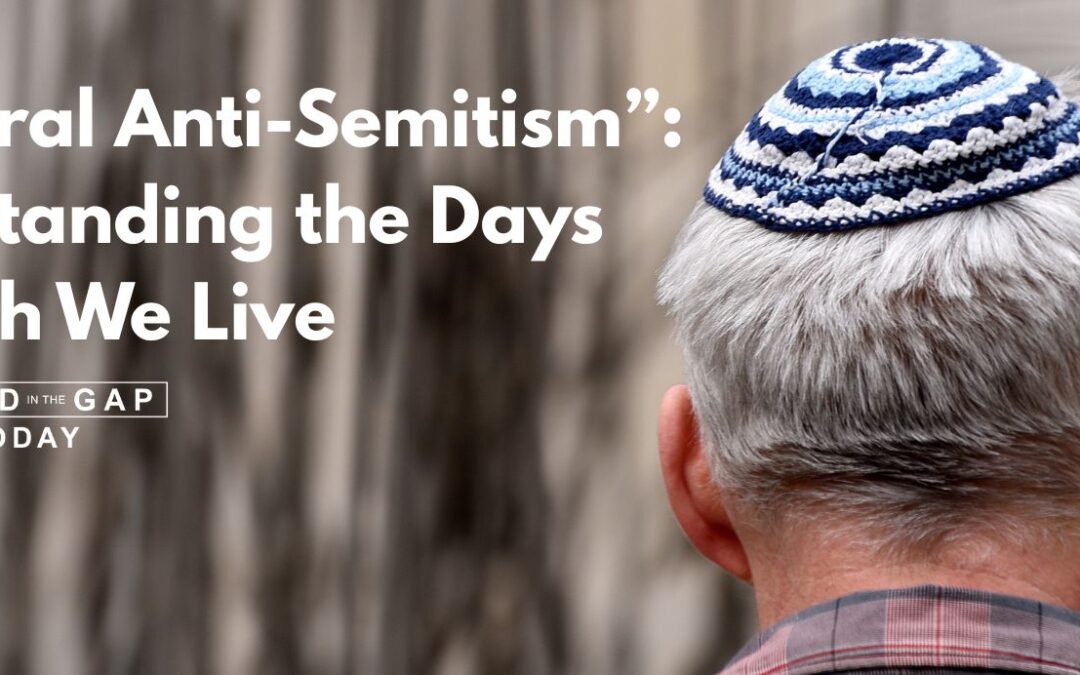

Collateral Antisemitism: Understanding the Days in Which We Live
April 29, 2026
Host: Hon. Sam Rohrer
Guest: Olivier Melnick
Note: This transcript is taken from a Stand in the Gap Today program aired on 4/29/26. To listen to the podcast, click HERE.
Disclaimer: While reasonable efforts have been made to provide an accurate transcription, the following is a representation of a mechanical transcription and as such, may not be a word for word transcript. Please listen to the audio version for any questions concerning the following dialogue.
Sam Rohrer:
Hello and welcome to this Wednesday edition of Stand and the Gap Today, and it’s also our bimonthly focus on Israel, the Middle East and biblical prophecy. Joining me today is Olivier Melnick. Olivier has a BA in Jewish studies from Moody Bible Institute and a master’s in biblical and theological studies from Dallas Theological Seminary. In addition to being an author, an evangelist and a teacher, Olivier serves as founder and executive director of the Shalom in Messiah, which has a website at shalominmessiah.com. And I’ll give that to you again. From a biblical and prophetical perspective, we know that because of what we term the fall, creation fall redemption, we’ve talked about as a biblical worldview here often, but the fall where Eve was beguiled by the serpent and Adam just flat out rebelled, God himself first promised his plan of redemption and it was first mentioned in Genesis 3:15.
Now, in that verse, God puts Satan on notice that he God would bridge the gap created by the fall and that Satan’s head would be crushed and a coming redeemer’s heal would be bruised, indicating at that point, even the crucifixion of Messiah. The balance of God’s word is then all about his story, history, his story, the unfolding plan of God’s working with rebellious humankind to bring his God’s promise in Genesis 3:15 to fruition. God’s covenant promise to Abraham, Isaac and Jacob as the human vehicle and the means through whom the promised Messiah would come, the nation of Israel’s rejection of the Messiah at his first coming in Yeshua’s victory over sin, hell and death was all prophesied and then recorded in the New Testament and the Old Testament really. And then the New Testament picks up from that. The New Testament proceeds then to lay out the furtherance of God’s plan of redemption centering on the church and God’s plan to make salvation available to the Gentile world.
Then when the times of the Gentiles was fulfilled, as Luke tells us, God’s word concludes with the revelation of Jesus Christ himself that we call the book of Revelation, providing for all believers further clarification and all we need to know to understand and to live victoriously in our day and the days ahead. Now, all along the way, Satan has attempted to derail, to delay or destroy God’s plan. He stood in the way of God’s plan involving the Jews, Israel, the nation, and the city of Jerusalem. He’s also attempted to destroy and alter the vehicle of the church, which Jesus said he himself would build. But end of this has walked efforts to persecute and to kill in many ways from the first promise of God in Genesis 3:15, he’s attempted to do that. In today’s culture, Satan’s opposition continues with one part being manifested, he does many levels, but in one part in what the culture terms to be antisemitism.
But understanding exactly what that term means and why it’s important is the focus of today’s program, which I’ve entitled Collateral Antisemitism: Understanding the Days in Which We Live. And with that, I welcome Olivia Milnuck to the program. Olivia, thanks for being with us today. Anxious to engage this subject with you.
Olivier Melnick:
Well, Sam, thanks for having me again. I must have behaved that you invited me again.
Sam Rohrer:
Well, as long as you tell the truth, you’ll be invited back. And you’ve been true to the word, Olivier. So let me just get right into this because I think your insight will be very, very good. But as a Jew by human birth, you, and a Christian by divine second birth is how I’m putting it, you bring a unique perspective to our consideration today. And I always like to begin with definitions. So if we could, let’s just start here. I’d like for you to define the term antisemitism, if you can, when it first came into being, since it’s a term not found in scripture, and since today, it varies greatly in meaning depending on one’s perspective.
Olivier Melnick:
Well, sure. And I so appreciate your first question because I have found myself at times assuming that people understood what I was talking about and I realized that we had different understanding of some words. So setting the stage with the proper definition, we know where we’re coming from, so that’s important. Antisemitism, I’ve been working on this for the better part of 26 years now, and I started with other people’s definition, my understanding of it. And then I developed my own, pretty soon, about 25 years ago, and it started pretty simple as antisemitism is the hatred of the Jews characterized by thoughts, words, and deeds against them. Then I realized, and that was back in 2000, the time of the second integra, I was working on some projects at the time and I needed to look into that. That’s what got me started. Then I realized it was not just the Jews that was too narrow.
So it became antisemitism as the hatred of the Jews or Israel, characterized by thoughts, words, or deeds against them.
Soon after that, and I don’t know exactly the date, but it’s over a span of 25 years, I realized that that hatred that I was witnessing, that I was documenting, researching, and speaking on was very irrational. People had never met anybody Jewish, still had a hatred of Israel, hatred of the Jews. And so it became antisemitism as the irrational hatred of the Jews or Israel, characterized by thoughts words and deeds against them. And then the minute I started speaking of irrational, not the minute, but after a while, the word irrational led me to think, you know what? It’s not just irrational, it’s demonic. And that was a big one. When I started realizing, probably maybe 15 years ago, when I started realizing that really this antisemitism that we were seeing back then that was resurfacing, repackaged, so to speak, was very demonic, very satanic. That became my go- to definition for the better part of the last 15 years, really.
Anti-Semitism is the irrational and satanic hatred of the Jews or Israel characterized by thoughts, words and deeds against them. And then Sam, something happened in the last few months, and I would say probably honestly since October 7th, 2023, but very noticeable in the last six months that prompted me to add one more word to my definition, which is leading to today’s topic of collateral antisemitism. So my current definition goes like this. Antisemitism is the irrational and satanic hatred of the Jews, Israel, or their supporter characterized by thoughts, words, or deeds against them. Because Sam, I realize one thing that not a lot of people are talking about, if anybody, is that you no longer have to be Jewish to suffer from antisemitism in 2026.
Sam Rohrer:
Well, that brings us right up to the break. That’s a great insight, Olivier, to see that development because ladies and gentlemen, in reality, that’s why I said at the beginning to define it because that word antisemitism has come to mean many things. And frankly, you see it changing almost by the day. But Olivier, you really put that together. And I’ll ask you to share that again at some point here when we get into it. But ladies and gentlemen, stay with us. Today, our theme is this collateral antisemitism, just defined, understanding the days in which we live. Then when we come back, we’re going to move from the what, the definition into the why, why all of that is happening. Well, if you’re just joining us, glad to have you aboard today. This is our focus, our bimonthly focus on Israel, the Middle East and biblical prophecy.
My special guest today, glad … Sorry, I just had to cut that out for a minute. I had to sneeze. Sometimes you have to do that on radio. That’s why there was a pause there. But anyway, Olivier Melnik is my guest today. He actually was raised in a secular Jewish family in Paris, France. He later met his wife and came to faith in Jesus Christ and has a ministry called shalominnmessiah.com. Been with me before, but we’re discussing today this concept of collateral anti-Semitism. He just defined that in the last segment along with anti-Semitism and how he has moved in his thinking over the years to what a definition that would actually properly describe antisemitism and out of that has come collateral antisemitism. But that being the case, moving into it because that’s the why. You have to understand what we’re talking about, but then it comes also the why.
I was thinking about this, Olivier, in Matthew chapter five, six and seven in that area there, scripture records Jesus beginning to teach his followers about how to think and to live differently as, and they were all Jewish disciples of Yeshua, the promised Messiah. Now, in the sermon on the Mount, in that passage and the beatitudes there, in the sermon balance, Jesus used the word persecution, and he specifically said, “Persecution for my sake.” Then all through the balance of the New Testament, the word persecution for the sake of Christ or persecution for my namesake or something similar is used with Jesus saying, “If they persecuted me, so will you be persecuted.” Now that’s all through the New Testament in reference to individuals who trust in Yeshua Messiah. So let me start here. From your perspective, as we’re talking about antisemitism and so forth, why is it even necessary, Olivier, to come up with the word antisemitism as an example?
Instead of just keeping with Christ’s own words, persecution for the sake of Christ. Let’s just go there. That may be a thought that nobody’s thought about, but I want to ask that to you. What do you think?
Olivier Melnick:
Well, first of all, the word antisemitism, interesting aspect of the word is that whenever the word semit or semitism is used, it encompasses Jews and Arabs because they are descendants of Shem, Genesis chapter six, and the descendants of Shem are the three sons of Noah are both Jews and Arabs. But when the term is used in a negative way, antisemitism, it’s only describing Jews. So just to keep that in the back of … We need to keep that in the back of our mind, but being persecuted for the sake of Christ is one thing, but antisemitism is not necessarily the same. I mean, most Jewish people, the vast majority, I mean, me excluded along with the Jewish Behaviors and Jesus, and we’re a small minority, but the vast majority of Jewish people who do not believe in Jesus as being the Messiah are suffering from antisemitism and has nothing to do with them being persecuted for the sake of Christ.
So I think we have two different things here. They’re similar in some aspects because people are being persecuted, people are being arose, people are being physically abused and so on and so forth, but it’s not on equal footing. So we as Christians are told in the Bible that we should do the best to serve and obey the Lord, and we know our future, we know we’re going to be in God’s presence, and we know that’s what we have to look forward to in the process of attaining that place of final glorification, our sanctification can and most certainly will include periods of frustrations and harassment and persecution. Okay.
Sam Rohrer:
Well, let me ask you a question here, Olivier. I think it’s a good question. And that is this, do you as a Jewish person by birth, but a believer in Yeshua, by second birth, do you feel in these days a level of hostility or hatred as you defined it by the fact that you were born as a Jew or is it now overridden perhaps because in persecution, as we’re talking here, as a disciple of Christ, do you feeling both of them or just one of them?
Olivier Melnick:
That’s a good question, Sam. I think that I would say both of them, because I could be having a conversation with somebody about being a follower of Jesus, a Christian, and they would be little what I’m saying, they would make fun of me, or they would even become do something dangerous is one thing, but I could also have another conversation. As a Jew, like let’s say I walk on the street with a yarmulka on my head or a t-shirt or wear a star of David around my neck and people would start calling me dirty Jew or you Zionist. So I think I can experience it from both directions. And it might be similar, the result might be similar, might be different, but I think it’s fair to say that I can suffer as a Christian, as well as a Jew by birth, which I haven’t ceased to be.
I mean, I’m still very much a Jew, and I can promise you that based on what happened during the Holocaust era, that born a Jew was plenty to send you to the gas chambers. It didn’t matter if you believed in Buddha or Jesus or nothing, if you were born of Jewish parents or at least one Jewish grandparents, that was your ticket to the gas chambers.
Sam Rohrer:
Okay, that’s excellent. And we could go further, but I’m glad I asked that and I’m glad you answered it in that way. That helps to understand. Let’s move on a little bit as to the why, because today, when I look around, since the scattering of Israel, nation of Israel, due to their rebellion to God’s commands, as Ford told, Moses actually for told that in Deuteronomy chapter 28:64 and Leviticus 26:33, but then scripture also tells us about the rebirth of the nation of Israel in a day in fulfillment of that Isaiah 66: eight. Then scripture talks about, and all of Israel knew it because it’s in the Old Testament that one day the nation would be scattered following the Great Dispersion there at the temple destruction, Jerusalem 70 AD and Ezekiel 36:24, Isaiah 11:11: 12 and Jeremiah 31:10, for tells that, but then God’s plan of redemption stays right on track, un-derailed, unstopped, and moves into our current time, seemingly coinciding with the rise of the political movement against the Jewish people.
When the nation of Israel was established 1948, antisemitism seems to have increased along with what you’re referring to as collateral antisemitism. Now, all that being said, the Jews are seeing all this that has happened. We as Gentile believers are seeing all that’s happened. So would you explain the why? Why the increase that we are seeing in these days, antisemitism or collateral antisemitism, and perhaps explain its depth and breadth where we see it?
Olivier Melnick:
So the increase is noticeable. As a matter of fact, I tell people, and I probably have said this in no less than the last year and not before, I tell people that I see two prophecies being fulfilled in front of our very eyes right now. And you have to be careful. I’m very conservative, biblically speaking, so I don’t like to say this is prophecy here, prophecy there, and then have to backpedal, but I can say the certainty that the regathering of the Jewish people like Ezekiel 36 in preparation for the chapter 37 of the valley of dry bones, the regathering from the diaspora, the Jewish people into the land of Israel in unbelief is something that we’ve seen really ebb and flow since the late 1880s out of different countries of Europe. And so it’s been going on ever since. And of course a big influx from the former Soviet Union and it keeps coming from different areas.
And so we’ve seen that. That’s one prophecy. The other one is Zechariah 12: three, when we read that Israel, that specifically Jerusalem will become a rock of offense to the world, and basically what it means is that the whole world will go against the Jews, will go against Jerusalem and Israel. And about almost a year and a half ago, a survey, January of 2025, a survey was conducted and the result of the survey was that 46% of all adults in the world harbor some sort of anti-Jewish sentiment. So that prophecy of Zechariah 12: three is being fulfilled in front of our very eyes. And it’s probably past the 50% mark as we speak right now. And this is all connected to the agenda of the final destruction of the Jews that has to happen according to Satan’s program because Satan wants to stop Jesus from coming back and that is connected to the Jewish people saying s it is you who comes the name of the Lord and that triggers the second coming of Christ, not the rapture, the second coming.
Okay? And that’s the two different events. And that second coming will take place at the end of the seven year tribulation when all Israel will be saved. And by the way, I believe that this is when prophetically the nation is reborn. A lot of people are divided on is it on May 14, 1948 that the prophecy was fulfilled or another time. I think it’s at the end times when all the Jewish people will become believers and say comes the name of the Lord, that the nation will be reborn because there’ll be reborn, not only they will be reborn spiritually.
Sam Rohrer:
That is a great point. And boy, I’d love to go further on that as well. That actually makes very, very good sense to me. And you’re right, it’s not shared by everybody, but that makes very, very good sense. Ladies and gentlemen, stay with us. We’ll continue on our theme here today and then we’ll come back. We’re going to talk about, I’m titling this section here, a Christian response, how we can respond as believers in Jesus Christ to this rising antisemitism. Well, we’re at the middle of our program today. Thanks for being with us. Special guest today is Olivier Melnick. He’s the founder and the executive director of the Shalom In Messiah ministry that the Lord called him to start, and that website is shalominnmessiah.com. All right. Now our theme, if you’re just joining us, is collateral antisemitism. Probably never heard that. We’ve all heard of antisemitism, but in the first segment, if you were not with us, need to go back and pick up the program, go back where in that segment, Olivier defined it, both antisemitism and how the collateral description has come up with has come into that.
Now, moving on into that, in the most fundamental consideration of modern antisemitism, it’s become a hatred focused on the Jewish people as separate from a linguistical hatred of all people of Semitic birth, which includes Arabs, Jews, and others of Mid-East descent. And Olivia, you talked about that briefly. What I just said there was something that is easily collectible if somebody were to Google and say, “What is antisemitism?” What I just said kind of comes out of that. It doesn’t throw into it what you were talking about adding in the word demonic and so forth, demonic hatred. But as Christians and true disciples of Jesus Christ, we know that in Christ, there is no such thing as Jew or Gentile or male or female or any other distinction of inferiority or superiority. And ladies and gentlemen, this is what makes the gospel so unique. What I just said there, understanding that in Christ, we can be made one, actually are made one in Christ, that at the foot of the cross, the only place where all are equal and that the offer of salvation there is extended freely to all regardless of birth or nationality or gender or status or level of prosperity or poverty.
And that’s what makes the true gospel the only true hope of all mankind. And it is the essence of God’s plan of redemption that he first spoke as recorded in Genesis 3:15. Therefore, there is nothing that is more powerful and able to eliminate what we’re talking about today, antisemitism, or I’m going to say or anti any color or anti any race. There’s nothing that is more powerful to eliminate that than the gospel, and that is the purpose of the church of Jesus Christ. And that is one way we can lead the way, the sharing of the gospel. All right. Now, Olivia, with that as a setup, as a, I’m going to call it a completed Jew, put it that perspective. As someone who is concerned about the communicating of the gospel, I’m referring to you and other Messianic Jews and many of I’ve had on the program here as well.
Personal question. How do you personally go about doing that, the sharing of the gospel when many Jews who have not yet embraced Yeshua as the prophesied Messiah often view messianic Jews almost as turncoats. So you’ve got a unique thing when you share the gospel with Jewish people, just a personal testimony and how that’s done.
Olivier Melnick:
Yeah. So I’m listening to you talking about, you’re making a reference to that verse about there’s no more male, female, Jew, gentile, we all in Christ Jesus. And while I agree with you because this is a truth from the Bible, we have to be careful that we have to clearly maintain some sort of distinction because while there’s no more male or female in Christ, we still have male, female today, and so we still have Jew Gentile. I think when it comes to justification, God sees all of us, male, female, Jew, Gentile, save, free, all as sinners in need of redemption. That is true. And we become the one new men. We become, as far as justification is concerned, but I continue ethnically to be a Jew. And I think that plays a part in the way that I’m going to be explaining that to a Jewish person who doesn’t believe in Jesus in the big misunderstanding, unfortunately, the big misconception that Jewish people have. And to an extent that Christians have from a different perspective, it’s the confusion between two words, the word Judaism and the word Jewishness. If people clearly understood the meaning of both words, it would alleviate a lot of confusion and frustration and rejection. One is the word Jewishness is a word that describes an ethnic state. I, as the son of a mother who’s Jewish and a father who was Jewish, was born of Jewish blood, of Jewish descent. There’s nothing I can do to change that. That was my parents and their parents were Jewish and on and on and on if you go back in history. So that is Jewishness. It’s an ethnic state.
I cannot lose that no matter what I do or no matter what I don’t do. Jewishness. Judaism, on the other hand, is a belief system, is something you practice, something you adhere to, something you believe in. And I can do it as a Jew. I can practice Judaism at different levels of religiosity and spirituality, and you as a Gentile can also practice Judaism. Guess what? As a Gentile, when you practice Judaism, no matter how much of it you practice, does not make you an ethnic Jew. So just like you cannot lose your Jewish identity, you cannot gain one by practicing Judaism.
And if people would understand that, then Jewish people would look at me and say, “Wait a minute, Olivier, you’re born a Jew, you’ll value Jew. You believe in Jesus. We don’t agree with you, but that doesn’t take your Jewishness away.” I wish they would understand that. And I wish Christians would understand that as well, because too often have been told, “Olivia, you used to be Jewish. Now that you’re a Christian, how does it feel?” And I tell them, I said, “I’m still a Jew. I’m a Jew from the Messiah.” Well, like you said, Sam, I’m a completed Jew, but I don’t even call myself that. I call myself a Jewish follower of Jesus. That’s my favorite term.
Sam Rohrer:
There you go. And that is perfect. And that description that you just went through there, I think it’s likely very, very, very helpful to those who are listening. And it is true, exactly. In Christ, we are made alike, but in this life, we have our distinctions. And that’s what you’re saying. So let’s move on. As a part of your ministry, Shalom in Messiah, you’ve started an emphasis that you call no synagogue left behind, kind of an intriguing title as just one way, not the only way, but as one way that Christian churches can reach out to Jewish people in their area in this time of increasing antisemitism. What’s that all about?
Olivier Melnick:
Well, Sam, this is something that the Lord really gave me about a year and a half ago and I’ve been working on it to fine tune it and started to implement it a few months ago and we did pilots on the West Coast and the East Coast and very successful and it’s very simple. Basically, it’s an invitation for pastors to locate, identify where the synagogue nearest to their church is, and then reach out to the synagogue, want to talk to the rabbi, and clergy to clergy already takes some barriers down. Anybody who’s unknown calling from the community, people are going to go like, “We don’t have time. The rabbi doesn’t have time.” Once it’s clergy to clergy, pastor so- and-so from local church wants to talk to you, it opens some doors. And then the pastor will say something to that effect, “We have a security team at our church that protects our people on Sunday morning for services or whenever we have services at other times, but we usually do not have a need for them on Friday night on Shabbat or Saturday morning.
I would like to meet with you for coffee, talking to the pastor to the rabbi and introduce you to our team. And if you’re interested, we’d like to offer free of charge.” And that’s important. Free of charge, we’d like to offer our team on a revolving basis whenever you have a need to bring security outside of your synagogue or inside of your synagogue. And these are trained professionals, they’re police officers, retired armed forces, and we’ve done it on the West Coast and on the East Coast and the results have been amazing. The Jewish community is seeing Christians who are actually are deciding to show that they want skin in the game, as I call it. They want to be involved in showing in a tangible way, involved with the Jewish community saying, “I’m a Christian. I read my Bible. I understand that God is not done with Jewish people.
I understand that Israel has a very special place in God’s program. We love Israel because we love God and because we love Israel and the Jewish people, we want to make a difference.” So that’s what I’m … So if there’s any pastor listening to this program, I would love to get their email to me, Olivier@chalamanmessiah.com and say, “Hey, I’m a pastor of this church. Please talk to me. ” And I can talk to them personally. I’ll take the time. Anybody who wants to talk to me, I would love to talk to them. They can also go to our website at shalumanmesia.com and there is a step-by-step directions on how to reach out to the synagogue, which is really simple, you know, On the landing page, you click and they’ll give you the step by step that I just outlined on the program right now.
Sam Rohrer:
No synagogue left behind. Good name. And that’s very creative, what you just laid out there, Olivier. So ladies and gentlemen, there are many ways to reach out into our various communities to share the gospel. Certainly we ought to be doing by the way we live. That’s very strong and the strongest perhaps, but reaching out in this way to the Jewish community is a way that Olivier has come up with that Lord seems to be blessing. You may want to consider that shaloominmessiah.com and you can contact him there. Stay with us. We’ll be right back. And we’re going to say right now, sum it all up and say right now, what should be our biblical mindset overall as we consider the things we’ve just discussed today? Well, as we go into our final segment now, again, give the website again for special guests today, Olivier Melnick, who is the founder and executive director of the Shalom In Messiah Ministry.
And that website is shalominnmessiah.com. So if you want to know more about what we just talked about in that last segment, something that he’s just recently developed entitled No Synagogue Left Behind, a way of reaching out to the Jewish community. From a church perspective, you can go get more information there. It’s on that site, shalominnmessiah.com. All right. In a world, Olivier, we’re prophetically, we can see God’s plan of redemption coming into very fast focus. And you were expounding upon that a little bit in the last segment. And really our listening audience, because we spent a lot of time on fulfilled prophecy and how that’s happening, would agree with you that yes, anybody with eyes to see just cannot deny the speed at which looking through the lens of a biblical worldview and the pages of scripture where what is happening around us is just coming into focus.
It’s kind of like sitting in the optometrist chair when he puts that thing in front of your eyes and we’ve all know what that’s like and click, click, click. Can you see this? Is this more clear? Is this clear? To me, that’s exactly what it is every day I look and I say, click, click. Today it’s a bit more clear. And the world’s eyes, as you said, are increasingly riveted. Zechariah talks about on the Middle East, Jerusalem being a stumbling stone. And the world just cannot gravitated. They’re pulled like a magnet to the Middle East and Israel because of God’s doing. It’s all in that little nation of Israel. It’s amazing what one little nation can do, but that’s what God’s doing. At the same time, true disciples of Christ are looking for the soon return of Christ as we see these things happen in the rapture.
We just touched on that when Christ comes back for the bride of Christ. And so here’s my first question too as we conclude today and directed towards how we think, the mindset. But how does the biblical teaching of the rapture and the return of Christ for the church? And I don’t know if you want to go to the aspect of how that ties into the Galilean wedding. I don’t know, however you want to go on that, but then that happens. Then there’s a seven year tribulation period concluding with the return of Christ with the church. So the rapture, the return of Christ for the church, the second coming of Christ, the return of Christ with the church. But how does all of that view and shape your view of what is happening around us today?
Olivier Melnick:
Well, the word that keeps coming to me in looking at world events, and Sam, I was on a vacation with my West that we have not done this in over a decade. And I did something I’ve never done before, which was very nerve wracking for me. I left my laptop at my desk and I flew away and I didn’t have any connection to what was going on in the world. And I mean, I had my phone, but I did not look, I did not seek. I just wanted to spend time disconnect and clear my head. I was gone for six days and I got back and I feel like I’ve been gone for a year. There’s so much happening on a daily basis now and the word that keeps coming to me when I look at world events is convergence. There is such an incredible convergence of events geographically, geopolitically, economically, spiritually, on a global scale that those of us who read our Bible cannot … There’s no way that you can miss the fact that we are really, truly in, it’s like 11:59 at the midnight hour.
We are in the end times. You look at all the players, Turkey, Iran, and don’t have time to get into that, maybe another program later, but Turkey, Iran, and Russia, and then you look at Gaga and Magog, and you look at the … Which I think the bigger than that is the advent of AI, which I think will play a very important role in the ministry, if you can call it that, of the antichrist. And so all those things happening so quickly, there’s no question in my mind that the rapture is at our doorstep. It’s right there, and it’s always been imminent, but we can almost taste it now. So
It does give me and you, and it should to all Christians who are serious about their faith and their connection to God, a sense of urgency. How much time do we have left before, like you said, the Messiah comes back to take up his ride at the rapture, and then we’re gone, and then the world is left behind, and there will be people that have a chance at salvation, and we will be saved, but many of them will perish. Two thirds of the whole planet will perish in the process. And also two thirds of the Jewish people, according to Zechariah 13: nine and 10. So there’s such a convergence and a sense of urgency that Christian right now should go like, “Okay, what can I do to make a difference for the kingdom before I’m taken away?”
Sam Rohrer:
Olivier, the words you used there are the words that I, if you would have asked me that question, I would have responded exactly the same way. Convergence, speed, frequency, intensity, the aligning of all of the various factors that Lord has given us in his word, Old Testament, New Testament, those pieces coming together in a way that they have never come together since the ascension of Christ after his first coming. Those are things to me that when I see Israel in the land and see the increase of persecution for those who truly love the Lord and antisemitism, generally as we’re talking about today, those are all parts and pieces of those converging factors that to me, yeah, I like what you just said, literally taste it. To me, that’s how I would describe it too, other than the urgency factor, which ought to do and holy living, which ought to be a result of that, how is that affecting your outreach to other Jewish people?
Olivier Melnick:
Well, I think the main thing is urgency. What I’m also doing is, I remember speaking with my sister not too long ago, who’s not a believer, not a follower of Jesus, but by a long shot. And I told her, I said, “Listen, I don’t know what’s going to happen to you if you’re going to outlive me, but just remember one day a lot of people are going to disappear.” And I did not use any theological terminology, why do that? And I told her, “One day a lot of people are going to disappear and you’re going to hear all kinds of things on the news, alien abductions or…” Which by the way, Sam, I find it interesting that all of a sudden we hear a lot about aliens on the news and even in the political field, I’m going like, “Well, where is that coming from?” Well, I think the stage is being set for an explanation of a lot of people disappeared at the rapture and because the world is not going to want to buy that as a possibility, they’re going to say it’s an alien abduction.
And I think people are being conditioned right now for that. But I told my sister, if you see me gone and with a lot of people, just remember, Olivier was right. You talked to me about Jesus coming to get the people who follow him and so you don’t have to believe me right now. And I would say this is the same to the Jewish people today. You don’t have to believe what I’m saying right now. You don’t have to agree with me. You don’t have to do anything if you don’t want to, but just keep it in the back of your mind. If one day you’re still alive when that happens, then you’ll go like, “Oh, I missed it the first time Olivia was right.” It’s still time to put my faith in Jesus for what you did.
Sam Rohrer:
There you go. Olivier Melnick, thank you so much for being with me today. Again, this website, ladies and gentlemen, shalominnmessiah.com. Thank you for being with us, and I hope this program has been edifying and above all, encouraging and motivating, motivating in these days to be more urgent than ever in our witness and in holy living.

Recent Comments