
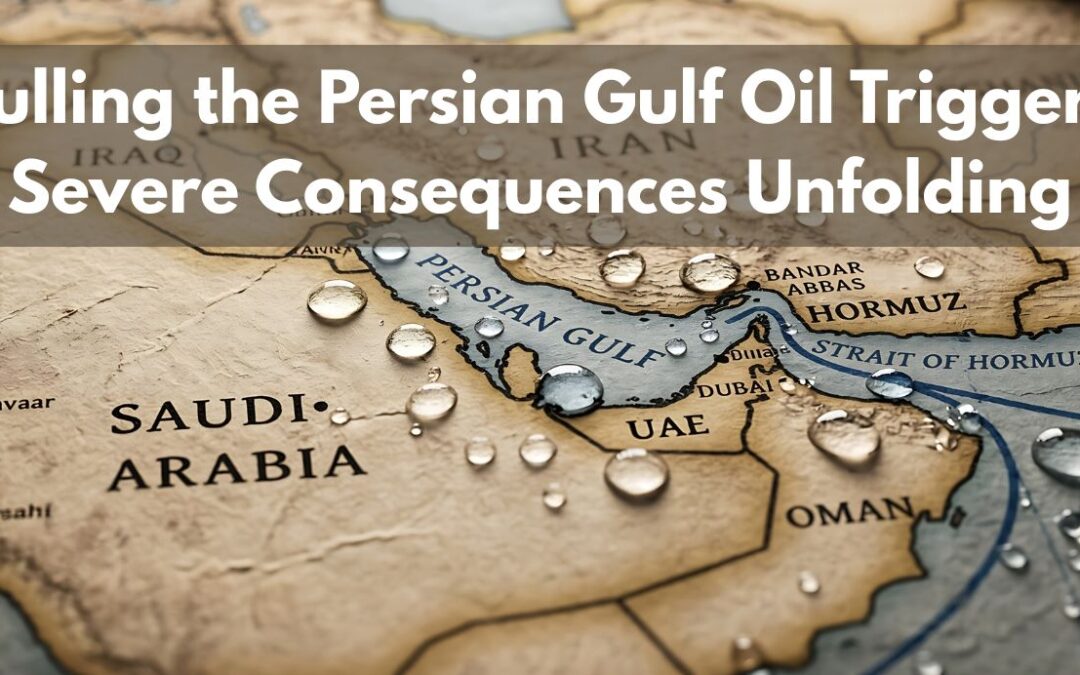

Pulling the Persian Gulf Oil Trigger
Severe Consequences Unfolding
April 30, 2026
Host: Hon. Sam Rohrer
Guest: David McAlvany
Note: This transcript is taken from a Stand in the Gap Today program aired on 4/30/26. To listen to the podcast, click HERE.
Disclaimer: While reasonable efforts have been made to provide an accurate transcription, the following is a representation of a mechanical transcription and as such, may not be a word for word transcript. Please listen to the audio version for any questions concerning the following dialogue.
Sam Rohrer:
Hello and welcome to this last day of April Stand in the Gap Today program. Hard to believe time is flying as fast as it is, but it is. And this is also today our monthly focus on economics, finance and biblical stewardship. My returning guest today is David McElvany. He’s the CEO of the McAlvany Financial Group, and he’s been in that position since 2008. That group is comprised of McAlvany precious metals and McAlvany Wealth Management, and they have a website at maculvaney.com. I’ll give that information later. Now, when it comes to the issue of economics, the media highlights simply, in my opinion, what they’re essentially told to highlight. Government routinely produces what I found over the years, officially fake numbers, geared to suit their given narrative, and that changes administration to administration. But the real test is what the average American feels when we fill up our gas or home heating oil tanks, or buy groceries, or even consider taking a vacation.
Now, according to the most recent Gallup data, the Economic Confidence Index, which they have been pursuing for many years, and they do it this time of year always, it plummeted to 38% in April, a 10 point drop since March, just a month ago. And staggering, their numbers indicate 73% of Americans believe the economy is getting worse and heading in the wrong direction. Even Republican voters in the under 45 age group, by a staggering 60%. These are big numbers. 60% now disapprove. They’re not neutral. They disapprove of the handling of the economy at this point, with inflation now hitting a reported 3.5% in March. And with each passing day, the American people, the economist watchdogs, the statistical analysts and truth, I’m going to say truth embracing people, have already come to the point or are quickly doing so, where they’re acknowledging that there’s a striking contradiction between what the White House is saying about entering the golden age and what their wallets are screaming.
And I’m going to say, put into this an increasingly AI driven government. And I think that’s being set up. We’ll do more on this, and we’ve talked to some in the past, but AI driving government policy and analytics is looking more like an algorithm driven … It’s not rather than a golden cage. It’s more like a algorithm driven golden cage. And I’m going to say with the disastrous disruption to the global flow of oil from the Middle East, literally impacting everything from finance to food, from manufacturing, to military preparedness, from Wall Street to Main Street, my contention is that the impacts and the consequences though already being felt are only beginning with the entire world being driven to some form of economic faltering, if not on the edge of collapse. And that’s the focus of our program today. The title I’ve chosen to frame today’s conversation is this, Pulling the Persian Gulf Oil Trigger.
Severe consequences unfolding. With that, David McAlvany, thanks for being back with me today. It’s a real privilege having you back.
David McAlvany:
Sam, great to be back with you. Thank you.
Sam Rohrer:
David, you’re a very vocation over the years and your interest revolves around making sense out of the routinely confusing economic data, which I just tried to give a highlight there. And what appears to me, as I follow numbers and have been in government for a long time, data presented, I’m going to say strategically, some could say deceptively, but designed to psychologically shape how Americans perceive reality. So my first question to you is this, how do you honestly see the economy in the US and increasingly the global economy? Do you agree generally with the very recent annual Gallup economy and finance tracking poll that was just done April 1st, April 15th reports that about 73% of Americans feel the US economy is getting worse. What do you think?
David McAlvany:
Yeah, I think the devil’s in the details. I mean, you can look at particular statistics and support either a growing economy or a contracting economy. It just depends on kind of your point of view. And I think Main Street has a different point of view than Wall Street, and Main Street has a different point of view than Washington. Washington is comfortable looking at a quantitative measure of the economy, what we call GDP. It’s the sum total of the horsepower within the economy. It includes government spending. It includes AI spending. It includes some extraordinary things that, frankly, for the folks on Main Street, they can reasonably develop a very different view. So GDP numbers today, 2%, up from 0.5%. Well, that is fabulous. 2.2 was expected. What’s not clear in that 2% is that that does include government deficit spending and an AI capex spend that is historic.
I mean, we’re talking about six, 700 billion dollars in extra spending that wouldn’t be there otherwise. And over the next couple of years, upwards of 1.6, 1.8 trillion dollars to build out data centers and create AI capacity. Again, how does that affect the man or woman on Main Street? Well, they’re going to the grocery store and seeing higher costs. And so it’s no surprise that the Gallup poll says that people aren’t happy. Well, because people aren’t seeing the same thing that Wall Street’s seeing. People on Main Street are not seeing what Washington DC. They’re dealing with the qualitative aspects, not the quantitative aspects. And the quantitative aspects say, “We’re okay, you’re okay. Don’t worry about it. ” Meanwhile, you’re getting a lot less groceries fit into the bag for the same dollars spent a month ago, three months ago, three years ago. And that’s where not only Gallup, but University of Michigan sentiment numbers were the lowest recently going back to 1952.
So obviously, Main Street’s got a different view.
Sam Rohrer:
David, is that part of what some are saying is the K shaped economy where in fact those at the very top are doing very well and getting better, but those down in the middle and below are experiencing something different. Is that part of what you’re talking about?
David McAlvany:
Absolutely. And I think that is directly where Wall Street would see it, where asset prices are fine. We’ve got equities trading near all time highs and on that basis, the wisdom of the masses, the mass market would say everything is just fine. Even Donald Trump would say, “Look, we got the 50,000 on the Dow. Look what I’ve done for you. ” And Wall Street would say, “Yes, we’re looking primarily at the top end of the K-shape economy where because asset prices are doing fine, everyone’s doing fine.” Well, the bottom half of the economy, the majority of people in America don’t have huge 401ks, don’t have assets that are going through the roof. They’re dealing with the mundane things like, “Am I going to have enough money to pay my bills this month?” And that’s where the perspective, again, the main street perspective is going to differ.
And it’s one of those things that’s very consequential in an election cycle because people vote their pocketbooks.
Sam Rohrer:
That’s a great point. That brings us right up to the break, David. That’s excellent. Ladies and gentlemen, no doubt as you’re listening to this, you’re going to understand perspective does make a real difference. Now, we’re going to break out and go further into some of that perspective. There’s that which we hear, that’s that which we experience. We’re going to go there. We’re going to talk about the impact primarily, not limited to that, but oil, some things that are happening that are driving consequences and impacts in the economy. We’ll talk about economic consequences driving mostly from that in the next segment. If you’re just joining us, thanks for being on board today. This is our monthly focus and sometimes we’ve been doing it more often than just once a month, but on the matter of economics and biblical stewardship and things related to that. My special guest is David McElvany.
I’m glad to have him back on with me. He’s the CEO of the McAlvany Financial Group, and he’s been in that position since 2008. They have a website at maculvaney.com. A lot of things there. It’s all, again, related economics, investments, wealth management, that kind of thing. So you can go there. Now, the theme today is on the trying to go the direction using, not limited to this, but built off of this, is the reduction of oil petroleum out of the Persian Gulf. That impact by itself is creating impacts around the world. Taken into account with other things, it becomes even more so. Now, David, just a couple of days, actually just yesterday, another one of my recurring standard gap today guest, Michael Snyder, he’s an attorney and an independent journalist, but he wrote on this matter of the 57% reduction from the Persian Gulf. He said this, I want to get your comment on it.
He said this, “Every single day that the Strait of Hormuz is closed, the damage that is being done to the global economy is getting even worse, but the full consequences,” I think that’s a key word. “The full consequences of the global oil crisis that we are facing will not be felt for a while because nations all over the globe are still running through their strategic oil reserves and the full consequences of the global fertilizer crisis that we are facing will not be felt until harvest season. “So he says,” So don’t judge the severity of this emergency by what we are experiencing at the moment, because the truth is that what we are experiencing at this moment is just a very small tip of a very large iceberg. “Now, first of all, David, what is your response to Michael’s sense that people shouldn’t judge the severity of what’s happening now as what will be because it’s very much like a large iceberg.
There’s a lot more under the water. What do you think about that as further talk about the broader impacts on the economy from this matter of the oil?
David McAlvany:
I think it’s fair to say that the implications of what’s going on in the Middle East take time to play out. And we’ve said from the outset that duration is key. If this is a short-lived event, one day, three days, two weeks, then the implications are fairly minimal and the longer it extends, the more the impacts of higher oil prices will sort of seep into the global economy.You’re going to see that most dramatically in Asia and in Europe, and we’re sort of in the third tier of impact. As the global dominoes fall, we’re further down the line, but you’re basically talking about a 20% reduction in global oil supplies. Yes, that absolutely hits the price and pushes them higher, and that gets fed into a variety of inputs. Today we’ve got the PCE, which is the preferred measure of inflation by the Federal Reserve, and it comes in higher than expected at 0.7% for the month of March up from 0.4 the previous month.
And so you are beginning to see it creep in, and again, it’s just down to duration. Where we see duration really having an impact, two factors that are probably the best predictors of recession, energy shocks and war. And we currently have both of them. Again, it’s just no big deal. If it’s a one and done, one day and done kind of skirmish, but we were supposed to and we were guided to believe that this was going to be done in a matter of days. Now we’re stretching beyond the two month mark and it will have an impact. And I think we’re talking about wave two of inflation, where on a global basis, this is not localized in one economy on a global basis. We got to 9% inflation a few years back. This is wave two, and it’s very much being baked into the cake because of the duration of the conflict.
Sam Rohrer:
Okay. I agree with you and what we’re saying that for many weeks, because we’re 61 days into this, the oil cutoff right now, effectively, but because of that, it was said, if it lasts only a few days longer, then things will be back to normal, but it’s not, it’s been 60 days. There’s no indication that it is about to be resolved anytime soon, plus so many of the refineries and so forth in the Middle East have been destroyed now and they can’t be back up to running. So three to five years, many are saying, or perhaps beyond. So it would appear to me that a point has been reached where we no longer can say if it quickly ends, then we’ll be back at it. It’s almost like we’ve already crossed a point where it can’t quickly be back to full normal. I mean, that’s a mental point.
Is that true from your perspective?
David McAlvany:
Very much so. I mean, whether it’s two years or five years or one year, having a tremendous amount of product offline is going to be consequential. And where you begin to see sort of a negative feedback loop is that inflation is one factor that drives interest rates higher. And so that inflation can come from an increase in energy prices, that inflation can come from supply chain disruption, which is also a part of what we see unfolding in the Middle East. It can also come from excess money creation. So inflation can be stimulated by a variety of things. We’ve got at least two, potentially three of those factors in play. But the other factor that we’re dealing with on a domestic basis is interest rates being pushed higher, not only by inflation, but by supply and demand in balance with our debt. We have too many IOUs, we have not enough buyers, and that puts sort of a negative upward pressure on interest rates.
Why that’s important for your listeners is because when the cost of money goes up, which is just interest rates, that’s what we’re talking about, the cost of capital, cost to borrow money. When those rates go up, it has a negative impact on real estate. It has a negative impact on stocks. It has a negative impact on bonds. And those assets begin to perform in a correlated fashion, which means that even if you took Wall Street’s view, we talked about perspective being key in the first segment. If you take Wall Street’s view, the top end of that K-shaped economy is also at risk. So we already have the lower end of the economy, the socioeconomic sphere, which is under pressure. Inflation is a reality. It is increasing. Now we get to see the knock-on effects from inflation and that supply and demand and balance with IOUs pushing rates higher.
That’s the negative impact to real estate stocks and bonds, which affect the top end of the K-shape. It’s, I would say, virtually inevitable, virtually unavoidable that we find ourselves in a recession. Again, energy shocks and war, we still have them. Duration is a key, and now we’re beginning to see it influence key factors like the interest rate environment, which is, I think, sort of the final nail on the coffin.
Sam Rohrer:
Okay. Now into this, David, just a couple of days ago as well, the United Arab Emirates, a member of OPEC, which is OPEC is there. They have supported the dollar, selling all oil in dollars, which has given us a reserve currency. And we’ve talked about that with our guests in the program, that if we were to lose our reserve currency status, then it would really make big trouble for us as Americans, but the UAE withdrew from OPEC, which sends the signals that OPEC is falling apart and therefore the ability to keep the dollar as world reserve currency is either over or being threatened, what does that add into the equation? Again, that’s all being driven by this matter of oil.
David McAlvany:
Yeah. I mean, I think one of the keys to the UAE leaving is that it degrades the integrity of the cartel. And so this is an asset that is oil and energy are price controlled by the cartel. If you allow for more product to flow outside of an arranged or agreed upon price structure, you’re talking about more energy market volatility. That’s one of the key takeaways. I mean, from the UAE’s perspective, this does make sense. For them to be able to move as much product as they want through their Fujaire pipeline around the strait of Hormuz, they are able to avoid this choke point in the Middle East because if you look at a map, the Fujaira pipeline goes to the south of the Strait of Hormuz and where all of the product is being pinched there at the straight, they can work around it.
Now it only accounts for about 60% of their total production, so it’s not 100%, but now they are unconstrained by the cartel and can bring as many barrels to the market as they want, and they have a price advantage in doing so. There’s a difference in price between a stranded barrel stuck on the other side of the straight and a barrel that is now available at some price, and this is particularly relieving to your Asian market, because there’s a number of refineries in Asia, which can handle the sour crude, coming from the UAE. So I mean, I think this is great for the UAE. It’s not great in terms of global energy price volatility, but it does allow for that sort of unconstrained flow, which should actually bring prices down a bit. Again, they’re only a three to four million barrel producer in total, so that doesn’t solve the larger issue of 20% of global supply.
It helps at the margins, but we still have a lot of barrels that are stuck, if you will, on the other side of the straight.
Sam Rohrer:
All right. Well, very good, and could go much further on that, but that’s great for the moment. Ladies and gentlemen, the other thing that oil is impacting is what we’ve just talked about, and we could have gone much deeper, because it’s literally into everything from manufacturing to plastic bags, which is an issue overseas to gas at the pumps and all of that. So oil in its diminished output is impacting the world. We just touched on it. But one of the things that’s impacting is also the matter of fertilizer, and that goes directly into the supply of food. Well, as we now move into this third segment of today’s emphasis on what I’m calling pulling the Persian Gulf oil trigger, that matters that we are all watching and experiencing us less here in the United States than other places of the world. So we’re, those listen to me right now, there are other places around the world where the impacts are already far greater than what we have here, so it’s important for us to keep that in mind, but the world’s eyes are fixed on the 57% drop in oil shipments.
We just discussed briefly the impact of the United Arab Emirates exit from OPEC and really didn’t get into it, but the impact on the dollar and therefore the value of the dollar and all that that brings with it. But all of those things that are happening, but there is developing, and if you’re noting it’s occurring more and more, and that is the impact on local supermarkets and grocery stores. The disruption of the strait of Hormuz hasn’t just blocked fuel. It’s severed what some are saying is the global urea and ammonia lifelines. Those are the essential aspects of fertilizers because without that, we are facing what is being termed a physical yield cliff, or in simple terms, what’s meant by that is that it’s a sudden non-linear drop in agricultural productivity where the supply of food doesn’t just gradually diminish, but actually reaches a point where it kind of falls off of the cliff and there’s a systemic failure because the soil nutrients having already been so depleted and depending so extraordinarily on fertilizer that the ground just doesn’t become able to produce and doesn’t make any difference how much labor you put into it or how much water you have.
And that’s another issue which won’t get into much right now. And that is the fact that drought is impacting US wheat production right now expected to be down the spring harvest down about, they’re saying over 50% of what’s expected. So there’s a lot factoring into that. So David, normally, at least for most Americans, the consideration of food prices and certainly food availability just hasn’t been an issue. God’s really blessed this nation in enormous ways, and we don’t recognize how much of a blessing that is, yet the oil and the energy reductions are having impacts. So from your perspective, would you offer your insights into the, what I’m saying, the likely to expected food impacts that we will be seeing? And the discussion is more into mid 2026, feeling it more, definitely fourth quarter of 2026 and absolutely going into 2027, that kind of thing. But how do you see that impacting fertilizer, food all coming off of oil, impacting Americans, and ultimately the economic activity that we’re talking about?
David McAlvany:
Yeah. I mean, from an investor standpoint, you see an increase in the price of wheat, corn, soybeans, and there’s an opportunity to make money. That’s very different perspective than the main street, the loaf of bread or bowl of oats in the morning or what have you, the costs are going higher. Year to date agricultural costs for the soft commodities, they’re up 10 to 20%. And again, this is wheat, corn, soybeans, the things that are critical to what we have as a diet. Back away from that, and you see that urea prices being up 50%, you see potash and phosphate prices being up 14, 15%.
These are material numbers and they ultimately have to be passed on to the consumer per acre impact. If you’re a farmer, you’re talking about nitrogen costs going higher by 30 to $55 per acre. This is a very thin margin business and you’re talking about insolvency for many farmers who can’t absorb those costs and have to be able to recoup it somewhere or they can’t continue to produce. So you look at a multi-year trend, if we have ag prices at these levels and moving higher because of a limited access to and higher prices for fertilizers, this is one more version of inflation, food inflation, which is super material. And climate certainly has something to do with it. You’re talking about drought, difficult to keep a healthy livestock number in play in the US or anywhere in the world when all your input costs are going higher.
If you finish your steaks or your cattle with corn, guess what? 20% higher for that input cost. And it’s not a surprise to see cattle at all time highs. So this is a reality for Main Street and yeah, I think the food crisis is a part of a broader inflation issue and it’s not going away anytime soon, which brings us back to energy shocks being so critical to being as a predictive factor for recession. Are we going to get it? When are we going to get it? I don’t know, but I think it’s fairly easy to connect the dots from here onto a six month timeframe and say, “Yeah, it’s almost in the bag.”
Sam Rohrer:
That’s interesting. Let’s move into that because what we’re talking about, David, is being fully observed by those in government and various departments. I mean, some in positions of authority would appear not to have any clue and maybe when they go out to eat, they’re not seeing anything and they’re not feeling it in their wallet, but those who are sitting in tracking numbers, they’re seeing that which we’re talking about here is happening. And I’ve noted this. I just want to see what you’re thinking about, how you would approach this because the world is talking about, in here as well, talking about food shortage because of fertilizer, they’re talking oil reduction, impacting supply chains and the cost of everything, the inflation part you’re talking about. I mean, it’s just the way it is. And so these things are being factored. The World Bank and others are using terminology of famine.
Now that’s a terrible thing to talk about, but they are and it’s out there and it’s kind of converging in this regard. I have noted that in the current administration where they have contracted with an AI driven company called Palantir, and we’ve talked about them and some other aspects, but they are a data driven entity that takes information and through AI analyzes. And at this point, that company’s been under contract to Israel, they’ve determined their military targets. Our military used them going into Iran, but they are now, as of today, they have contracts with between 22 and 30 administrative agencies of the federal government. Effectively, one could say they are becoming the operating system literally for our government. Now, I am wondering in times of need, when people get hungry or when they become fearful, government always has a tendency to grow. Are you seeing perhaps a movement towards a more centralized government through AI or all of this because how this whole matter is dealt with by government is always a matter of how things work out.
So anyways, any linkage, anything you want to comment on that as to what oil is driving changes in economics, which then is perhaps driving changes perhaps in governance?
David McAlvany:
Yeah. I mean, that phrase, never let a crisis pass you by, there’s an opportunity there for government because crisis equals a ratchet in control. I think the gravest implication from the realities of food price inflation is that fear serves as a fulcrum for gaining political control. I think the reality of a food crisis is one thing. The far more grave implication is what happens to the body politic and how it is used as a justification for creeping governmental control. And again, this is just a matter of historical fact. When we have any sort of a crisis, whether it’s a financial crisis or in this case a food crisis, government steps in, but they never recede in terms of their sort of fingers being in the mix once the crisis passes by. And so yes, I think this is a normal playbook to see an increase in centralization and control.
And the issue of AI, I go back to a book by Richard Bookstaber called The End of Theory, where he basically says, “We don’t need an economic theory to describe human behavior. In a world of big data, we can map what people are likely to do and we can guide their decisions according to using carrots and sticks.” And so we don’t need a theory anymore to describe human behavior. We will direct human behavior. To me, that’s sort of very, very offensive in the sense that it is against agency. It is against our freedom of choice, but the use of AI takes what was just a large database of information and it allows for systematized control and sort of guidance of human behavior towards preferred outcomes. So I mean, if you haven’t read the end of theory, your listeners might find it a little bit boring, it’s a little bit dry.
Bookstabber was head of risk management at Solomon Smith Barney for years. He helped write the Dodd-Frank bill after the global financial crisis. So not only was he involved in sort of the implementation of derivative structures which brought the world to its knees, but then he had a fix for it in the form move Dodd-Frank and a very interesting look at how big data and AI are likely to be a part of this control function you’re describing.
Sam Rohrer:
Well, boy, you did a great job. That’s a lot of information. I’m going to have you give that book again when we come back, but that’s a lot of what’s, David, you’re talking about in this predictive nature of AI, which you’re talking about. Ladies and gentlemen, we’ll talk about that more into the program. Stay with us, we come back. In light of all of this, all we’re talking about, what is a biblical response? How should we approach it? Because we do need to choose how we … Well, as we go into our final segment, again, if you perhaps joined us partway through the program, our focus today is an economic discussion. My special guest is David McAlvany. He’s CEO of McAlvany Financial Group, and they have a website at McAlvany. It’s M-C-A-L-V-A-N-Y McElvaney.com. And if you go there and you back/stand in the gap, they had put together a special page for anyone from this listening audience that may want to check further there.
Now, all of this being said, if you’ve listened to this from the beginning or perhaps only part way through, there’s a lot of information that David has shared and have talked about today because this matter of economics is very broad. It involves finances. It involves money. And for most people, that is their God. Now, for us as believers, finances and money must not be our God. But we all know that when we don’t have enough, it becomes a concern. When government overspends and goes into debt, or when we go into debt, it’s a problem. And the scripture speaks to all of … Matter of fact, scripture speaks more to finances almost any topic. And I’m going to ask David in just a little bit to give some thoughts because when we hear all this information, of which we’ve presented today, all truthful, all a valid, true perspective, it then ends up making a say, “Well, now what do I do in light of this?
” And when I was thinking about that and how we conclude today’s program, it made me think of the book of James. James chapter one verse five, for instance, the apostle James says, “If any of you lacks wisdom, let him ask God who gives generously to all without approach and it will be given to him.” But then he goes on to say, “But let him ask in faith with no doubting.” And I looked at that further and wisdom in this verse. It’s not to be confused with just more information. It’s not knowledge. That’s not what it means. Wisdom there means spiritual, mental, and biblical understanding that enables a person to make right choices that honor God. Now that’s key. And of course, James there is not asking if any of you wants more knowledge. He’s not even saying, “Maybe he wants more wisdom properly defined because it really is implied.
We all need it. ” But the real question is, do we understand that it is not knowledge alone that we need and certainly not worldly advice that leads us away from the Lord, but wisdom that we as true believers need to make right choices based on God’s word, based on what we see around us that don’t just make us feel good, but allows us to honor God. Now, that’s key. That’s why we must ask in faith that God will work out what we don’t understand for his glory, but that’s a choice and that has consequences. When we do that, that is good. Now, David, in our days, where the world and the world system, the government, the majority of the people around us are confused and deceived and unable to think biblically. And the reason I say that is because even my guest is going to be on the program tomorrow, Dr. George Barnum, confirms that only 4% of Americans have a biblical worldview, 4%.
So the number of true believers and disciples of Jesus Christ who understand true wisdom and understand what the Apostle James is talking about is rather small. But in light of all that, we’ve discussed today, what kind of advice would you give regarding biblical planning of response, stewardship, and choices generally that our listeners wanting to honor God should do in light of what we’ve talked about today?
David McAlvany:
Well, I go back to First Chronicles. Sons of Issachar not only understood the times, but if you read further, it says that they knew what to do. So to your point, wisdom is not just a collection of data information and knowledge. It is applied. One of my favorite words is perspicacity, which means wisdom and application. And to me, that’s where the rubber meets the road. What are the things that you can conclude from our conversation and what should you do? A couple of practical points that I would take note of. I would de- risk my portfolio. I would look at my stock and mutual fund portfolio and I would take some chips off the table, so to say, raise cash. We’re talking about factors that … We’re talking about the drivers of interest rates and how that impacts real estate stocks and bonds and there being more correlated performance there.
That’s correlated performance, negative performance. And so de- risking and raising some cash, I think makes a lot of sense. I would look at gold and silver as an addition to a portfolio, provides asset preservation. It serves as a hedge against market volatility so that the remaining portion that you have invested in stocks and mutual funds, if there’s downside volatility, gold and silver tend to perform very well in those kind of timeframes. And as we talk about inflation, this is something that is sort of an anchor within a net worth picture that allows for preservation of purchasing power. And so I think the other thing that I would tie into our observation about AI and sort of the control factors coming in, I like precious metals as a tool for maintaining agency. It is a form for 5,000 years of money and can be spent anywhere in the world.
It is a way of having a financial asset outside of the financial markets. And if you think you’re alone in that, think about the central banks aggressively buying gold from 2022 to the present, doubling their allocations to gold to over a thousand tons per year, because they didn’t want the US Treasury Estate Department telling them what to do. They needed to have money that was not directly influenceable or controllable by the US Treasury Department and our influence over the financial pipes all over the world. We use something that we call the prospective triangle, which is a basic asset allocation model. If you draw a triangle very quickly on the right hand side, there’s cash or liquidity. At the bottom, there’s insurance in the form of precious metals. On the left hand side, there’s growth in income, a variety of means of generating growth and income applied to this perspective triangle, implicit to the perspective triangle is humility.
We don’t know what tomorrow holds precisely. We can get close, we can estimate, we can make educated guesses, and in the end, you have to have some balance between keeping your options open with a healthy cash position, insuring against the worst with an insurance position like precious metals, and still being willing to take some risk in terms of your growth and income allocations. No more, no more can you be an autopilot investor, just hoping for the best. Yes, we can hope for the best, but you’ve got to prepare for the worst and you have to be ready for anything. That’s a phrase that my dad brought into our conversation, dinner table conversation frequently. Hope for the best, certainly. But if you are only hoping for the best, not prepared for the worst or ready for anything, I think you’re going to find the years ahead a real struggle and whatever financial goals or expectations you have, whether it’s retirement or some form of financial security, that can erode very, very quickly.
So I like our perspective triangle as a way of balancing risk and opportunity. And I think frankly, gold and silver have never been more important in a portfolio. That’s probably a conversation for a different day, but I think that idea of perspicacity, take what you know and put it into action. That was the mark of the Sons of Isakar.
Sam Rohrer:
And David, that brings us up to the end. And I would say what you just laid out there, that happens to be my philosophy and approach, not because you and I had talked, but it is good basic approach, stewardship. And I think what we’ll do is we’ll get into the program, we’ll go further into that because I’m sure somebody says, “Well, what do you mean raise cash? How much should I have? ” We didn’t talk about debt, ladies and gentlemen. That was a basic thing, get out of debt, that kind of thing. There’s more we’ll go into at a later time. That book again that you mentioned, the title of that book, David.
David McAlvany:
Yeah, it’s Richard Book Sabre and it’s The End of Theory.
Sam Rohrer:
Okay. The end of theory. End of theory. Okay. All right. David McElvey, thanks much for being with me. Ladies and gentlemen, his website, maculvaney.com. And if you go backward/actually forward/ I believe it is stand in the gap, there’ll be something there that perhaps will be helpful and I encourage you to go there and to look at that. All right. Well, thanks for being with us today. Blessing to have all of you listening. A part of the program. Again, David, thank you. Join us to again tomorrow, Dr. George Barnot and I will be here on this program.

Recent Comments