
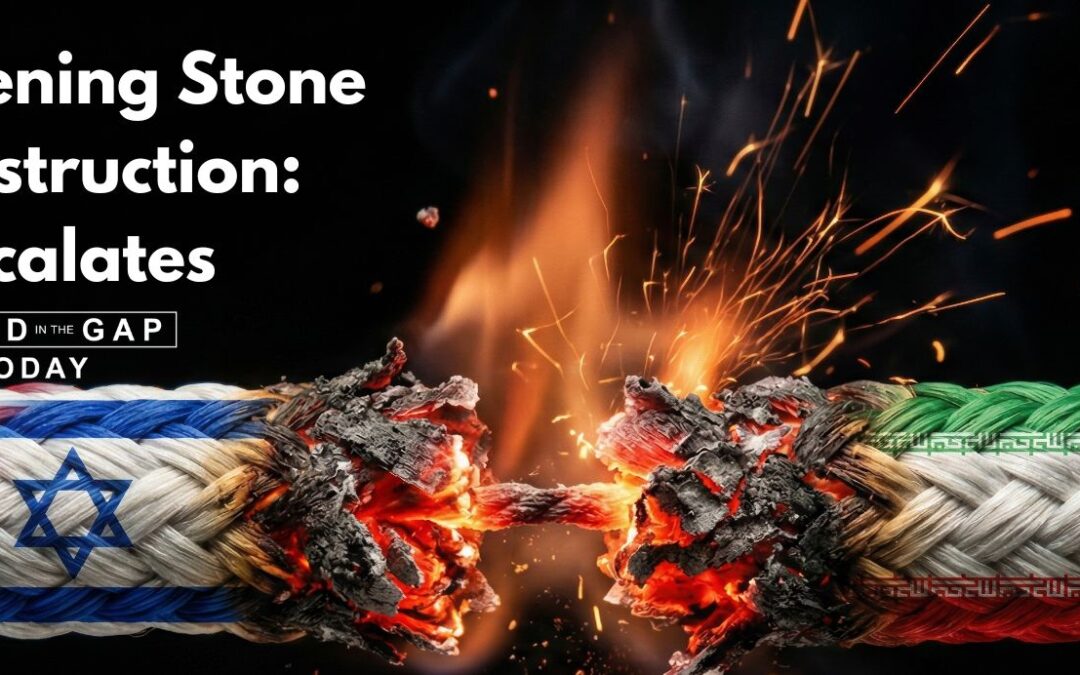

Threatening Stone Age Destruction: War Escalates
April 6, 2026
Host: Hon. Sam Rohrer
Guest: J.R. McGee
Note: This transcript is taken from a Stand in the Gap Today program aired on 4/2/26. To listen to the podcast, click HERE.
Disclaimer: While reasonable efforts have been made to provide an accurate transcription, the following is a representation of a mechanical transcription and as such, may not be a word for word transcript. Please listen to the audio version for any questions concerning the following dialogue.
Sam Rohrer:
Hello and welcome to this Monday edition of Stand in the Gap today. And it’s the first Monday of April, and it’s also the first day after the celebration of Easter. The greatest event to have ever happened in all of human history. And that’s all because of the resurrection of Jesus Christ from the dead. And I trust that all of you who are listening to me now were able to, if you were able at all to do so, to have attended a church that believes in the reality and the power of our resurrected Savior and King and that you are excitedly looking forward to his imminent return. For who? Well, for you and me, if you know him as Savior, for the church. The Bible refers to this as the rapture or the harpazo. It means the catching away. And for me, I can tell you each passing day makes me look more forward to our bridegroom’s return for the true church than I did the day before.
As it seems like each day there’s an additional layering event, an event after a prophesied event almost one on top of another and coming at ever increasing speed and intensity. Well, with that as a backdrop today, I’m glad to have back with me, J.R. McGee. Not a stranger at all to this program and to all of you listening. He’s the extreme leadership group founder and CEO. He’s taught leadership and counter-terrorism in a lot of ways, specialist training for over 35 years, also a student of biblical prophecy. And we try to, here on this program, generally the first Monday of every month, we try to take a look at and examine the matters of national security or international geopolitical significant items, and all through the lens of biblical prophecy and a biblical worldview. Now, the title I’ve chosen to frame today’s conversation is simply this, threatening stone age destruction.
Threatening stone age destruction. War escalates. And all, of course, in that title, what I’m referring to there is the escalating tempo of war in the Middle East against Iran, led by the United States and Israel. And I’m going to say stoked by the many increasingly inflammatory and sadly vulgar statements being made by our president in the past few days. Including the threat to bomb, I ran back into the stone age. Now, I’ll say more about some concerns about things that have been said probably in the last segment, but with that, I welcome to the program right now, J.R. J.R., thanks for being back with me.
J.R. McGee:
It’s always a privilege and a priority for me to be with our audience and to provide some value, Sam.
Sam Rohrer:
And you do so much, and I want to thank you for that. So Jared, let’s get right into it. From the beginning of this war, and you and I talked about it about a month ago, so it’s now been going on, but what was then a potential three to four days short war? We’re now into the fifth week with the president giving indication of weeks more, some saying well into September. We don’t really know. But on this program weeks ago, as I mentioned, I said that when there is no agreement, agreed to agreement as to the objectives of the war, there may well be no end to the war because things change and they appear to have. Now, from your perspective, as you look at what’s happening in the Middle East, and I’m going to say the changing goals and objectives, what do you think is the real objective?
J.R. McGee:
Well, Sam, ironically, there’s never been a war in history that’s ever followed a schedule or a timetable, and that’s because the enemy always gets a vote. There’s been an astonishing amount of progress in what we’ve done. If you look at what happened in the original Gulf War, in 100 days, they defeated Iraq. That was considered to be unbelievable at that time. What we’ve done this time far eclipses what they’ve actually accomplished back then. Over 11,000 targets have been successfully hit. We’ve really destroyed an amazing amount of Iranian military and political infrastructure. Now, the goals I don’t think have changed as much as some people might think. The ultimate goal is to prevent Iran from getting a nuclear weapon. The secondary objective is to prevent Iran from being able to threaten their neighbors in Israel in particular with ICBMs and missiles. The third objective is to maintain the waterways, both the Straits of Hormuz and the South China Sea and the other waterways for commerce.
Those objectives have not changed. Now, the degree to which we’re going to claim success for those is shifting, but the objectives themselves haven’t shifted, Sam.
Sam Rohrer:
All right. Now, obviously the Strait of a Moose opening, that was added in. That was not a beginning one because the straight was open and there was no restriction in traffic. So that was what I’m going to put in there, that was added. But you’re right. The enemy does get a vote. Now let’s move into this. Over the weekend, there was a rescue. A US pilot went down. F-15 fighter jet had been hit, an A- 10 ward hog was shot as well. And a lot went into that. It was on Saturday night, the president declared a victory in finding that pilot went down and we’re so thankful that that in fact happened. Yet it seems strange to me that on Wednesday night of last week at the president’s update, he made it very, very clear Iran had no defenses left. There was complete access to the skies of Iran.
And so when these things happened, it was a surprise. So here’s my question. How did the shootdowns occur? And what’s the status today of the troops on the ground there? Because it appeared that several hundred went in and part of the rescue, some are saying that many of them are still on the ground. What do you know about that? And anyway, just comment on that incident.
J.R. McGee:
Well, Sam, we do have air superiority. In fact, I still say we have air dominance. In the Air Force in particular, in aviation, military aviation, we have a saying that a golden BB will bring you down. You can actually shoot a fighter jet with a BB gun, and if the BB hits the blade inside the jet engine at just the right point, it will destroy that engine. So it doesn’t take anything. A handgun can bring down a fighter jet if it hits the exact right spot. And what we have done is we’ve decimated the air defense systems of Iran. They are for all practical purposes eliminated, but as long as they have rifles and shoulder fired rockets, we call them man pads, man portable air defense rocket systems. They’re infrared, typically infrared guided, and they’re very effective. And there’s thousands of those and they’re carried by individual soldiers.
You can’t get rid of all those. So it’s never legitimate or even reasonable to think that you’re going to eliminate 100% of all systems and weapons that the enemy has. Our pilots train for this. They train knowing that at any moment they could run through what we call flack, which is ground fire. And that flack can be deadly. It was deadly in World War I, World War II. It was deadly in Vietnam, deadly in the Afghanistan and Iraq, and it’s deadly now. So I think that we have established astonishing levels of control of the airspace over Iraq. Now, as far as having people on the ground, I believe all of the troops that were involved in the rescue of the pilot were extracted.
Sam Rohrer:
Okay. And with that, JR, hold it. We’re out of time. I’m going to come back and have you complete that at the beginning of the next segment. Ladies and gentlemen, stay with us. You listening to Stand in the Gap today. J.R. McGee is my guest today. And our theme is Threatening Stone Age Destruction. War Escalates. And of course, we’re talking about what’s happening in the Middle East with Iran. All right. Welcome back, ladies and gentlemen. J.R. McGee is with me today, and we’re looking at primarily what’s happening in the Middle East, and we want to go after several aspects of it here. JR, I’d like you to conclude any comments that you were making. I had to cut you off there because of time, but also to throw in this as well. And this is a primary question. The president has given 48 hour ultimatum.
That was a part of what the whole world is aware of. And that was a dreadfully an embarrassing statement by the president yesterday using a great deal of profanity to talk about Iran. It was shameful. But nonetheless, that is there. And they now have until … Well, it’s now moved actually 10:15 today till it’s eight o’clock now tomorrow night. And this program is live right now. We’re doing this at about 12:20 right now here on Monday. At one o’clock coming up here, the president is going to have a press conference and talk about this aspect and whatever’s taking place. But I want your thoughts about this. What are the strategic implications of this Tuesday deadline as you see them?
J.R. McGee:
Well, Sam, I’ve spent a lot of time looking at this. In the Geneva Convention and the additional protocols that govern international law for warfare, this is a direct quote. It forbids attacks on civilian infrastructure unless they become military objectives and contribute effectively to military action and their destruction offers a distinct, definite military advantage. Now, there’s serious lawyers at the Department of Justice and some very, very significant lawyers in the Judge Advocates group and the military looking at these. And the JAG has veto authority over our targeting list. If they thought that we were violating international law, they would stop this. They would not give their approval for these targeting lists. So somebody clearly believes that there’s a legal basis for us to go after these targets. My concern is that there’s a great deal of pressure being put on President Trump to stop this. And President Trump very much wants peace.
He does not want to be known as a wartime president. He would far rather this to be resolved with a peace treaty than to continue the war. I’m afraid that we will stop this before we truly finish it, and we’ll be right back here two, three years later from now doing this again. And in terms of the vulgarity, I try to be very neutral on President Trump and most presidential office holders, but there’s no need for that level of vulgarity. There’s been two or three presidents that’s cheap in the office of the presidency, and that type of language, that attitude has no place in the office of the president. I very much appreciate a president who’s muscular, who’s tough, and who defends the United States, but there’s no need for that, Sam. As a Christian and as an American, I think that hurts us more than helps us.
Sam Rohrer:
Yep. On that, I concur. And let’s just leave what you’re talking about there. We’ll know more of whatever the president’s going to say on that 48 hour thing later here today. Ladies and gentlemen, so we’re just going to let that sit there for right now. But in this whole matter, J.R., While Israel has its objectives in the war with Iran, I know I did a program a couple weeks ago with actually Chris Katulka from Friends of Israel, and he was the first one who said, “You know what? Israel’s got their objectives. The US has their objectives.” And I noted that, I’ve thought about it and I really believe that to be the case, but Israel would love to see complete the regime change in Iran. Some of these words have been used that they would never, again, ever be capable of threatening war against Israel.
The US has its objectives, which I think, again, we’ve talked about some of the other programs, of dealing with the world’s energy supply. And by so doing limiting China’s ability to weaken the US’s current global financial and economic dominance, because without a doubt, oil is tied to the strength of the dollar. It’s called the petrol dollar. We’ve talked about it. China would like to dislodge that. The United States wants to hang onto it, and so into it, other factors are coming than what we generally hear on the news. But while China clearly does not want an all out military engagement with the United States, in many respects, Iran almost strategically becomes a de facto battleground in some respect. A proxy war almost between the US and China, similar to what happening in Ukraine being the proxy on a war between the West and Russia. So I make that connection.
You can comment if you want, but how are you interpreting China’s relationship with Iran? Recognizing that Iran’s oil is critical to China and Iran selling its oil in one Chinese currency or any currency other than the US dollar is a major goal of the entire BRICS nations, Brazil, Russia, India, China, South Africa, those nations that are seeking to dislodge the dollar. All right, your thoughts?
J.R. McGee:
Yeah, you’re exactly right. The entire effort that’s going on right now is between the United States and China. All of these things are related. And China has been trying to shut down the United States access to rare earths, and that would cripple our manufacturing and our electronics industries and our whole economy. In retaliation, the United States has gone after China’s energy. What we’re doing is Venezuela and Iran constitute over 20% of China’s oil imports. Russia accounts for another 20% of China’s oil imports. So these conflicts have directly impacted almost 40% of China’s energy imports that are absolutely required because China has almost no oil reserves of her own. She has to import all of her energy. So this is crippling China’s economy. This is our response to their efforts to cripple our economy. And you’re exactly right. The oil is tied to the value of the dollar and where oil goes, the US dollar goes.
Our reserve currency status is dependent upon the oil reserves in Saudi Arabia and now in the United States. We are one of the largest producers, if not the largest producer of oil and gas in the entire universe. So we’ve got that. Whoever controls energy ultimately controls both money and power. It’s all about energy. It’s not money. People say follow money, follow the energy because the energy is what creates the wealth.
Sam Rohrer:
It really does. And with the linkage of particularly the dollar to the oil and so forth. So we could go so much further on that, but I need to tie that in and go a little bit further because as China sits here and looks at this ongoing war now going into its fifth week and all of the comments, and we’ve talked about it as well, the US is depleting a lot of our supply of missiles, both offensive and defensive where a lot of equipment being used, all of that kind of thing. And they’re also looking and seeing, because other foreign press is talking about it, American support for the war has plummeted. Their latest research, 40% American people were in favor of the war 1st of March, according to Quinnipiac polls, to now 28% the 1st of April, from 40 to 28%, according to Ugov and some other surveys.
But for China’s perspective, they don’t mind all of that. And my question to you, how are you observing this? And do you see China’s goal to annex Taiwan still on the table and being a part of this? And to what extent is it still firmly in play that is China with Taiwan awaiting perhaps the right time, but their involvement in this? Anyways, your thoughts?
J.R. McGee:
It is absolutely involved. And Taiwan is very much in play. In fact, the Taiwanese president is traveling to China this week for a meeting with Xi Jinping to try to come to some type of an agreement in terms of peaceful coexistence. China still wants to annex Taiwan, Taiwan still wants to remain an independent nation. Now, the fact that we’re depleting our missiles, we still have significant stocks and reserves. However, we do not have enough manufacturing capability to replace these fast enough. That’s one of the reasons why Donald Trump just announced a $1.5 trillion defense budget for 2027 is to dramatically increase our ship building capacity and our manufacturing capacity, because it doesn’t do any good to have high tech weapons if you can’t manufacture them fast enough for them to be sustainable in a conflict. In fact, if we were to go to war with China with the size and the scope of China’s military, that depletion would be even more rapid.
And it’s a dramatic concern. It’s not critical yet, but it’s going to take some two, three, four years for us to fully replenish all of the stocks that we’ve given to Ukraine, that we’ve given to Israel, that we’ve given to other countries, and that we’ve depleted ourselves in the last 18 months. That’s a concern, but America’s manufacturing might was demonstrated in World War II. We have the capability of doing that again, and the fact that we’re onshoring so much more of our manufacturing and rebuilding our manufacturing base here in the United States says that we’re serious about doing this. It becomes a matter of timing. Do we have enough time to do this before China sees their window of opportunity to take Taiwan? If they take Taiwan, that would be catastrophic for the United States. We say, “Oh, that’s not our war. They’re way over there.” Taiwan is absolutely essential for America, our technology and our culture’s sustainability, Sam.
And
Sam Rohrer:
JR, we could go much further on that. And I agree with everything that you’re saying, but I also understand, as you said, to rebuild our capacity to do what we once did after World War II, as an example, is far beyond our ability or supply chain to be able to do in any near time future or distance. So ladies and gentlemen, those are some of the major challenges that face us. But not only is China involved in Iran, there’s all some other major changes and transitions happening. We want to shift to the EU and NATO, because they have a response as well. And well, the whole world’s in transition. We’ll talk about that next. Well, if you’re just joining us today, this is Stand in the Gap today. This program is every day at this same time, however you’re listening to it. And my guest today is J.
- McGee. Theme is threatening stone age destruction. War escalates. That’s the theme, and I always have a theme that kind of binds the whole program together. And the focus is really dealing with what’s taking place in the Middle East, where the world’s attention is focused and increasingly as each day goes by, it seems. But continuing on, not only is China involved and have their fingers in what’s happening with Iran, actually supplying many things to them, connected with them because they are a source of oil to China and Iran not wanting to sell oil in dollars makes it a target. And anyways, won’t get into all that, but all those things involve. But all of this that’s happening there, as you know, if you’re listening to news, is impacting relationships of almost every other country around the world who depends on oil coming from the Middle East.
Now, the US relationship with Europe, and that’s where we’re going to go, Europe and NATO, I’m going to say is without doubt strained beyond measure. Everybody knows that. A lot of it has to do with the president’s accusations toward leaders of the European nations and the various countries there. Most observers are stating that this struggle challenge has reached, where I’m reading these words more and more, an historic breaking point. Their relationship, EU, NATO in particular, their relationship to the United States as predictable allies is changing. Just days ago, for instance, the president explicitly called NATO a paper tiger. When asked by the telegraph, new service from UK about US membership in NATO after the Iran war, the president stated that it was “beyond reconsideration,” and that he was “absolutely” considering a full withdrawal from NATO. In addition, he very recently has called European leaders cowards.
Well, that doesn’t do much to entice them to want to come to any kind of an arrangement. So in the past days, for instance, the country of Spain, since the Iranian involvement, Spain has closed, officially closed its airspace to any US military flyovers. Italy and France have officially using the term restricting its airspace for any US military usage related to Iran. These are things that are actually unheard of. So JR, clearly the US relationship with all of its historic allies has been fractured, is very clearly, and/or lost perhaps since the president’s assaults and accusations that he has done regularly, not just against Europe and NATO, but frankly doing things even to South Korea and Japan. This is an issue, but based on your observations, how do you see the EU and the NATO relationship with the United States changing vis-a-vis the United States?
J.R. McGee:
Well, Sam, it was retired General Keith Kellogg who called the NATO allied cowards. Donald Trump’s been very hard on them, but even some of our military members are truly appalled at the lack of support that NATO is providing the United States. Now, if you look at the alliance itself, nothing lasts forever. In fact, the NATO alliances lasted far longer than military alliances typically last throughout world history. But if you look at who we naturally are becoming aligned with, it looks like it’s Poland, Hungary, the Netherlands, believe it or not, Finland, Sweden, Denmark, Estonia, Latvia, Lithuania, the Baltics, Japan, the Philippines, and ironically Vietnam, and possibly Australia and Indonesia. These are our natural current allies with mutual self-interest. If you look at France, Spain, and the UK, they’re clearly anti-United States and antagonistic, not just to Donald Trump, but to America in general and everything that we’re trying to do.
Trump is kind of the focal point, but they were antagonistic before he became president. They were not supportive whatsoever under Biden, and it’s just continued to go downhill. Germany is in the middle. Germany could go either way in this, but Turkey’s clearly hostile to the United States and NATO, even though they remain a member, they’re a member and name only. I have to say, the past six months have generated some events that are going to have dramatic and long-lasting impact on this alliance and future actions and activities that we do together and how they play out. The world’s changing as fast as technology is driving it. And it’s unfortunate. There’s a lot of things that we still have in mutual interest with each other, but it seems that as immigration is changing the cultures of our allies, their needs and their perceived self-interests, national self-interests are changing, and that is creating fractures along these lines that one cannot ignore.
Sam Rohrer:
J.R., in the last segment, next segment, we’ll bring in the biblical and the prophetical part because we know that the coalitions of nations in this time in which we live will be changing and clearly that’s what we’re seeing, right? So anyway, we’ll talk more about that in the next segment. But one of those areas where things are changed relationship wise, and it revolves significantly, not exclusively, but significantly around the matter of energy precipitated by what’s happening in Iran is Russia because before Ukraine or shortly after the Ukraine began, that effort began, Russia provided a steady, cheap supply of energy to all of Europe. And we all remember the Biden implicated destruction of the Nord Stream pipeline. That started to change everything and then Europe became really dependent and now you’ve got the matter with Iran and oil not going to Europe. Europe’s in big trouble because they don’t have their supplies.
So here’s the question. How do you see the changing paradigm of what’s happening energy wise in Europe and NATO as it regards Russia and Russia’s involvement?
J.R. McGee:
Russia’s got an economy that’s about the size of Italy’s. We think of Russia as this magnificent landmass, this monstrous landmass that spans so many time zones, but their economy is relatively small and oil is by far the dominant driver of their economy. That’s what funds their government, that’s what funds their programs and that’s what keeps them afloat. And the Europeans have been buying oil from Russia, ironically supporting the very nation that threatens them, which nobody could understand, but they began to shut that off, especially when Donald Trump came in and began to tighten the screws on some of that. And Russia produces about 10 million barrels of oil per day. Now the EU used to buy a lot of that. Now that the European Union only purchases about 3% of Russian oil output, but by 2027, which is next year, the EU would like to be fossil fuel free.
That’s totally unrealistic and they’re beginning to panic because that plan is falling apart because it simply doesn’t work. Now, this has had catastrophic results on their energy prices in Europe and the EU’s desperately seeking oil from anywhere right now to keep the lights on. And ironically, very ironically, almost all of their current oil inputs come through the straits of Hormuz. You would think that they would see their national interests involved in trying to keep that open and to keep their energy flowing. They’re critically low on their stockpiles of oil, natural gas, and liquid natural gas. And the very source of it is being shut down by Iran, and yet the Europeans say that’s not their concern. That’s something that boggles the imagination. And that’s exactly why General Keith Kellogg, who I respect highly, by the way, said that they were cowards. They’re not willing to defend their own self-interests.
They’re not willing to go out there and risk what it takes to protect their natural resources, their assets, their ability to sustain their economies. I look at this as one of those things. We hear it all the time. You play stupid games, you win stupid prizes.
Their energy policies have driven them off of a cliff, and now they’re desperate and their only source of supplies they’re not willing to go defend. Try to explain that. I can’t.
Sam Rohrer:
Yeah. I don’t know. I did hear over the weekend, JR, that what’s happening is that France, I think Philippines, Japan, while all the attention’s been where it’s been in the news over the last week, they have been negotiating with Iran. And evidently, from what I have seen, I believe it to be supported, is that Iran has let through a tanker for France and for the Philippines and Japan because they’ve negotiated on their own and they’ve agreed to pay the extra in order to get it. So ladies and gentlemen, what you can say is this for sure, change is happening. I think some people have their own idea of how it’s all going to end up. I think China would like to have their idea how it’s going to end up. I think Russia would, I think the EU does, I think our own president has his idea of how he wants it to end up, but when it comes down to it, well, it’s going to end up the way the Lord has established it for it to end up.
And we’ll go there with some concluding thoughts here in the next segment. Stay with us. We’ll be right back. Well, as we go into our final segment, we’re going to try and wrap up and bring a perspective to a lot of the things which we’ve only touched on. Some things have gone into depth a little bit regarding the overall perspective of what’s happening around this world, and particularly what’s grabbing our attention in the Middle East, and we’ll do so for quite some time, I believe, as we go forth. And I’m going to ask J.R. To do some synopsis of this, look at two things, what the world thinks about where we’re headed, and then what we know from a biblical perspective about where we are headed. And it’s important to keep these two things in mind. Now, with that being said, I want to make just a short statement right now.
This program is called Stand in the Gap. Stand on the Gap for what? Stand in the Gap for Truth. This is not a political program. I was in office for a long time. All of you know that by now. And so I know what it is like to serve in government, and I know what it’s like to preach the gospel. I know what our commitment here on this program is, and that is to biblical truth, the authority of scripture. Let God’s word be God’s word. Now, last week, many of you probably know if you’re following anything, know that at the White House, I have to give a reference to this. At the White House, on Wednesday afternoon, there was a meeting about 150 of the faith group led by Apostolic Reformation leader, Pastor Paula White, who is the appointee for the White House faith team.
At that luncheon, and if you haven’t seen it, you can Google it’s fine. It’s everywhere. Paula White made a statement. It’s not real long, but you can find it. I’m not going to read it all. That’s not the purpose for it right now. But I have to say this, that in the statement, she made very, very specific references to the president and his political history in light of and compared to the ministry of Jesus Christ and how the president has been persecuted, accused, and rose victorious. And that is the story we learned from Jesus. And that was the whole Easter connection. But what I found objectionable, and I must state it, this is not a political statement. Paula White ascribed to a person, glory due only to God himself in Jesus Christ. That is wrong. That’s blasphemic.
That happened in that setting. It went viral. People around the world began to say, “That’s blasphemy.” The White House pulled down the video and then attempted to change the narrative. All I can say is right now is this. I fear for our country. I fear for the president. I fear for those who make such statements and give glory to any other, even remotely making the connection and to call it appropriate. It’s not appropriate. And I’ve been very and highly disturbed since then. And so I wanted to share that right now because I know how God thinks. I know how God thinks about it. He does not share his glory with any other. And with that, I’ll let it sit because I’ll come back and I’ll share some more in the future, but I want to go to you now, J.R. I just had to say that.
So those who are listening, because I felt if I did not say it, I would appear to be as complicit of those who were at that setting who did not say anything. And I cannot do that. J.R. Okay, from that perspective, from a human and world’s perspective, we’re looking at all that’s happening with these nations, the nation’s alignment and all that kind of thing. Where do you think the world say we are headed and then just flow right from that into what the Bible tells us about what we see developing?
J.R. McGee:
Well, that question flows into what you just said, Sam. If I look at this from the world’s perspective and the Bible’s perspective, they’re contradictory, which is not a surprise whatsoever. And I have to say, Nebuchadnezzar did the exact same thing in equating himself to God. It didn’t work out well for Nebuchadnezzar. I don’t think it’s going to work out well for our leadership team either. And as I’m looking at where all this is headed, Ukraine is doing far better than anyone ever thought that they could. In fact, in the last year, they’ve made significant gains. They just attacked another petroleum refinery in Russia. Russia’s had to move a lot of their manufacturing for their missile and aircraft systems further east. They’re back on their heels. It doesn’t look well for Russia right now. It doesn’t look well for Iran. Iran is being pummeled. I can’t remember in my lifetime, and I can’t remember as a student of history, seeing a country take the punishment that Iran is taking right now and surviving.
It looks like that both Russia and Iran will not make it through this. That would be exactly what the world would look at. If I look at where the Bible says that this is going, it says that Russia and Iran form an alliance with other nations, predominantly Shia Islam nations, which are the nations that are taking a beating right now, to attack Israel and Israel stands alone. Right now, the United States is standing shoulder to shoulder to Israel. So this is clearly not that time. This is future. And it doesn’t look like what we’re seeing right now would lead one to believe that that alliance would be possible, but yet the Bible tells us that that’s going to happen, which tells me that Russia comes out of this aggression with Ukraine on top. As unlikely as that would seem right now, Russia’s going to come out on top.
Iran is going to remain, and I’m terribly afraid from a patriotic point of view and a national interest point of view, I’m terrified that the current religious fanatics in Iran will remain in power. And if we produce a peace treaty or an agreement or heaven forbid a ceasefire that leaves them in power, what will occur will be something that creates worse than what we went into this with. And that’s exactly where the Bible tells us that we’re going to go. I’m looking at all of this and I’m seeing where China is playing a role. China is supplying surface to ship missile systems, which is allowing Iran to shut down the straits of news. That wasn’t the case when this war started. That was why it wasn’t really taken into consideration or being a serious threat. We always knew that Iran was going to try to shut down the straight.
We knew that. That’s why we went after their Navy from day one. We didn’t believe that China was going to supply them with surface to ship missile systems that were so accurate that would threaten these tankers to the degree that they have. That completely changed the dynamic of this about two weeks in that we’re still responding to. And China is using Iran as a proxy to diminish the United States.
All of this is playing out exactly the way the Bible tells us. And Sam, we’ve talked about this. I don’t have the faith that it would take to be an atheist. I don’t have the faith it would take to be a non-believer because everything the Bible has told us would happen has happened just the way it said it would. And everything it tells us is going to happen in the future. I have to believe that because of the accuracy of the past, the accuracy of the future is going to be just as accurate. And so far, now things are coming into clear focus. We can see how this arrangement between Russia and Iran is going to build and play out in the aftermath of these aggressions. It’s all coming together exactly the way that the Bible says it was. We should be paying attention to that and evangelizing our friends and neighbors like never before.
We need to be telling people exactly
Sam Rohrer:
What we believe, Sam. And with Amen, JR. And with that, we’re at the end of the program today. Thanks so much for being with me today. Great wisdom shared there. Ladies and gentlemen, thank you again for being with us. Come back and listen to the program again. Pray for us. Stay with us and we’ll see you back here every day this next week. Somebody will be here with good information.

Recent Comments