
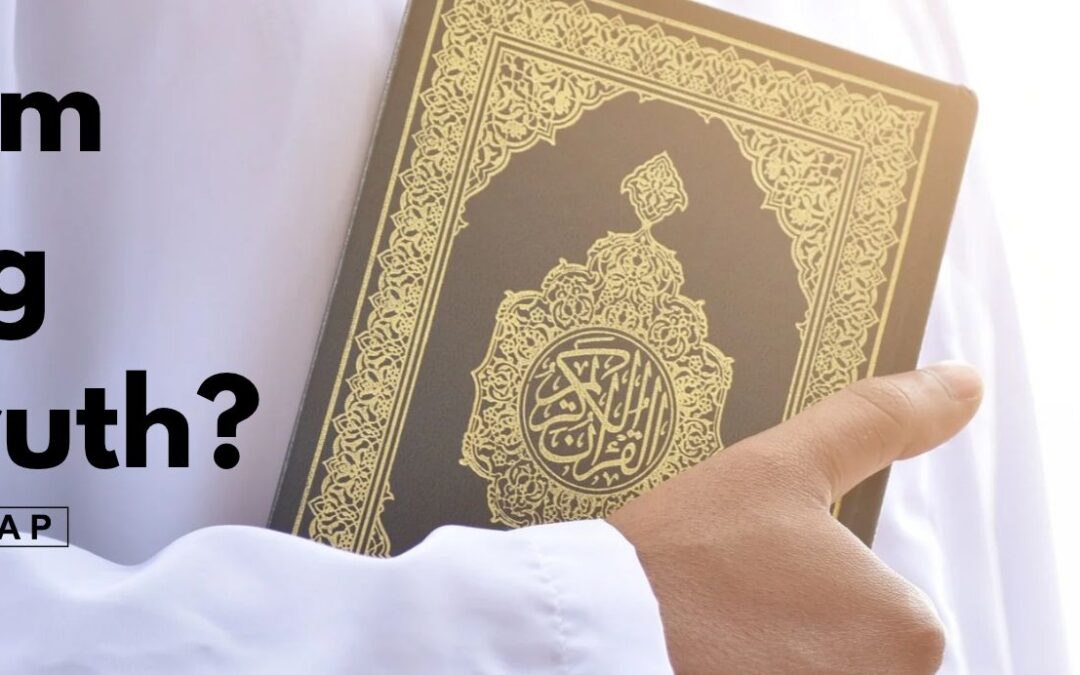

Is Islam Telling the Truth?
Nov. 3, 2026
Host: Dr. Jamie Mitchell
Guest: Daniel Amari
Note: This transcript is taken from a Stand in the Gap Today program aired on 11/3/26 To listen to the podcast, click HERE.
Disclaimer: While reasonable efforts have been made to provide an accurate transcription, the following is a representation of a mechanical transcription and as such, may not be a word for word transcript. Please listen to the audio version for any questions concerning the following dialogue.
Jamie Mitchell:
Well, welcome again, friends, to another hour of what we call Stand in the Gap today. I’m your host, Jamie Mitchell. A number of weeks ago, we were remembering the 25th anniversary of nine eleven when the American people stared into the face of the evils of Islam for the first time. We learned then that this Middle East religion was not just people of faith, but a religion that harbored deep hatred for most of the world and was willing to unleash all kinds of terror to gain domination. Our attitude then was very different to what it is now. Now we have Muslims overwhelming city councils to gain control and influence those communities. The Islamic flag flies over some city skylines and literal cities are being developed and built in places like Texas, devoted to Islamic faith and law. We have a mayor of the largest city of America who’s a professing Islamist.
And this election cycle, we have numerous candidates who today are running for Congress with loyalties to groups like Hamas and who refuse to denounce Sharia law. Now, I know that only 2% of the US population make up those who follow Islam, and we have heard from many that not all who adhere to Islam are violent or dangerous. But with the rise of Islam in America and more finding their way into places of power, should we be concerned? Well, today we want to take an honest and close look at this issue. Today’s program, Is Islam telling the truth? And to help me is Daniel Amari. He was born and raised in Jordan, his father an evangelical pastor who boldly stood for their love for Christ. He has been a front seat watching the growth and some of the deceit behind much of what we see with Islam.
Daniel, welcome to Stand in the Gap.
Daniel Amari:
Thank you, Jamie, for inviting me. It’s a pleasure to join you and your listeners today.
Jamie Mitchell:
Daniel, I want to pull the curtain back on Islam today and help our listeners get a full understanding about those who are Muslim. And as always, our hope and prayer is that many of them will come to faith in Christ. That’s our hope. But to accomplish that, we must understand the tenants of Islam, but also the mindset and the culture that drives their faith. But before you do that, would you take just a moment and share your own story and better start with your dad and what he faced and what you witnessed as a son and how your ministry has grown from that.
Daniel Amari:
Thank you, Jamie. My father, Dr. Rafat Amari, was an evangelical doctor and minister whose work is dedicated to comparative religion and understanding the roots of Islam through ancient religions, history, archeology, and Islam primary sources, of course. One thing that is very fascinating is that in his last book he wrote, he wrote the last book in 2014, he describes his experience in Amman Jordan and he talks about he knew Muslim neighbors who were kind and friendly toward Christians. After the Iranian revolutions, the Islamic-Iranian revolution, he observed a mark changed in many of them. People who had greeted him warmly became distant and stopped greeting their Christian neighbors. He understood this as part of a broader religious change taking place around him in Jordan and in the whole Middle East. For him, that raised a serious question. What kind of conviction that could bring such change in people he knew personally?
I mean, you and I called them moderate Muslims. What changed these moderate Muslims? And answering this question meant looking beyond outward behavior and practices and examining the belief beneath it. That connection between understanding Islam and presenting Christ as a central to our ministry is central to our ministry today. Our work is theological and historical and studying Islamic claims carefully and equipping Christians to answer Muslims questions and proclaim the gospel faithfully. I mean, that is my central concern is to present the gospel to Muslims, but also to understand exactly the worldview that Islam brings and therefore the danger, not only to the Middle East, but to Europe and to the USA, to the West.
Jamie Mitchell:
So Daniel, if I hear you correctly, your dad, a preacher, your family knew Christ. You lived in a Muslim country, but there was a time where Christians were not viewed as “the enemy,” but something changed. And are you seeing that change here in America?
Daniel Amari:
Absolutely. Absolutely. There is something that is very important to talk about, which are the stages of Islam. And the stages of Islam are at the beginning, when Muslims come to our country, they come as a very friendly minority that they intend to work hard and only mind their own business and so on and so forth. But it goes through very important stages, such as religious teachings and radicalization as the first stage in which basically they are opening schools, they are building mosques, they are trying as much as possible to teach the Quran and so on and so forth. And then there is the second stage where there’s a political demand, the demands for increased political representation, also official recognition of religious rules and Sharia. And then there is the third stage, which is unrest and pressure and the fourth stage, the control of the government.
And the fifth stage is the domination of the country and persecution of the minorities, the Christian minorities. These stages have been observed for hundreds of years over many countries. Again and again, the pattern is undeniable. And if I may, I would like to read something that my father wrote in his last book that he wrote it about 15 years ago. And if you could look at this over here, it is amazing. He comes and says, “Planting Muhammad’s unvarnished doctrine reaps radicalization in every plot, be it a Western expanse like America, Europe, wherever Muslim enclaves thrive. Today, that’s 15 years ago. Muslims erect mosques and Islamic schools at will, crafting curricula steeped in the Quran and perilous hadith of Muhammad. Chaplains in the American army preach these texts to Muslim soldiers striving to sway even the non-Muslim ranks. Islamic groups haunt university campuses dispensing Qurans and books to native tongues that stalk radicalism popped by Saudi Arabia and the other Qatar and other rich countries and so on and so on.
We could talk about universities. And the radical message 15 years ago in America mirrored the radical messages of the Islamist clerics in Khartoum, Sudan where basically major persecution of Christians happened.That is stage one 15 years ago. Imagine where we are.
Jamie Mitchell:
Daniel, what an incredible insight and your father saw it 15 years ago, but he saw it in a Muslim country. The problem is it’s now here in our country and it’s growing and it’s moving through those stages. When we return, I want Daniel to use his historical understanding and help us understand what Muslims believe. Don’t go anywhere. Stay with us. Well, welcome back and thanks for staying with us and leaning into today’s program that we’ve entitled Is Islam Telling the Truth? Daniel Amari is the president of the Religious Research Institute and he’s our guest today. Daniel, I want you to take a moment here and share where did Islam come from? How did it begin? What was it that Muhammad wanted to accomplish by starting this religion? I think it’s important for our people to understand the genesis of the Muslim faith.
Daniel Amari:
That’s a very important question, Jamie. Listen, in my book Creative Islam, I go in depth about the subject and I show based directly on the primary books of Islam, primary sources of Islam, that Muhammad’s central theme was power. He did not care so much for religion. In fact, he was willing to change his practices. He was willing to change doctrines. What he wanted to do, the most important thing is to dominate, to achieve power, wealth, women, and so on and so forth. So that comes to a very important point. And my thesis is that it’s better to think of Islam as a political entity, a sociopolitical entity than a religion. It’s a primarily a political entity than a religion. And we can see this one very clearly in so many examples from the primary sources of Islam. For example, Muhammad, when he was raised in Arabia, he later on had to deal with very savage tribe called and he made a deal with them.
He said, “Listen, I will compromise on the practices and the religious practices. I will change this and this to accommodate you. I don’t care about these things. What I really care is actually dominating the city of Yezrip.” And the city of Yasrib today is called City of Medina, the name of it called Medina. And the interesting thing is that people who lived in the city of Medina were Jewish tribes, Jewish tribes that worked very hard and very good merchants and they were good people. And so with these two savage tribes, Muhammad went over there and attacked and slaughtered part of the Jewish tribes, raped the woman, kicked some of them out of Arabia. And from there, the whole Islamic religion changed and also the verses of the Quran changed. It’s no longer a peaceful religion. It’s no longer a religion in which it’s calling other people to have a dialogue and to consider what it is.
It became violent. In other words, Muhammad’s strategy changed when he became powerful. When he was a small minority, he was appealing to people to listen to his points, to be convinced. When he became a majority, when he had a city under his arm and he stopped, then it’s a war and we threw out all of these births that are calling for peaceful living together and so on and so forth. And that pattern continued for 1400 years. When Islam Muslims are a small minority, when they’re a small minority, they are calling for peaceful coexistence. They are appealing to minority rights. They are asking only to live peacefully and that their religion be respected and that they be left alone, but it changes dramatically when they become a major force. And the change actually becomes, depending on their percentage of the population, when they’re the smallest, smallest minority, all they want to do is just educate and build mosques and build schools.
But the next stage, when they become more powerful, then they started to win elections and they started to impose their own ideology. They started seeking anti-Semitism and demanding basically that governments change their status towards its allies and possibly started to threaten other prime ministers of other countries as we have seen actually in the USA by some mayors. So if you notice that there is a pattern in the history of Islam that is rooted in the practice of Muhammad, the prophet of Islam itself.
Jamie Mitchell:
Wow. Now Daniel, talking about Muhammad, why such anger? Historically speaking, what we know about him, what is at the root of this anger and at the root of why he’s so violent, why he wants power? Was there something in his background and do Muslim people fully understand what a scoundrel he was?
Daniel Amari:
These are very important questions. So the first point, and that is very remarkable, it has to do with the study of the books of Syrah and Hadith, which has to do with the life and words of Muhammad, but also the Quran. One of the most interesting chapter we call it Surah, Surah of the Qur’an called Surat El-Jin and Eljin are devils. If you look at basically, if you study the Islamic text and you studied the books of Hadith, you come to the conclusion that Eljin are devils. And so the Eljin, the devils, they have a dedicated chapter, if you could say chapter of the Quran. And in that particular chapter, one of the things that they strongly do is they attack the deity of Christ, attack the deity of Christ as strong as possible in that chapter. And at the same time, they try to come and say, “Some of us are bad and some of us are good.
We are the good people.” And look at this, they’re speaking directly. It is as if they wrote the Quran, which they did. So behind everything, there is a deep demonic influence on Muhammad itself. My dad wrote a book, it is not published yet, but we are working on it by the grace of God. It’s called Occultism and Islam. And he went over there and he gathered data for the last 2000 years about demonic positions and so on and so forth. And he was able to find about maybe 50 kind of symptoms that are related to demonic positions and came with the conclusion that these 50 symptoms, you need only two of them to be diagnosed possibly as demonically possessed. Now the fascinating thing, according to the Islamic books, Muhammad had all of these 50 symptoms, all of them. So in history, you needed two or three, but Muhammad had all 50.
And so behind the religion of Islam, behind the violence you see, there is demonic forces. And so that is the reason there needs to be deep discernment among Christians. We are not simply dealing with a political entity or religious beliefs. We are dealing also with spiritual warfare in which basically we need to pray and we need to fast and we need to think and we need to be watchful about this one. And that is the calling for us as a Christians. The world can deal with lot of the other issues, but one of the primary issues that we need to deal with is to stand in the gap, stand in the gap in terms of prayer, in terms of research, speaking the truth and discernment, understanding Islam, presenting a ready answer about why Christ is the son of God, why the Trinity is true, why the crucifixion is a historical event because the Quran directly denies these as direct as possible.
And that is the calling of Christians to actually refute the claim of Islams and stand against that worldview that is affecting our country.
Jamie Mitchell:
Daniel, we have about a minute left. You mentioned something there and that was this idea of deceit and deception. I’ve heard from missionaries as well as former Muslims that they view Islam as the culture of deceit. Why is deceit valued? It is part of their virtue to be deceitful. Why is that?
Daniel Amari:
This is exactly what Muhammad practiced. Everything that you see that is practiced, especially by radical Muslims and lot by other Muslims must go to the root cause is Muhammad himself. Muhammad wanted to achieve power by any cost possible, by any way possible. And so he used deceit, he used violence, he used…, he used every possible way. And he actually had alliances with non-Muslims at the beginning that after he won the war, he turned against him. So he plays all sorts of games to do such things.
Jamie Mitchell:
Wow. Wow. Friends, listen, we need to reach the Muslim for Jesus Christ. That is our heart. That’s the heart you can hear it in Daniel is that he isn’t here to just point out the failures and the evil within the Muslim history and Muhammad and Islam. They need to know Christ, but we also need to know what we are dealing with when we are faced with people from Islam. And so when we return, I want to talk and have Daniel talk about the lies behind Islam because this is the most important thing. In our country, we provide liberty and freedom and religion is honored and we want to give people of different religions opportunities. But as we’re seeing, there is deep, deep levels of deception behind Islam. And so when Daniel returns, I want to start to pull the curtain back to understand the lies behind Islam so we are fully equipped to know how we can reach Muslims for Jesus Christ.
Don’t go anywhere. Today our focus is, is Islam telling the truth?
Well, if you’re just joining us, welcome. You’ve picked a great program to listen to today, especially being election day and so much at stake. Daniel Amari is with us and we’re trying to uncover things about Islam that we may not fully understand and could cause us to drop our guard and open us up for all kinds of problems. Daniel, you have said to me that what you hear and see from Muslim people are not always true. Even Muslims who seem docile and kind and innocent, there could be a problems running underneath the surface. Can you help our listeners and outline some of the lies, both theologically and maybe practically or things that we need to keep a watch on when we’re interacting with those who hold to Islamic faith?
Daniel Amari:
Jamie, one of the fascinating thing is studying the people of Gaza. We know about the radicalization of the people of Gaza and how Hamas representing Gaza themselves. And one thing that is very interesting in the history of Gaza is the people of Gaza were not always like that. So earlier in the 20th century, they were more open-minded, more willing to let missionaries come and they built basically a Baptist hospital over there. And the missionaries and the Vaxer missionaries were conducting Bible studies in which Muslims were actually attending from reading about Gaza. But one important catalyst is that when Gaza became under the Egyptian rule, they mandated the teaching of the Quran and that was the root cause. The Quran itself was the root cause of radicalizing Muslims. And so behind all of these things, all of these items we find the root cause for the radicalization is the Quran itself.
And that comes to the most important lie that the Quran itself is innocent. It’s only an interpretation of some radical clerics or some radical countries. No, the real interpretation of the Quran is the most radical one. And even if you take ISIS or Al-Qaeda, they will never reach the level of hatred and violence and atrocity of Muhammad himself. Muhammad was the type, the archetype of violence and radicalization itself. And the Quran is his book. And of course behind all of this is demonic power. But one thing that is very interesting is that how these elements are presented to the West, they say that Allah is the same as the Old Testament God. In other words, what they try to say is Allah is like the Old Testament God except without the Trinity and that the Trinity came later in the New Testament. But the fact is, and that is very important, archeologically, when you look at history, when you look at archeologically and combine it with the books of Islam, Allah is nothing but a pagan deity, has nothing to do with the God of the Bible, but it actually has everything to do with the pagan religion that existed before Islam.
The claim that the Muslims say that Muhammad was descendant of Ishmael and Abraham, and they say that Abraham and Ishmael visited the city of Mecca and built a temple of Kapa, the blackstone you see and the temple around. And all of this is not true. Muhammad has nothing to do with Ishmael. He’s not descendant of Ishmael. Historically, biblically, historically, even if you look at the primary sources of Islam, they don’t support that in any way, shape or form. They support different direction. The fact that they claim that the practices of the fasting and the pilgrimage that we called and so on and so forth, that Abraham practiced these things. This is what they say, but Abraham did not practice Ramadan and Abraham did not go to Mecca. In fact, Mecca was not there 2000 BC. Mecca was built at the earliest, at the fourth century, at the earliest.
So there is almost like 2,400 years between the time of Abraham lived and between when Mecca was built at the earliest. And so there is a message that even moderate Muslims are very convinced of that our religion came from Abraham and through Ishmael and it’s the same God of the Bible and only the Christians basically corrupted it and they made Jesus to be God and they claimed that Christ was crucified and so on and so forth, but there is no relationship. And this is very important, Jamie. This is very important because I am hearing a lot from evangelical pastors and evangelical Christians that no, we cannot say that Allah is pagan. Well, the determiner of this is not your theological conviction. The determiner of this one is archeology, is history. When you look deeply in archeology and history and compare it to the primary source of Islam, Allah cannot be nothing but a pagan deity and we have names for it and we have inscriptions that talk about it and talk about its attributes.
And more importantly, when we actually conflate Allah with God of the Bible, we do something very dangerous. We conflate the pagan attributes of Allah that with the wonderful biblical attributes of God of the Bible and they don’t meet in any way, shape or form. If you look at the practices of Allah, in the Quran, Allah is deceitful. Allah is hateful. Allah is violent. Allah is inconsistent. Allah plays games. Allah supports adultery, supports rape of women, praises the extreme violence and the most extreme option of violence. That is not God of the Bible. That’s not the consistency that the soul seeks. No. And we do not do favor to moderate Muslims or any Muslims by hiding the truth from them. We do them the biggest favor when we open their eyes and say, listen, your religion, your book, the Qur’an is a mythical book, is a book of scientific, unhistorical, mythical, and purely pagan because the true God is the Lord Jesus Christ himself and the only salvation is through Christ himself.
And the only true book is scripture itself.
Jamie Mitchell:
Wow. What a tremendous insight. And Daniel, I can tell you that I have heard many evangelical pastors make those same mistakes when they are trying to help people understand and it is a dangerous opening of a door that really shouldn’t happen. Daniel, we’ve got a couple of minutes left here. Why do many, not all, but why do many Muslims seem to hate America and Americans? What is it about America that is such an affront and causes the kind of animus towards our nation, our people, our culture? What is it? I know there’s the demonic aspect, but is there something about America that Americans need to understand that Islam just hates?
Daniel Amari:
Well, it has everything to do with establishing a worldwide Caliphate system in which Islam rules the whole world and everybody becomes Muslim and everybody becomes subjugated to Islam. Now to the minds of Muslims, they would see, well, what two countries are the greatest obstacle for achieving this in their mind? Well, it’s Israel and America. And so to them that these are the obstacles. But if America did not exist and Israel was not there, you know what country would be the obstacle? It would be Spain because if Israel did not exist, they will carry a flag saying, “Free Andalusia, free Spain.” And if Spain fails, they’re going to go and say, “Free France, free Italy.” So it’s not about America. It’s not about Israel in particular. It’s really about the Islamic domination over the whole world. And there is something very fascinating, I have to say to you, the amount of hatred towards Israel and the Jewish people is unprecedented in any way I have seen.
And that started from Muhammad himself. The most hateful verses against the Jewish people came from Muhammad himself and weak Then study and see the contributions of radical Islams to Nazi Germany and to Hitler and the influence they had on convincing Hitler to do what he had to do.
Jamie Mitchell:
Wow. Friends, I hope you’re fully grasping what Daniel is sharing. This is crucial when we fully appraise what Muslims mean when we engage with them. They’re not saying what they mean. They are saying different things. There seems to be a lot of double speak in statements that they make, but understand that the hatred and the animus that they have, as he has said, it is America and Israel standing in the way. The Old Testament, New Testament is standing in the way. That is why they make statements in the Quran about people of the book. They’re talking about God’s word, about what we know to be true, who Jehovah God is, who Jesus is, who the true and living God is. And we need to fully be aware. Now, when we finish up, is the rise of Islam really dangerous here in America? I think you probably can answer that from what we’ve already spoken about, but I want to go a little further and just talk about the political and social issues that are taking place in our country today and why Islam is a tremendous threat to America.
Well, this hour has moved quite quickly and there are many more questions I have for Daniel and Mari about Islam and how to share Christ with them. Daniel, can you quickly tell our people how they can find you, your ministry, and the many resources that would be helpful for them to expand their understanding of Islam and how to reach the Muslim people?
Daniel Amari:
Absolutely. Thank you, Jamie. The website is Rrimedia.org in which they can look at the resources. There are many free resources and many of the books that are translated to different languages are available for free, but also they can look at and see the books that are available and we are expanding our resources very soon.
Jamie Mitchell:
Daniel, I want to talk in this final segment about what’s happening here in America. As I’m on the radio here with you, I’m also viewing some news along the way and I’ve heard today a statement being made that if Abdul Assad, who’s running for Senate in Michigan does not win, Islamic leaders are saying, “Prepare for a backlash, a threat, a threat. You don’t vote for this man, then we are going to bring pressure to bear. We’re going to cause problems.” In a nation like ours that is opening and welcoming to all kinds of people, all kinds of faith, that’s an amazing part of our history, yet it seems that being welcoming to Islam is posing now a danger and a threat. Should we be concerned with the rise of Islam in America? And if so, is there anything we can do to confront it? How do we handle this?
Daniel Amari:
Very important question. So basically the first stage of Islam is the stage decades ago in the USA where mosques are built, Islamic schools are built, Muslim chaplains, universities, and so on and so forth. We talked about it, that’s stage one. Stage two is Muslim population grows, demands increase for political representation, official recognition of religious rules, Sharia provisions for certain areas and so on and so forth. Now the third stage is riots, demands for greater conditions, increasing antisemitism, these kind of things. So if what you’re telling me is true, if it truly happens, that means we are at the brink of stage number three. And to understand the stage three, all we have to do is look at Europe, look at what’s happening in France, look what’s happening in Germany, look what’s happening in Netherlands, in Belgium, in Britain. The riots that happened in Paris, these are not isolated riots.
If you look basically every once there are more riots and the riots becoming more destructive and violent, you look at the gang rapes in Britain. So if an Islamic riot happens, that means we are the brink of stage three. In other words, basically Muslims are radical enough and they are empowered enough and they feel that they have the power to do it, to go and riot and do some activities of backlash. But I think more interestingly enough, the fact that they come out and say it publicly without fear or… I mean, who would come out and say, “Hey, listen, if I don’t get my way, what I’m going to go is I’m going to do some bad things.” That’s very dangerous, but it tells us basically that we are right now at the brink of stage three. And if you look at what happened in Sudan, Sudan, at one point it was a majority Christian country.
We all know about the history of Sudan. If you look at Lebanon, you look at Syria, if you look at Iraq, if you look at Nigeria, the patterns of these countries going through all of these stages is undeniable. Now, what can we do about it? That’s a very important question. We have to realize that we are not simply facing or merely facing a political entity. We are facing a worldview that is fueled by a book called the Quran. And the answer for this one, it is our calling as Christians to understand the Quran and refute it. It’s exactly the pattern that Christ gave us in the gospel. Christ understood very well the false traditions of the Pharisees and the Sadducees, and he understood it so well and he was able to discuss it with them and refute it and showing it that actually it is contrary to scripture.
Thus, he gave us the example, the real example, how do we face the tradition of Islam? We face the tradition of Islam by actually taking the religion of Islam seriously. We study it very well. We understand it very well. We take advantage of the resources to help us understand what Islam is. And then we actually proclaim the truth about what Islam is. And that is part of presenting the gospel. Presenting the gospel is not merely saying Jesus loves you. That doesn’t work. Presenting the gospel is how Christ presented in the gospel. And Christ presented the gospel by not running away from the tradition of the Pharisees, but confronting the traditions, saying, “I know your tradition. I understand it better than you do.” And more importantly, it’s wrong tradition. And we need to have the same kind of attitude, follow the same footsteps that Christ sets in the gospels by confronting also the traditions of Islam, confronting the book of the Qur’an and showing it to be a pagan, mythical, unhistorical, unscientific book word by word.
Jamie Mitchell:
Daniel, that is so good. Daniel, we have a minute. You mentioned to me before, in America, we’re seeing Islam open the door to socialism, but I think it’s more insidious. Why this marriage of socialism and Islam? We have one minute.
Daniel Amari:
From the days of Muhammad, Muhammad made alliances with other people, other groups, only temporarily. He used them and then he turned against them. He used them, then he later on killed them. And that strategy has always been used by Islam throughout 1400 years. They make alliances, temporary alliances, they use each other and then they turn first against their friends, first against friends. So if there’s an Islamic domination happening in any country, they are going to go against their friends first after they win. And so that’s very important.
Jamie Mitchell:
Wow. Daniel, thank you for your courage. Thank you for your honesty. Friends, the most telling aspect of this program is that many people who I approach that either work with Muslims or former Muslims, and I tried to get them on this program, they refuse to come on in fear of what would happen to them if they came on a program like this. You need to understand the courage of someone like Daniel and his father in the past. And Daniel, I just want to say, God bless you. Thank you for making us aware, to making us informed and helping us. Friends, you have heard the truth today. You need to be wise. You need to be wise in who we’re electing. Watch along the landscape of America what is happening in regards to the rise of Islam. And most importantly, pray that we can get the gospel of Jesus Christ to the Muslim person.
To do that, we have to do what I say every time we have a program, live and lead with courage until tomorrow. God bless you. Come back and see us again in 23 hours for another episode of Stand in the Gap today.

Recent Comments