
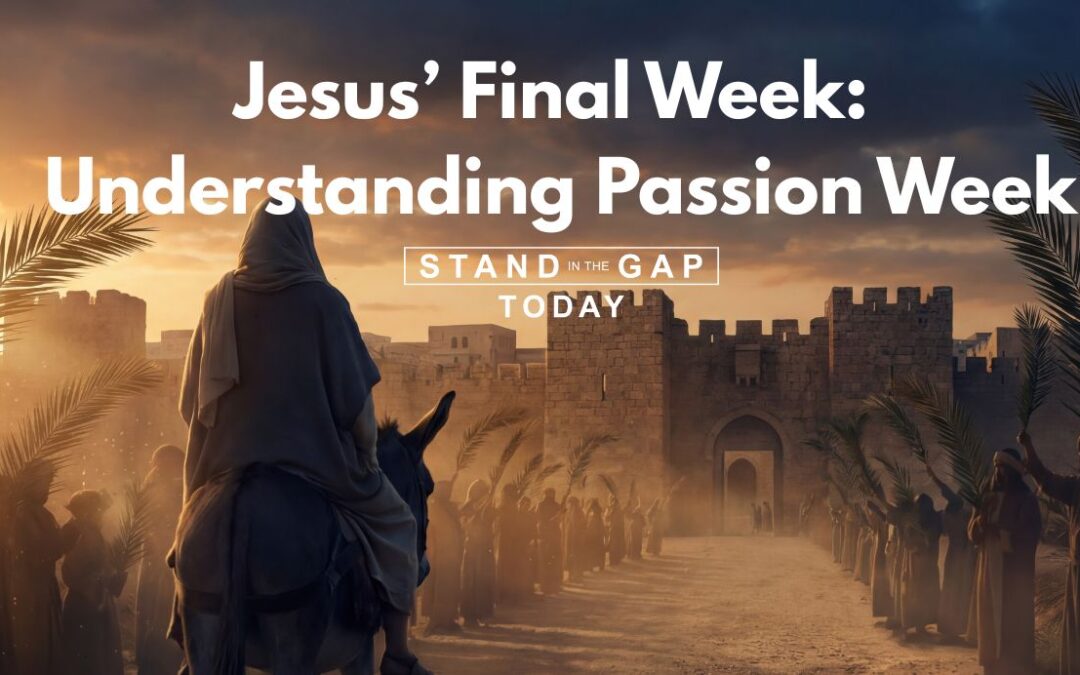

Jesus’ Final Week: Understanding Passion Week
February 24, 2026
Host: Dr. Jamie Mitchell
Guest: Ryan Day
Note: This transcript is taken from a Stand in the Gap Today program aired on 2/24/26. To listen to the podcast, click HERE.
Disclaimer: While reasonable efforts have been made to provide an accurate transcription, the following is a representation of a mechanical transcription and as such, may not be a word for word transcript. Please listen to the audio version for any questions concerning the following dialogue.
Jamie Mitchell:
Good afternoon friends, and welcome to Stand In the Gap Today. I’m your host, Jamie Mitchell. Easter comes early this year, first week of April, and a matter of fact, it’s just four weeks from now. We’re going to break out those decorative bunnies, color some eggs, and then of course start singing those glorious resurrection focus hymns. In church Easter is without doubt the single most important event in all of human history. It’s the day that Jesus Christ rose from the dead and provided a way for us to have our sins forgiven and the guarantee of eternal life. Hallelujah. What a Savior. Yet before Resurrection Sunday happens, there are a series of significant events that took place leading up to that day, starting with the Sunday prior to Easter, and it’s commonly called Passion Week. Today I want to walk through that week, highlight what Jesus and his disciples experienced, and look at this final week in Jesus’ life and understand the Passion Week to help me a return guest, pastor Ryan Day from Revolved Bible Church in California. Ryan, welcome back to Stand of the Gap.
Ryan Day:
Hey Jamie, thanks for having me. I’m glad to be here.
Jamie Mitchell:
Well, Ryan, I want to do this program to get people really thinking about Easter, get pastors revved up about preaching this great message, and I want to get this idea of the passion of the Christ. Mel Gibson used it in a title of a very famous movie, but why have Christians called this week from Palm Sunday to Easter Passion Week?
Ryan Day:
That’s a great question, and I love the title Passion Week because it conveys the idea that Jesus was not a victim when he went to the cross. In fact, the idea of Passion Week, it’s the passion of Christ because Christ went to the cross to be crucified voluntarily. I like what Steven Ook said in his book, Christ Crucified when he talks about the voluntariness of Christ’s death, he lays out three reasons, theological reasons why He says that Christ’s death was voluntary. He says that his death was voluntary because of his person. He takes that from Philippians two. He then says that Christ’s death was voluntary because of the Father’s justice, and then third, because of the father’s acceptance, I would add a fourth point that Jesus’s death was voluntary because of his love for those who the father had given him. When you go through the events of the last week of Jesus’ life, there’s a theme that’s interwoven through the text, which is that Jesus is in total control of orchestrating the cross. So we call it the Passion Week because it was Jesus’s decision. No one took his life, but he breathed his last. He voluntarily gave his life for us.
Jamie Mitchell:
Ryan, it reminds me of what you just said there of Hebrews chapter 12 where it says, and the joy step before him, he looked to the cross, he endured the cross, he went to the cross. Well, let’s talk about Passion Week, Ryan, the first day of that week, Palm Sunday, what happened that day in the life of Christ and why is it so significant?
Ryan Day:
Yeah, that’s a great question. That’s a multifaceted event. There’s a lot going on there. I would argue that it was actually not Palm Sunday. It was Palm Monday. The traditional timeframe for the Passion Week begins on Sunday, and then that traditional timeline then has dark Wednesday because they would say nothing happened on Wednesday, but if you move the date up to Monday, then there’s consistent events happening from Monday through the time of this crucifixion. But why Paul Monday? Now again, theologians disagree. Scholars disagree on this. Some say Palm Monday, some say Palm Sunday. The main reason for the argument for Palm Monday is because Palm Monday was the 15th of NI Nissan, which is when the first Passover lamb is slaughtered to begin the Passover celebration. Or I’m sorry, that would then mark the beginning of the Passover celebration, which would then make Jesus’s crucifixion happen exactly on the 15th of Nissan, oh, I’m sorry, I’m reading my notes wrong.
Palm Monday would mark the day where the Passover lamb would be inspected to make sure that it was spotless and without blemish. And so Jesus presenting himself on Monday would’ve been him presenting himself to the nation of Israel as a spotless lamb. So really there’s three reasons or three impacts or for Palm Sunday first to present himself as the Passover Lamb. Second, not only to present himself as the Passover lamb, but to present himself as Israel’s Messiah. In the Talmud, the rabbis taught that the Messiah would ride into Jerusalem on a donkey. So first Palm Sunday or Palm Monday was to present himself as the spotless Lamb who would be slain second to present himself as Israel’s Messiah, and then third, to present himself as Israel’s true king as there was a crowd coming down from Jerusalem to meet him and crowds going with him up to Jerusalem as he wrote on a donkey, they were waving palm branches, which would’ve been similar to what they did with Judas Maccabeus when he hammered the Assyrians, or I’m sorry, the Assyrians out of the temple after they had taken Jerusalem in the Intertestamental period. So waving palm branches was a sign of victory of a conquering king. And so when Jesus presented himself on that day, it was a sign that he was Israel’s true king, that he was Israel’s messiah and that he was indeed the spotless lamb. He was presenting himself in preparation to be crucified.
Jamie Mitchell:
Ryan, when I think about Palm Sunday, I always think about it in the context of it being a day of surprises because in many respects, the Jewish people, yes, they anticipated a king, but they were hoping that Jesus riding in would be this victorious king. Finally give them liberation over Rome, finally get to reestablish the Jewish people into their rightful place. But he wasn’t coming as a military or political leader. He was coming, as you even say, to be that sacrificial lamb, to offer himself to again with the joy set before him, get ready to face the cross. Well, friends, as you see, there is not a day wasted throughout this last week of Jesus’ life. He’s involved in each step of the way to Easter. Every encounter person touched, even controversies has its meaning. When we return Jesus’ final meal with his friends and the last prayer meeting that he had, don’t go anywhere.
We’re starting to celebrate Easter here at Stand of the Gap today. Well, thank you so much for tuning in today, a special Easter program. We’ve entitled Jesus’ Final Week understanding the Passion of the Christ, and our guest today is Pastor Ryan Day Ryan Jesus last week begins with Palm Sunday or Palm Monday, and we know that he then cleansed the temple of the money changers and reestablished God’s house to be a place of prayer. He also begins to share with his disciples throughout that week that he soon would die and what that meant yet it was the Last Supper that we really begin to see things moving quickly to Golgotha. Can you explain that meal that Jesus shared with his trusted friends? What were some of the unique aspects of it and what should we now glean from that experience?
Ryan Day:
That’s a great question. I’d encourage your listeners that if they’ve never been to a Jewish Seder, which is the word, Seder just means order, and it’s the name of the feast that’s celebrated to commemorate the Passover Jewish Seder. There are several organizations that put them on, and if you’ve never been to one, it’s extremely helpful to understand what was going on at what has now been called The Last Supper. The Last Supper was a Jewish seder that was transformed by Jesus into what we now as New Testament believers would call communion or the Lord’s table. Now, the Seder is a ceremony that’s based in Exodus six, six through seven where we read this quote, say therefore to the sons of Israel, I am Yahweh and I will bring you out from under the hand labors of the Egyptians and I will deliver you from their slavery, and I will also redeem you with an outstretched arm and with great judgments, then I will take you for my people and I will be your God and you shall know that I am Yahweh, your God, who brought you out from under the hard labors of the Egyptians.
Now, the Seder was organized around four cups of wine. Now, there was actually 12 steps to the Seder and they all have significance, but the main portions were around these four cups of wine, and the first cup is called the cup of sanctification, the second cup, the cup of deliverance, the third, the cup of redemption, and the fourth, the cup of redemption. And that language comes from Exodus six, six and seven, which we just read, and particularly four times in those two verses, Jesus says, I will, I bring you out, I will deliver you. I will deem you, I will take you. So at the Last Supper, the cup that we focus on and the cup in one Corinthians 11 where Paul instructs the church of Corinth, the cup that we celebrate as Christians is Jesus taking the third cup, which is the cup of redemption where the Lord said, I will redeem you.
And Jesus then says, do this in remembrance of me. And Jesus is basically claiming that he is the ultimate redemption that was prophesied from the Passover. And so that’s what we do as we partake in the Lord’s table. It’s a memorial service whereby we remember that the Lord Jesus Christ is our redemption. Now what’s interesting, that’s the third cup in the Seder service. There was actually four cups as I mentioned earlier, and Jesus himself did not take the fourth cup. That is the cup of deliverance. In fact, in Matthew 26, 29, we read, but I say to you, I will not drink. This is Jesus speaking of this fruit of the vine from now on until that day when I drink it with you, it new with you in my father’s kingdom. Now, the reason why Jesus didn’t drink the fourth cup is because he in the third cup transformed the Seder into our Lord’s table. But then he kept it a perpetual memorial until he comes. He will not drink that fourth cup until he drinks it with us in his kingdom, and I would interpret that as the millennial reign of Christ, which is his kingdom. So there is yet a future celebration of the Lord’s table that we’re rehearsing as we do it together in church, and that future feast is when we’re reunited with the Lord.
In fact, in Luke 14:15 we read, but when one of those who we’re reclining at the table with him heard this, he said to him, blessed is everyone who will eat in the kingdom of God. And then Revelation 19 tells us about the wedding feast of the bride. That’s when we’re going to have that fourth cup with Jesus. So at the last Supper, he took the Seder that was celebrated perpetually by the Jewish people. Since the time of the Exodus, the Passover feast is actually the longest unbroken religious celebration in the world, and Jesus took that and 2000 years ago, he transformed it. So technically speaking, biblically speaking, the Seder service should have ceased at that last supper instituting a new dispensation, which is now when we partake communion. So I would even argue that communion or the Lord’s table is a dispensational distinctive
Jamie Mitchell:
Ryan, you’re so right. Everybody should go to a Jewish seder. And amazingly as you sit there and you listen and you watch it all unfold, you say, how can you not see Jesus and God’s plan of redemption and the Messiah? Can you not see it all through that glorious picture? And boy, we can hardly wait that day when we are with the Lord and we watch him lift that cup up and what a glorious ending. Hey, Ryan, we got about two or three minutes for this segment, but I want you to touch on quickly sometime after the last supper, they then proceed to the garden Gethsemane and they go into an intense time of prayer. Quickly describe what happened there and why is that so important to the passion week?
Ryan Day:
That’s a great question. The Garden of Gethsemane, interestingly enough, John does mention a garden, but the phrase Garden of Gethsemane is actually never mentioned in the Synoptics. Again, this is an area where I think that tradition is a little different than scripture. It probably wasn’t, I don’t think, in the Garden of Gethsemane. It was in a cave. That cave I think is still there. It’s about a hundred yards away from the traditional site of the Garden of Gethsemane that’s on the grounds of what is now called the Church of All Nations. Scholars do believe that that is the most likely site for the event where Jesus was arrested and the events occurred what we call the garden of dissemination. In the garden of dissemination. Jesus is in this cave, it’s about 60 feet deep and 30 feet wide, and he has his disciples at the entrance and he goes to the back of the cave when he begins to pray.
He probably prays for about three hours when you put together the timeline, and he ends up interrupting the disciples three times because they had fallen asleep. But during that prayer, we’re given a little bit of insight into what Jesus prayed, and he prays and says, father, let this cup pass for me. If it be your will, but not my will be done, your will be done. And so the question is, what does that mean when Jesus prays, let this cup pass for me. Well, in the Old Testament, a wine cup is pictured as God’s wrath. And so as you go through the Old Testament, there’s this metaphor describing the wrath of God as a cup. And so Jesus, when he’s praying, let us cut pass for me. He knows that he’s going to take upon himself the wrath of God as he hangs upon the cross, and he’s just in his humanity. He’s wrestling with the reality of what’s going to happen to him in just a few hours.
Jamie Mitchell:
Ryan, we hear also that while Jesus was praying, he drips little blood drops of sweat. This was an agonizing time for Jesus, wasn’t it?
Ryan Day:
It absolutely was. Yeah, that’s actually an actual medical condition. The doctors tell us that you can be so anxious that it affects your body physically to where you sweat drops of blood. He knew what was coming. This is the purpose for which he came, but that moment to experience a mysterious separation between he and the Father was an absolutely dreadful thing, and that’s what he did for us. He went to the cross to take upon himself the wrath that we sinners deserve.
Jamie Mitchell:
I’m reminded again of what Hebrews said and the joy that was set before him. The joy was knowing that we would escape the wrath of God and we would be united again with he and the Father each eternally. What a glorious story. And all through that week, we get indications of that. Well, friends, like any person who recognized that their life on earth was coming to a close, Jesus has some very meaningful conversations, purposeful activities, all pointing to our redemption. Now, when we come back a moment of insight as we look at both his betrayal and then his arrest, I hope this is exciting you igniting in your heart a desire to pick up your Bibles and start reading through this Passion week. So don’t go anywhere. Stay with us here and stand in the gap today. Well, maybe you’ve just joined us and we’re glad you did Today.
We’re considering the passion week of Christ last week here on Earth his last few days before Easter, and why each thing that Jesus did had meaning. Orion Day is our guest. We’ve considered Palm Sunday the Last Supper, the garden prayer. We’ve learned some new and interesting insights, and now we want to look at his arrest. Ryan, Jesus and his disciples are in the garden. They’ve been praying, and a group of soldiers and religious leaders show up with Judas. A lot took place in a very short period of time. Can you set the stage and provide context of what happened and what is it that we really need to know about when he got arrested?
Ryan Day:
Yeah, that’s a great question. What jumps to my mind? Let me just lay out five truths about the arrest of Jesus. I think first, it’s important to understand that it was absolutely illegal. The Sanhedrin broke 22 of their own laws when they arrested and tried Jesus, that they came when they arrested him with an enormous crowd. I think sometimes when we think of the arrest of Jesus, we think there was just a couple people here there, but the gospels tell us, and John in particular in John 18 three, that a Roman cohort came with the temple guards, the Jewish people or the Sanhedrin rather had to have permission from their Roman occupiers to do this arrest. And that permission resulted in a detachment of Roman guards going with them. And John tells us in John 18, three that it was a Roman cohort.
Now a Roman cohort, Allegion had nine cohorts, and there was about 600 men in a cohort, and a cohort was made up of five smaller units of about 160 men led by two centurions. So if we’re taking the text literally in John 1813, that was about 600 Roman soldiers, if it was just a detachment from a cohort, would’ve been about 160 Roman soldiers. So you have the Roman soldiers, then you have Judas, and with Judas you have officers sent from the chief priest, the scribes and the elders. And this is one of the micc laws they broke. It was the Sabbath. And so the chief priest and the scribes could not leave their compound. So what they did is they, in their hypocrisy, sent their officers of the court, the guards of the temple to be their proxies. And so they sent this detachment of Jewish soldiers with the Roman cohorts and Jewish, and then there was the slave of the high priest, Malki, and Malki was there as well to kind of be a representative of the high priest and to supervise everything.
So there was this enormous crowd that came in to arrest Jesus. And what made this illegal was several things. There was to be no arrest by religious authorities that was affected by a bribe. And we know that this arrest was affected by a bribe. In fact, Judas sold Jesus over according to Matthew 26 15 for 30 pieces of silver. Not only that, but according to the laws that the Jewish people came up with or the Jewish leadership came up with themselves, was there was to be no criminal proceedings to recur after sunset. And this was done after sunset before the Sun rose the next morning. We know that because John 18 three says that this group came with Lanter and porches. Not only that, the members of the Sanhedrin were not allowed to participate in the arrest, which they did through Malki as their proxy.
So I think the first thing is this was an illegal arrest, but not only was it legal, it was sad, and it was sad because the guy leading the arrest was Judas. He was one of the 12. He betrayed Jesus with a kiss. Matthew tells us that that kiss was a brazen, lavish kiss and that he was very friendly to Jesus as he identified him with a kiss. Luke 22 in John 15 tells us this, saddened the Lord, it was illegal arrest. It was a sad arrest, but it’s important to know that it was voluntary. Jesus allowed himself to be arrested. Now when they came and they asked, who is Jesus? Jesus said, I’m he. And they all fell down. And then Peter got emboldened, pulled out a sword and cut off the ear of Malchus. And then Jesus told Peter to put away his sword, and then he healed Malchus’ ear because Jesus was willing to go.
It was not the time for the disciples to defend Jesus. It was time for Jesus to voluntarily submit himself. And this was all under the predetermined plan of God. So it was a divine arrest according to Acts 2 23. And then we could even go on from there and we could say that it was a lonely arrest. And this is actually a great encouragement to me in John 1450 and in other places like John 18, seven and eight, listen to this, Jesus said after when they arrested him, he said, whom do you seek? And they said, Jesus of Nazarene. He said, I told you that I am he. And then he says this. So if you seek me, let these go their way. It’s so encouraging to me. Jesus made sure that the disciples that were with him did not get arrested that night. He let them go. And this was for two reasons, I think because he loved them. He didn’t want them to be arrested, but I think it had to do with his work, the work he had to do. He alone could do, he alone could be our substitutionary atonement. And so when Jesus went voluntarily, he went by himself and he went, because he alone is the one who can ultimately pay the price for our sin. So those are five reasons or five truths about the arrest of Jesus. It kind of sets the stage a little bit,
Jamie Mitchell:
Ryan, there’s a lot of speculation about Judas. Give me your insight. Why did he betray Jesus and even his demise, how his life came to end? How do you see Judas and this very sad aspect of passion week?
Ryan Day:
Yeah, that’s a hard question because I think there’s a human side and there’s a divine side. The divine side, acts 2 23 says, this all happened by the predetermined plan of God. So what Judas did in no way violates the sovereignty of God. But it’s sad because it also gives us a warning about how to respond to Jesus. And Judas gives us a warning that you can be someone who professes to follow Jesus and still go to hell. I think Judas is an extreme warning to those of us who profess to follow Christ, but we actually are not bearing fruit in our lives. Judas followed Jesus. It was the woman who broke the alabaster jar a year’s salary over Jesus’ head to anoint his body for burial that provoked Jesus before the last supper began. Then at the last supper, Jesus told Judas, go do what you do.
Do it quickly. And because Judas was so angry at that act, he thought it was a waste of money. So he sold Jesus out for 30 pieces of silver. Judas was greedy. He was the lover of money. But what’s interesting about Judas is Judas wasn’t the only person who betrayed Jesus. All of his disciples did. In fact, when Jesus was at the cross, nobody was there. It was just the women looking from far off. Peter denied Christ three times. Judas did the same thing that all the other disciples did. And so what’s the difference? Well, the difference is repentance. The other 11 repented acknowledged their sin and fled to Christ. Judas instead of repenting of his sin, he did feel guilt, but instead of letting that guilt drive him to Christ, that guilt drove him to suicide. And so he hung himself. It’s a good warning.
Number one, if you’re someone who says, I’m a Christian. I’m a follower, Jesus, but there’s no fruit in your life. You need to be warned from the life of Judas. But if you’re also someone who knows that you have betrayed Christ, you have sinned against God. The encouragement here is, Hey, don’t deal with the guilt that you have yourself. Let that guilt be taken care of at the cross. Repent, turn himself, run to Christ. And what we see when the other disciples did this, after Jesus is resurrected and he’s meeting with the disciples for 40 days, particularly when he meets with Peter, and he asks, Peter, do you love me? And he says, yes, Lord. And then as an expression of Peter’s love for Jesus, he’s commanded tend to his sheep and to feed them, to preach to them. And so Peter’s love for Christ resulted in him ultimately following Jesus for his whole life and then dying for Christ. Amen.
Jamie Mitchell:
Friends, Jesus will go through a series of bogus trials and ultimately sentence to death by crucifixion on a Roman cross, this would be an agonizing and brutal death. He would be hung at 12 noon, breathed his last breath around three. We call that good Friday. And when we return, where did that lifeless body of Christ then go? And what happened on Sunday? Don’t go anywhere. Stay with us. Well, thank you for being with us today. It’s been so good to think through the final week of Jesus life and some of those main events and maybe some things that you hadn’t really taken much time to think about. Pastor Ryan Day revolve Bible Church in California has helped us consider Passion Week. Ryan, we got a lot to do in this last segment, but Jesus has now suffered a terrible death. He declared it is finished, he dies. What happens next? Where did they take the body? And what should we know about his burial?
Ryan Day:
Yeah, his burial is an absolutely critical part of the Passion week because the burial of Jesus confirms that he actually died for our sin. Theologically. What happened was after Jesus breeds his last, he hung upon the cross, from 9:00 AM our time to 12:00 PM or I’m sorry, to 3:00 PM but at 12:00 PM the sky went dark, symbolizing God, pouring out his wrath on the sun. Then at 3:00 PM the sun comes out again. The lights go on. Jesus, after Jesus breathes his last, and that begins according to a Jewish day. The first evening, the Jews celebrated two evenings. One began after the evening sacrifice around 3:00 PM and then the second evening began at sundown about 6:00 PM. So in the first evening, Joseph of Arimathea, who was a prominent member of the Sanhedrin, he asked Pilate if he could have the body of Jesus. Now, what’s really interesting about that is that according to Roman law, the part of crucifixion was you forfeited all your possessions and you hung upon that cross until your body decomposed.
That’s one of the reasons why we call where Jesus died, lg Gotha, the place of the skull. That could be because there were literal skulls on the ground, but the Romans permitted the Jewish people to actually take a body down because the Jews had a law that a body could not hang on a tree after sunset. Joseph Ian knew that, and he knew that because of their Jewish laws, that Rome permitted them to take bodies. So a great risk to himself. He asked Pilate for the body of Jesus. It was given to him. And so Joseph Ofra Methe, he took the body of Jesus and he put it in his own tomb. And he had help. He had help from Nicodemus. And what’s striking to me about this particular event is they probably would’ve done this themselves, maybe with some of their slaves. They would’ve had to lift his body off of the cross, take the nails out of his hands and his feet.
This would’ve been a very messy thing to do. And then in preparation for burial, they would’ve cleaned the body and wrapped him in strips of linen. And so it’s at the burial of Jesus was done by Joseph Athea and not Josephus, I’m sorry, his name alludes me right now. Nicodemus. There it is. And the women were watching all of this happen as eyewitnesses, and that’s why they knew where to run at daybreak. They were actually going to anoint his body with oil. I don’t think they fully thought through that because I didn’t know how they weren’t going to be able to get past that stone. They didn’t need to anoint his body for oil because that woman with alabaster jar had already done that previously. That’s how Jesus himself described that event where Mary broke that alabaster jaw on his head, and Judas was upset. And Jesus has said, no, she’s anointing my body for burial. But it’s important that the women saw where Jesus was buried because his disciples had scattered, and it kind of sets the scene up for Sunday morning, and it also verifies that Jesus was in fact buried. So it was a very important event.
Jamie Mitchell:
Now, on the third day, meaning on Sunday, a group of women do go to the tomb where Jesus been late, what did they find? What happened? What’s important for us to remember about that moment?
Ryan Day:
What’s important for them to remember? Well, they found the tomb empty. One of the reasons or the reason why there was a Roman guard stationed at that tomb is because the Sanhedrin went to pilot and said, Hey, we’re scared that his disciples are going to take Jesus’s body because Jesus himself said that he will raise himself up on the third day. So Pilate said, okay, fine, I’ll put a guard there. And they sealed the tomb. They put strips presumably of leather, and then nailed in to the side of the tomb or the side of the limestone wall to seal it. And so when the women got there in the morning, the Roman guard was gone. The seal had been broken, and the stone that would’ve been rolled over the entrance had been moved. And when they peeked in, there was an angel sitting there saying that Jesus had gone.
So what’s significant about the women finding the body is really apologetic evidence. The Bible’s a historically reliable document. It has events that are real historical events that have been corroborated by eyewitnesses accounts. So what happened when the women found the body reinforces the reliability of scripture and also the reliability of the resurrection. The women left. They told the disciples, Peter ran and saw himself, and that then began the events of the 40 days of Jesus then walking on Earth before his ascension, before he took his seed at the right hand of the Father to forever intercede for us. By the way, that’s the importance of the ascension of Christ, is that the risen Lord in bodily form has risen, and he now ascended to the right hand of the Father where he lives to forever intercede for us.
Jamie Mitchell:
Ryan, what a rollercoaster of emotions. One day you watch your friend, your leader, whom you believe to be the Christ, the Messiah, hanging on the cross, and just a few days later, you hear the news, he is not here. He has risen Ryan, this brings an end to passion. Week he rises from the dead, demonstrates power of God to defeat sin and death. But then what? And you got 60 seconds. What’s the aftermath of Easter from your perspective?
Ryan Day:
Years ago, I gave an Easter sermon titled The Resurrection according to Romans, and I went through the epistle to the Romans, and I preached on everything that it said about the resurrection. So I’ll just recap those points quickly. Now, the resurrection declares that Jesus is the Son of God according to Romans one, according to Romans four, the resurrection proves that those that placed their faith in Jesus are indeed justified. The resurrection proves our justification. Third, the resurrection secures our deliverance from future judgment. According to Romans five, fourth, the resurrection empowers new living. We now walk in the newness of life. Paul says fifth, not only that, the resurrection guarantees our bodily resurrection. Just as Christ has been raised, we will be raised. The resurrection secures us eternally. Seven. The resurrection demands a response because of what Jesus did, and because the evidence is so secure, we must respond to the finished work of our vision, Lord,
Jamie Mitchell:
Wow. Wow, Ryan Day. You’re a blessing, my brother. We’ve just scratched the surface of a packed week. Passion week, get out your Bible. Spend the next few weeks digging into the importance of Easter and make this the best resurrection Sunday ever. God bless you. We will see you back here in 23 hours for another edition of Stand In the Gap Today.

Recent Comments