
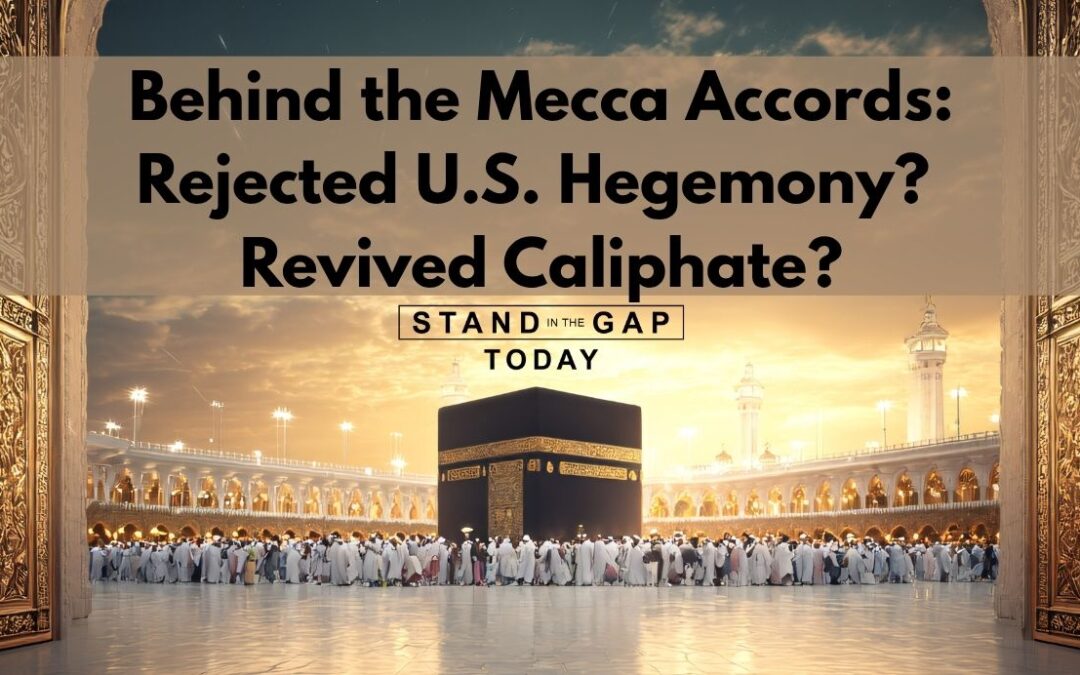

Behind the Mecca Accords: Rejected U.S. Hegemony? Revived Caliphate?
Sept. 2, 2026
Host: Hon. Sam Rohrer
Guest: Michael Rubin
Note: This transcript is taken from a Stand in the Gap Today program aired on 9/02/26. To listen to the podcast, click HERE.
Disclaimer: While reasonable efforts have been made to provide an accurate transcription, the following is a representation of a mechanical transcription and as such, may not be a word for word transcript. Please listen to the audio version for any questions concerning the following dialogue.
Sam Rohrer:
Hello, and welcome to the special Wednesday edition of Stand in the Gap Today. Now on Monday’s program, if you were listening, I had Mr. Ted Vanlandeghem with me. He’s a 26 year Air Force veteran serving with the White House Communications Agency there, and he’s now director of synagogue and church engagement with the Messianic Jewish Alliance of America. But on that program, we focused on the theme, and here’s the title, what we did, Shadow of Things to Come. And we looked at the fall feasts and the alignment of nations. So if you didn’t hear that, you can go back and pick up on that because it ties in to today. We’re going to go deeper today. One of the things we considered was from a biblical perspective on that program, how the nations of the world, particularly in the Middle East, are aligning. And we looked at how they’re aligning in accordance with biblical prophecy, Old Testament prophecy.
And today I’m glad to have back with me for a second time, Michael Rubin. He’s a fellow at the Middle East Forum where he specializes in Middle Eastern countries, particularly Iran and Turkey. And his career includes time as a Pentagon official with field experiences in Iran, Yemen, and Iraq, as well as engagements with the Taliban prior to nine eleven. Now on Monday’s program, Ted and I looked in part at the developing phenomena as it referred to as the Mecca Accords. Today, we’re going to dive deeper into the who, what, why, and I’m going to say the wherefore of this monumental geopolitical shift taking place in the Middle East. And frankly, one that could fundamentally or perhaps is fundamentally rewriting the global balance of power. Here are the details. On August the 7th, less than a month ago, leaders from Saudi Arabia, Turkey and Pakistan met in the Islamic Holy City of Mecca and they signed an historic collective defense treaty declaring that an armed attack against one was an armed attack against all.
And it’s this development that we’re going to consider today from a geopolitical and alignment of nations perspective. The title I’ve chosen to frame this conversation today with Michael Rubin is this, Behind the Mecca Accords: Rejected US Hegemony? Or revived caliphate? And I want to say maybe both. And with that, Michael, welcome to the program. It is a real privilege to have you back again.
Michael Rubin:
Hey, thanks for having me, Sam.
Sam Rohrer:
Michael, your expertise on this subject today is well established, your knowledge of the nations involved as well as the ideologies behind the politics and I want to say both the stated and the unstated motivations of the respective political leaders involved. So with that, I’m glad you’re here to speak to this. Now in this opening segment, I’d like to lay the foundation for this pact and developing alliance of nations and define and describe the who of these Mecca accords. So here’s my question. Who is really behind this initiative?
Michael Rubin:
Well, Sam, the top line of this is that all of these member states are Sunni as opposed to Shia. So we can look at this as aligning a certain block of Middle Eastern countries. The question is aligned against who? So they could be aligned against the United States or they could be aligned against the Islamic Republic of Iran. Now when you say who is behind it, here’s the thing. It looks like Saudi Arabia is behind it. And of course, Saudi Arabia was the country that hosted and through its possession of Mecca has taken, if you will, the leadership reins over this. What’s not clear is how cohesive this alignment is and whether or not beyond their declarations, anyone with any member truly believes in the mutual defense clause.
Sam Rohrer:
Okay. And we’re going to get into that. We’re going to get into the why. So at this point, it’s Saudi Arabia, it’s Turkey and it’s Pakistan. That would be the who, right? Now let me ask you this. Where do, I’m going to say global heavyweights for instance, like China and/or Russia, or I’m going to put into that Washington, Donald Trump, Jared Kushner, they are part of the who. Are they playing any role or have interest in this initial pact?
Michael Rubin:
Everybody is watching Sam from the sidelines, but they’re taking a different approach to this alignment. So when we talk about Pakistan, what makes Pakistan special is that it is the only Islamic state that has a nuclear weapon. The other thing that makes Pakistan special is at this point they’re pretty much a wholly owned subsidiary of China. China has indebted Pakistan and the Pakistani military depends disproportionately on Chinese weaponry, Chinese fighter jets and so forth. And so the Chinese are kind of looking at this block as, you know what? If we can pump a little bit of energy into this block, maybe it could be something that could impede the United States. Russia tends to look at this the same way. And what’s interesting here of course is the membership of Turkey, which of course is not only a NATO member, but it has the second largest military under NATO.
That said, when you look at what the Saudis are saying at least, and of course, just because Saudis say one thing doesn’t mean they’re thinking another, the Saudis are basically making the argument that they no longer trust the United States to provide an exclusive defense umbrella. Frankly, President Donald Trump has told people in the region that they need to take charge of their own defense as well. And therefore what the Saudis are saying is this isn’t meant to be an opposition to the United States. In fact, we Saudi Arabia still rely on the United States. Rather, we simply want to diversify our defensive arrangements.
Michael Rubin:
So Saudi Arabia seems to have a different perspective. Okay. Oh, go ahead.
Sam Rohrer:
I’m sorry. The next thing, we’ll get into the why, because a lot of these things you’re talking about motivation. Let me ask you one more question before we get out of this break, and that is this. Whereas these first three you mentioned are Sunni, there are other entities, countries that have been thrown out as being potentially considered as part of the mix, Egypt, other Gulf allies. Iran’s name has actually been thrown into that, which then would say, “Well, what are we talking about?” So who else is being courted at this point to perhaps join in with this group?
Michael Rubin:
Okay. Well, let’s put Iran aside for now because when their name was floated out, that was, I mean, sort of kumbaya fantasy world on the part of some diplomats. It wasn’t a serious proposal. What is being talked about much more seriously, number one, Egypt. And Egypt’s importance, of course, is that one out of every six Arabs lives in Egypt. It’s the most populous Arab state. Kuwait is being talked about, and Kuwait, of course, was the country who we went toward to liberate back in 1991. And the other country, which is being talked about a great deal, but we’re not paying attention to is Bangladesh. And the reason why that is important is because the Sunni block may not be dedicated against or targeted against Israel or the United States. It may, but also it may be targeted against India.
Sam Rohrer:
Okay. And with that, ladies and gentlemen, stay with us. We’ll be back in a moment. We’re going to go to the drivers of this whole pact. Well, for just joining us, welcome aboard today. We’re about to be in our second segment and our theme today is this. Here’s the title of it to frame our conversation, Behind the Mecca Accords. The Mecca Accords is an arrangement that is being developed right now in the Middle East, the Mecca Accords, behind the Mecca Accords. And we’re going to answer two possibilities for why. One, rejected US hegemony. In other words, why are the countries doing that? Rejecting us perhaps. And the other is perhaps a revived Islamic caliphate. There may be more, but I’m talking today with my special guest, Michael Rubin. He’s been with me before. He’s a senior fellow at the Middle East Forum and they focus and specialize on all matters that would touch the Middle East.
Let’s put it that way. That’s why that’s Middle East Forum. And they have a website at MEForum, meforum.org. Now, with that being in place, in our opening segment, Michael Rubin today, my guest, laid out the foundation of what’s called the Mecca Joint Defense Agreement, Mecca Accords, which was signed on August the 7th, 2026, just less than a month ago, and identified primarily the who behind it, the nations and the political personality. We didn’t get too much into the names of the people involved, but the nations, primarily Saudi Arabia and Turkey and Pakistan. But it’s beyond that now. But now in this segment, I want to shift to the why, because I think there are competing motives. I’m going to ask Michael about that. There certainly are regional rivalries going on. The Middle East is just known for that. Overarching visions perhaps could be a shared one, it could be individual as to why nations would want to put this together.
But in any event, it appears to be an expanding coalition. Now, while Riyadh, that’s Saudi Arabia, Ankara, Turkey, Islamabad, Pakistan, whereas they present it, I’m going to say unified front, their underlying goals are complex. And I’m going to say like all alliances that have ever existed, each member brings something to the table or there’s no need for them to be there. Some bring more, some bring less. In this case, Saudi Arabia, well, they bring vast capital, other things too, perhaps. Turkey, NATO grade military technology, perhaps other things. And Pakistan, as Michael shared, provides a nuclear power. Yet underneath this mutual defense commitment, I’m going to say from my perspective, each member is an Islamic nation by ideology and therein lies a deeper question about how each of them perhaps envisions a future Islamic leadership role in regional power within the currently, I’m going to say transitioning global world order.
And we’re not going that broad right now, but that’s happening. Anyways, Michael, why is this coalition, let’s go there, why is this coalition being formed? Speak to the motivations there and how they may vary or be the same between Saudi Arabia, Turkey, and Pakistan and others. And again, is this primarily a practical Sunni counterweight formed to hedge against Iran as being presented or is there something more?
Michael Rubin:
Okay. You laid out a lot there, Sam. And so let’s just talk about the motivations of the three main countries. Superficially, they will all say that this is a Sunni block. And I agree with you that at least one member here, Turkey, has this idea of utilizing it to lead the Islamic world. There’s absolutely no doubt that Erdogan, the current president of Turkey, sees himself as a new callus. Saudi Arabia, their motivation, at least in the short term, is simply to diversify their defense, especially because President Donald Trump asked them to, to ask them to take matters into their own hands. And so this is a way of doing that. With regard to Pakistan, which is as anti-American as Turkey is, one of the most anti-American countries in the world, Pakistan is basically looking at this as a market because they’re building up their own indigenous defense industry and they think that they can make billions of dollars selling things to Saudi Arabia.
Sam Rohrer:
All right. Well, that’s it. Let’s go to the next one here, then maybe we’ll come back on it. Is there though a broader ideological motive at play? For instance, does this pact and this initial agreement, does it deceptively appear to create an internal Islamic division, meaning Sunni versus Shia and those things you put in there while in fact perhaps laying the groundwork for, I’m going to say a longer term consolidated Islamic front that they’re wanting to bring out. And again, that takes us back to Erdogan and Turkey’s desire to perhaps lead the reformation of the Ottoman Empire. To what extent is the Islamic ideology driving these initial three at least, if at all from your perspective, or is it just purely regional defense concept?
Michael Rubin:
Well, Sam, it’s the glue that holds together the internal logic of this alliance in the first place. And the symbolism of cementing this at Mecca is real. It’s not arbitrary. It’s not the Yanbu agreement to name another Saudi city or Cobar agreement. It’s a Mecca agreement and that symbolically is hugely important. Now on one hand, while the Islamic identity and especially the Sunni jihadism is what is gluing this together, it could also be the undoing of the movement. So for example, the whole basis of legitimacy of Saudi Arabia is that the king of Saudi Arabia is supposedly the custodian of the two holy mosques in Mecca and Medina, only from the sake of the birthplace of Muhammad
In Muhammad’s life. Now, Turkey has oftentimes claimed to lead the Islamic world. So how can you lead the Islamic world without also controlling Mecca? And so on one hand, while these two countries are playing nice with each other, on the other hand, if you ask Turkey, look, you want to have, excuse me, you want to have control over Jerusalem because of the Islamic sites. Why don’t you also want to have control over Mecca? The Turks would say, well, we do, and that then leads to the dissolution of this coalition. If you scratch the surface, I don’t think this coalition can hold together too well.
Sam Rohrer:
Okay. All right. Back on this. Erdogan has this vision, the whole Ottoman Empire, which means all of the member countries would have some kind of obeisance, perhaps maybe to him and his mind. So that’s on one hand. So my thinking is shouldn’t Saudi Arabia fear that as much as they may fear the Shia in Iran? What’s the difference? I think the
Michael Rubin:
Answer is yes, Sam. Absolutely. And I mean, this has always been the downfall of various movements in the Middle East. Starting in the late 1950s, we could talk about Pan-Arabism, and that was all well and good when you are in charge of Egypt, the largest Arab country. But as other countries try to exert their identity, they don’t want to be controlled by Egypt. You can look at this in terms of pan-Islamism, where one of the problems with the Pan-Islamist movement is that subject countries didn’t want to be subject to anyone else. And so you were the one, Sam, who brought up Erdogan and his neo-Ottomanism, this idea of reconstituting the Ottoman Empire. The thing that President Erdogan in Turkey doesn’t understand is that he and Turks have a much fonder remembrance of the Ottoman Empire than any of its subject peoples do.
Sam Rohrer:
That’s
Michael Rubin:
Why when a lot of diplomats who are green or new to the portfolio say, “Oh, if we only solve the Israeli-Arab conflict, there’s going to be peace in the Middle East.” Absolutely not. Almost every country in the Middle East has a conflict with its neighbor.
Sam Rohrer:
All right, so that’s interesting. So let’s put into that, you mentioned Egypt. Egypt is in the mix, I think. Malaysia or Indonesia, I think I’ve seen their names in the mix, whatever. But Egypt is more primarily Arab. It’s got the largest Arab population, not as much Islamic, maybe Muslim brotherhood. I don’t know how you look at them, but where did they go into it and what would be the entreaty by this group, the Turks and the Saudis and the Pakistanis, what would be their invitation to Egypt and what would be Egypt’s interest in wanting to align with this group?
Michael Rubin:
Well, look, Egypt’s economy has as much internal logic as selling ice at the North Pole. The fact of the matter is Egypt’s economy can’t float on its own, and so it’s taken billions and billions of dollars in subsidies from Saudi Arabia. Jordan has as well. When the war with Iran broke out and Iran started shooting missiles at the Emirates, at Saudi Arabia and so forth, these states were absolutely furious that Egypt didn’t send forces to support them after being on the receiving end of billions of dollars of aid. So while Egypt is being talked about, Saudi Arabia at this point doesn’t want Egypt as an equal. They want them as a subordinate partner because they don’t think that they’ve bought into the same status that Saudi Arabia should have. And so here you start having the divisions within all these Sunni countries, which frankly have been insurmountable in the past, and I don’t see any reason why they’re not going to be insurmountable in the future.
Sam Rohrer:
Interesting. And that brings us up to the break, ladies and gentlemen. Stay with us because there’s another aspect that the development of these Mecca accords that are called this mutual defense pack that’s being put together by the Saudis, the Pakistanis and the Turks. But as these accords, Mecca accords are being developed, well, what happens? Because there’s already some accords in place. Ever hear of the Abraham Accords or the Gaza Board of Peace that’s already existed? I’m going to talk to Mike when I come back about how these interrelate. Do they interrelate? We’ll be back in just a moment.
Well, welcome back. And again, our theme today is behind the Mecca Accords. We’re looking at the Mecca Accords, what’s happening in the Middle East and raising this question, rejected US hegemony, in other words, as to why it’s being done. Are they rejecting US presence in the Middle East? We’ll still get to that, and/or a revived caliphate. In the case of Turkey, there is, and we talked about that a little bit in the last segment. But into this mix, my special guest today is Michael Rubin. He’s been with me once before, just about a year ago, where we actually were talking at that point about Middle East peace, interestingly enough, because that’s what we’re going to talk about in this segment. But he is a senior fellow at the Middle East Forum, and they have a website at meforum.org if you’d want to access a list of really well-written treatises on almost anything that touches on the Middle East.
Now, that being the case, we’ve laid out the groundwork for the Mecca Joint Defense Agreement, that’s its official name, that was signed on August the 7th, 2026. And then some of the complex motivations driving its core signers, Turkey, Saudi Arabia, and Pakistan. Now in this segment, I want to turn to how this new Islamic Defense Pact, which it is, it’s not just regional, it’s Islamic regional, how it collides or interacts with Western-led diplomatic efforts and security frameworks in the Middle East as the world, I think, continues to separate and align seemingly in the East versus West. Now, just for a bit of history, for years, Washington, specifically Jared Kushner, Donald Trump’s son-in-law, but sanctioned and politically owned by Donald Trump himself, pushed the Abraham Accords. The Abraham Accords were officially signed on the White House South Lawn on September 15th, 2020, and ostensibly it was to integrate Israel into regional defense architectures.
That’s what was said. Then later in Donald Trump’s second term, the current term, a second historic and a very centralized, appointed, unelected versus appointed meaning unelected, and totally unaccountable, a government structure was created, authorized by the UN Security Council by a vote of 13 to nothing with Russia and China in that vote abstaining. That occurred less than a year ago, November 17, 2025. Now, I’ve talked about this before, but in my words, and this is a bizarre formation because never had it happen before, but in that creation, Donald Trump in his personal capacity, not as President Donald Trump, but as Donald Trump the individual was appointed as chairman for life of this governance structure referred to as the Gaza Board of Peace. And since that time, this entity has attempted to manage regional stability under Western leadership and international peacekeeping forces, but all totally separate from any oversight by the United Nations or Congress.
So it’s a truly unique entity. But into this Gaza Board of Peace arrangement is directly now, that’s linked with the Abraham Accords by the provisions that put together the Board of Peace and the American Accords, they go together. But now that’s confronted by this new thing called the Mecca Accord, which presents, as we’re talking about, in my opinion, a very stark alternative, an exclusively Islamic security block operating independently of Western mandates. And in this segment, I’m going to bring up these questions. Michael, I haven’t heard too much discussion about this, but seems to me these are either on a collision course. I don’t see how they mix, but how does the Mecca Accord, as we’re talking about it, directly either compete with or undermine the long-term vision of the Abraham Accords, or does this actually work in some way with it that we’re not seeing?
And put that together from the standpoint of how these two are going to work.
Michael Rubin:
Okay, Sam, what diplomats would say is that the Mecca Accords, it’s just a mutual defense pact, but let’s also face it, all diplomats lie. So there’s probably some more ambition there than these countries will admit to right on. And it’s not a coincidence that all the countries joining at this point, this new Mecca accords, Pakistan, Saudi Arabia, Turkey, are antagonistic to the state of Israel and are not members of the Abraham Accords. Now, as an analyst, what I’m actually looking at, Sam, is what happens with Syria, because Syria, of course, the regime changed there in December 2024 when Basra Assad was forced out. Ahmed Al-Shada, who was a former Al-Qaeda terrorist, probably still a current Al-Qaeda terrorist, took over, and he’s a Turkish proxy. Now, Turkey is pressuring for Syria to join the Mecca Accords. At the same time, President Donald Trump has spoken about normalizing Syria and taking this former Al-Qaeda gentleman, Ahmed Al-Shada, who now wears a business suit and trimmed his beard and making him respectable.
And so Donald Trump is pressuring for Syria to join the Abraham Accords. And this is hugely important because if Syria joins the Turkish-led, Saudi-led Mecca Accords, it really puts an antagonistic anti-Israel force right on the borders of Israel itself. That’s when World War III breaks out. So all eyes to right now should be on which way Syria goes.
Sam Rohrer:
Can I ask you for your opinion? How do you think they are leaning? I mean, to me and many people, it is very strange for our president, Donald Trump, to declare Erdogan a good friend, and he wouldn’t have gone to the last meeting had Erdogan not been there. And then the Syrian situation you talked about there removed terrorist status from that country and making this terrorist, as you described there, just now a suit wearing. This is a strange position for America to be in. I mean, how do you see it going?
Michael Rubin:
I absolutely agree with you, and where I think that the United States constantly makes a mistake is thinking, number one, that history starts out when a new president enters the Oval Office, that that new president can have a tabula raza. Number two, American presidents often fail, and American national security often fails because we don’t take into account ideology. We have a separation between church and state in the United States, and therefore many of our diplomats treat religion as a third rail. But as someone who’s lived in Afghanistan, lived in Pakistan, lived in Saudi, in Iran, and so forth, I can tell you, you can’t separate religion from these places and these governments. And if you don’t understand that they do not operate on the same value system as we do, you’re guaranteed to failure.
Sam Rohrer:
All right. So you are describing, as I’m hearing you, more of a, well, a competitive nature. How do you think? I mean, if Syria joins the Mecca Accords, then you actually said that could cause World War III to break out. My guess is because Israel would say there’s no way we’re going to have a Turkish presence domination there in Syria, perhaps, but explain what would be that trigger and at this juncture, how can the Mecca Accords, if it continues to develop, what will we see happen to the Abraham Accords and the Gaza Board of Peace?
Michael Rubin:
Well, first of all, I mean, Turkey is an ideological state and Erdogan wants to re-institute the caliphate. That is not a controversial statement. The reason why I made a dire prediction is because last week, Israel bombed Syria, and the reason it bombed Syria is Turkey was starting to move its own forces into former Russian bases inside Syria. Now, the United States have had Turkey and Israel come to an understanding that would respect the status quo in Turkey. By Turkey moving its troops into Syria, Turkey was violating that status quo. But if you suddenly have a mutual defense clause where Turkey moves in, Syria is a member of the Mecca Accords, Pakistan has nuclear weapons, Israel’s not going to roll over and allow itself to be eliminated by jihadist terrorists, whether they are under the protection of NATO or the Mecca Accords or not. That’s where there is a real problem.
Now, when it comes to the Gaza Board of Peace, look, I tend to look at the Gaza Board of Peace differently. The United Nations is the problem in the region. The United Nations does not resolve conflicts. It perpetuates conflicts. And UNRA, the United Nations Relief and Works Administration, putting aside that its own internal documents called for it to end its operation in 1951. Putting that aside, the fact of the matter is the UN Members of this agency for the Palestinians engaged in terrorism openly. They’ve been caught. More than a hundred people have been fired. If you have internal rot in your organization, it’s time to dissolve that organization. The other thing which people need to know, Sam, is that Unra, in the UN, in Gaza, and one of the ways in which they perpetuate the conflict is they have a different definition of refugee than anywhere else in the world.
Sam Rohrer:
Okay. And with that, Mike, we’re just going to have to hold because of time. We’ll pick up on next segment. Ladies and gentlemen, can I come back and conclude with this focus geopolitical consequences? Now there’s things that are going to happen, somewhat we’re talking about, but American Gulf, hegemony, other unintended consequences. As we move into our final segment, I hope that you’ve been with us from the beginning because all of the segments of our focus today, which has been the Mecca Accords, it’s referred to as the Mecca Accords. It’s a mutual defense agreement that has been signed, signed actually on August the 7th, just last month, between the Saudis and the Pakistanis and the Turks. Those three countries, all Islamic, all come at it a little bit differently, but they all share a same common fundamental drive, and that is their view of Muhammad and so forth.
Now that being the case, we’ve talked about who else is behind it, the motivations, and how now that’s kind of coming into conflict with some preexisting arrangements. One Abraham Accords signed in 2020, September 2020. And last November, the Gaza Board of Peace and my special guest today, Michael Rubin, who is a senior fellow with the Middle East Forum and is expert on this part of the country and everything that we’re talking about. I’m so glad he’s with me today. We’re talking about what could come of this. But in this segment, I want to talk to Michael about answering the question that it was in our title. Is there involved in these Mecca Accords perhaps also a motivator to reject US hegemony? That’s the presence, the power, the thrust, the influence of America, the US specifically, the West generally. We’ve already talked about that aspect of a revived caliphate, that desire we know exists because it’s been repeated many times by President Erdogan of Turkey.
Now we’re going to step back and I’m going to say a little bit about the wherefore of this, which involves I’m going to say the broader macro level question and that in several terms, what does this seismic shift as it’s developing? What does it mean for the future of American leadership, not just in the Middle East, but maybe beyond Western influence generally and the global balance of power? Because since World War II, the United States has maintained an unassailable position. The dominant security guarantor in the Middle East is all tied to the original deal with Saudi Arabia and the forming of OPEC. We’ve talked about that on this program before, but the reality of it is as our spending as a nation crosses way over 40 trillion, bond market under tremendous duress as we speak. And the other nations of the world that have supported our spending like Japan and others not wanting to buy our bonds, the whole world is looking at this.
And so, well, do they see this as an opportunity to make a move? All right, Michael, here’s a question I’m going to pose to you. Does the rise of the Mecca Accords mark, I’m going to say a formal or informal rejection of US hegemony power in the Middle East? And are we witnessing perhaps a fundamental shift where traditional American allies no longer trust Washington’s security umbrella? And even though you say Saudi Arabia is pursuing this because Donald Trump said you ought to be taking some of your own efforts, is it really because we’ve not been able to do that and all these things are kind of working together? Work that
Michael Rubin:
Out. Sam, I think all of these are working together. The United States has projected strategic confusion and if you will, a disdain for allies since at least the Obama administration. And we see this in terms of the whiplash sort of foreign policy diplomacy where the Democrats and the Republicans seek to undercut each other more than pursue a unified foreign policy like we had in the days of Ronald Reagan and who is Republican and House majority leader Tip O’Neill, who was a Democrat. Now that said, I’m not in panic mode for this reason. Before the Mecca Accords, Saudi Arabia and Pakistan had a joint defensive alliance. When Iran started firing missiles at Saudi Arabia, Pakistan was nowhere to be seen. And so it’s easy for these states to shoot a rhetorical shot across the bow, but it’s a different thing for them to actually put this into implementation.
And I see absolutely no sign that there is yet any substitute for American leadership in the region. I just wish we would lead a little less apologetically. And also we would show some strength so that these countries would also have the wherewithal to take on the most radical Islamist movements and isolate countries like Turkey, which pose a threat NATO member or not.
Sam Rohrer:
Okay. Let me ask you this question because you hit a point. Back at that point, and I can remember Tip O’Neill and President Reagan, and yes, you have to go back about that far to find some common agreement, yet our policies ought to reflect both, but they’ve increasingly become partisan and what the former president did, I’m not going to do and all that. And you’re saying that plays right in to this fracturing, put it that way, of our foreign policy. Now that’s happening and it could be fixed. I personally don’t see any quick fix to the partisanship, but it could. But let me shift here in the last moments of this program. We’ve been looking at this primarily from our perspective here as Americans. How are the folks in Israel looking at what we’re talking about today?
Michael Rubin:
Israel is worried about American wherewithal, and this is one of the reasons that Israel is starting to take its own defense into its own hands. We see what’s happening with Israel being replicated with what’s happening in Saudi Arabia. Different countries are going different directions, but they all have one unifying factor, which is they don’t trust the United States. They’re looking for an alternative. And unfortunately in Israel’s case, besieged as they are, that means likely more conflict.
Sam Rohrer:
Okay. And comment on this. We talked a little bit on our Monday program, but I saw just yesterday, Israel renewed quietly an agreement with Finland, which seems kind of odd. Finland’s way off. What can they do? But there’s an alliance with Greece and Cyprus with Israel. So Israel is attempting to kind of firm up its alliances, but less with the United States. Anyways, comment on some of that and what they are doing as response to all of this.
Michael Rubin:
We’ve talked about the Abraham Accords and the Mecca pact. What Benjamin Netanyahu is pursuing is an alternative which he’s nicknamed the Hexagon Alliance, where you would have India, you would have Ethiopia, you would have Greece and Cyprus, you would have Armenia. Basically, you would have countries that are non-Islamist opposed to Islamism, which would operate in conjunction with the view that the whole is greater than the sum of the parts. And what’s interesting is Lebanon, which of course has the largest Christian population in the Middle East after Israel, is also seeking increasingly to join this alliance.
Sam Rohrer:
So we’re about at the end. We don’t have much time to go further. Michael, anything you want to say about Middle East Forum before I let you go here?
Michael Rubin:
The Middle East Forum is where the cutting edge work goes on at the Middle East right now, on the Middle East right now. And I would say that if you read the New York Times, what the New York Times is headlining, you would have read at the Middle East Forum a month before.
Sam Rohrer:
I didn’t know what you were going to say, but I have found that to be the same as what you just said, a very accurate representation. Michael Rubin, senior fellow at Middle East Forum, their website, meforum.org. You can find the articles and they really do a fine, fine job. Thank you for being with me, Michael. Sure do appreciate it. Ladies and gentlemen, thank you for being with us here today on Stand in the Gap today. Tomorrow at the same time, join us again. And if you’re listening right now tomorrow, my guest will be Twila Brase. We will take a look at health freedom issues here tomorrow on Stand in the Gap today.

Recent Comments