
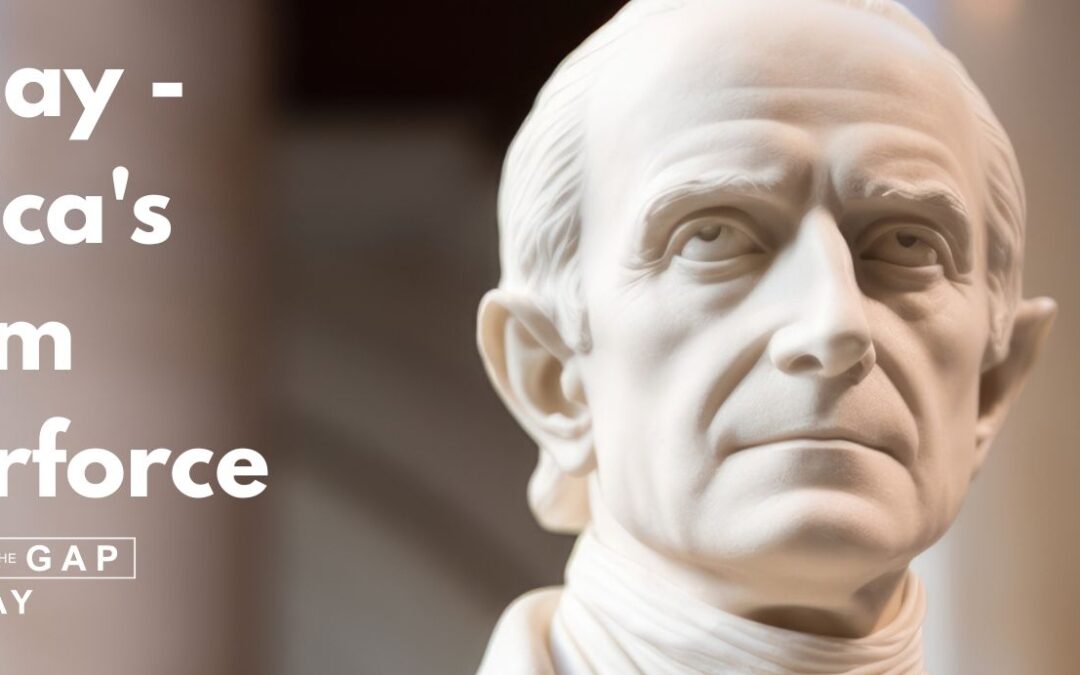

John Jay – America’s William Wilberforce
Oct. 20, 2026
Host: Dr. Jamie Mitchell
Guest: Dr. Alan Crippen
Note: This transcript is taken from a Stand in the Gap Today program aired on 10/20/26 To listen to the podcast, click HERE.
Disclaimer: While reasonable efforts have been made to provide an accurate transcription, the following is a representation of a mechanical transcription and as such, may not be a word for word transcript. Please listen to the audio version for any questions concerning the following dialogue.
Jamie Mitchell:
Well, good day and welcome again to Stand in the Gap today. I’m your host, Jamie Mitchell. One of my great loves is history. I just returned from two weeks in Egypt and Jordan investigating the pyramids and tombs and learning much about ancient history. I love visiting my family’s ancestral site, and of course I’m enthralled whenever I get a chance to consider American history, but it’s not just the places and locations, it’s the people of history. And when it comes to our nation, we focus a lot on Washington, Jefferson, Adams, Franklin, Madison, and yet there are a number of what I would call behind the scenes characters who have had significant roles in our founding. One of them is John Jay. I should have known more about him growing up in the New York City area. I do remember a lot of my friends who wanted to pursue law enforcement going to John Jay College, yet that was my extent.
However, I have learned that this man was an important foundational stone for our nation and someone worth giving our attention to, especially we who are people of faith to help us today understand John Jay and his contributions to America is the Reverend Alan Crippen. Alan Crippen II and Anglican clergyman and serves as the director of Hillsdale Colleges, Blake Center for Faith and Freedom in Somers, Connecticut. Prior to that, he was the executive director of the American Bible Society’s Faith and Liberty Initiative, a project of national scope to engage people in exploring the “good book” as a principle freedom text of American ideals institutions. And as we learn, John Jay is somebody that had a part in the American Bible Society. Reverend Crippen is also the founder and former president of, namely John Jay Institute, a Christian organization that was dedicated to forming principled public servants.
And most importantly, Alan is a father of five adult children, 15 grandchildren, and that was with his dear wife, Michelle, who tragically died of cancer. He since has remarried Lenora Lee, who is a mother of four herself, seven grandchildren, which makes for a very busy and big family. But we’re so glad that Alan can be with us. Alan, thanks for making time and being part of Stand in the Gap today.
Alan Crippen:
Well, thank you, Jamie. It’s a delight for me to be on the show and I look forward to talking about John Jay.
Jamie Mitchell:
Alan, I have to admit that to my shame, I gave little attention to John Jay until you introduced me to him. And I knew of him and I knew a few facts, but the more I learned about him, I realized that this is a remarkable and significant person. Now, as we start off investigating Jay, can you tell our audience some things about Jay and what was it about him that caught your attention and interest, I guess, many years ago?
Alan Crippen:
Sure. My knowledge of John Jay was not really unlike yours. I would call John Jay sort of second tier of principal founders. He is in the principal founders, but you rattled off the list, right? Washington, Jefferson, Adams, Franklin, Madison, and then stop. So if you were to come down to the next tier, it would be John Jay. Of course, he’s one of the authors of the Federalist Papers along with Hamilton and Madison. He was in the First Continental Congress. He was in the Second Continental Congress. He did not sign the Declaration of Independence. I just happened not to be there, but for reasons I could talk about later. But he’s really everywhere. It’s from New York. He was our principal author of the New York State Constitution in 1776. So he was a diplomat. He had diplomatic missions in Spain. He was a principal negotiator for the Treaty of Paris, which brought the Revolutionary War to an end.
He later served as George Washington’s point man and nominee to be the first Chief Justice of the United States, and then ended his career as public career as governor of New York. And then there’s this sort of post-public career where he is one of the founders and the second president of the American Bible Society. And that got my attention. So I picked up, this was back in, I don’t know, 2005, maybe I picked up Walter Starr’s biography. Walter Starr’s biography came out that year. It was the first scholarly biography on Jay in maybe a half century. And Walter did a fine job. He piqued my interest in Jay. And I’m reading this as a Christian, reading this as a clergyman and thinking, “Wow, there’s so much here that ought to inspire Christian people about a role model public servant.” And so I took that inspiration to really found an organization called the John Jay Institute, which is dedicated to preparing young men and women for Christian service.
So it was Jay’s remarkable faith, his commitment to the good book, the Bible, as the mainstay of his life that inspired me to dig in more and learn more about John Jay, and then to try to emulate his life in my work at the John Jay Institute.
Jamie Mitchell:
Alan, we’re going to dig into both his public life, his political professional life, and also we’re going to talk spiritually about Jay. But one of the things as I’m reading about Jay’s life and I’m thinking to myself in a contemporary setting, why is it that we don’t see more men like Jay today?
Alan Crippen:
Well, that’s a great question. I think in some ways men like Jay are a rarity, period. I’ve made the argument that Jay is America’s William Wilberforce. Many of your listeners no doubt know who William Wilberforce was, the British parliamentarian in the late 18th, early 19th century who was the chief advocate for the abolition of the slave trade worldwide. In the last, I guess, 20 years, maybe 25 years or more, there’s been a sort of a cottage industry made around Jay. I mean made around Wilberforce rather. There’s a Hollywood movie about him. There’s several biographies. His memory has rightly been recovered. And so what I found is that many evangelicals are rediscovering William Wilberforce and they’re inspired by his story. They’re inspired by his accomplishments. They’re inspired by his philanthropic work beyond that of slavery. And I’m looking at Jay saying, Jay’s done many of the same things, only in the American context.
So we have a Wilberforce. We have a John Jay to give us inspiration and encouragement.
Jamie Mitchell:
Wow. Well, there’s much more to uncover about our friend John Jay. And when we return, I want to discuss with Alan his public life, some of his political and professional accomplishments. Don’t go anywhere. Today we’re investigating a historical figure that every Christian should know about. Well, welcome back. I’m so glad that you’ve joined us for this special program today. Looking at the life and the impact of American historical figure John Jay Allen Crippen, director of the Blake Center is our guest. Alan, I’ve ordered today’s program by first looking at Jay’s impact on American history, and then we’ll talk the next segment about his spiritual influence. So let’s get into his accomplishments and those things that really helped shaped our history as a nation. What role did he play in the founding of America? And you’ve mentioned a couple of those things, but would you expand on them because they are very significant things that John Jay seemed to be right in the middle of along with some of the major characters that we always talk about.
Alan Crippen:
You’re correct, Jamie. I’m happy to do that. I do want to say a couple more things about his formation. So his family emigrated from England. His name is French, right? They are from French Hugano or French Protestant extraction. And his family found religious refuge in England. They left France. His ancestors left France for England where they enjoyed religious freedom to be Protestants in England, which was not the case in France at the time. And then of course they make their way to New York, the colony of New York. It was an influential, wealthy family. Jay’s father was Peter Jay. His mother was a van Kortlet, Mary Van Kortlin, who was from a Dutch reformed family. So Jay’s family, having been in England, we’re church of England people. So his faith tradition has the sort of Dutch reformed influence of his mother and the Huegenots and then Anglican influence of his father.
So he’s basically homeschooled. He did experience a year or two away in a boarding school of sorts. It was a very small private boarding school. And then he went to Columbia College. He went to Columbia College at the time, which was called the King’s College. It was an Anglican institution. When we think of Columbia University, it was a large secular institution on Manhattan Island. And then it was a small building with one or two tutors and they were all clergy tutors. So Jay went to college at age 14, 13 or 14. So he’s a young teenager. His professor was the eminent Dr. Johnson, an Anglican clergyman, followed by Miles Cooper, another eminent Anglican clergyman. And so imagine he’s basically classically trained in ancient history, in Latin, in the Greek language, in just clearly theological instruction. In those days, the King’s College would have been a Christian institution.
He graduates from college, he becomes a lawyer and he enters politics basically at age 29 as a member of the first Continental Congress. He’s newly married, 29 years old. We think of the founders as aged men, maybe because they’re picture wearing powdered wigs.
And Jay may have been wearing one of those wigs, but he’s a 29 year old. And the first Continental Congress is where many of the founders meet each other for the first time. And of course, it’s convened to address the crisis in Massachusetts, which is the blockade of Boston Harbor, an act of war by the mother country. “Hey, this is terrible. How do we respond? “is the question. And there were some eager revolutionaries in that assembly, Patrick Henry being among them. Patrick Henry is basically saying,” Government is at an end. We’re now in a state of nature. We need to reorganize and constitute a new country. “And this is a pretty radical idea, right? It was very much revolutionary. And Patrick Renne had this great reputation as an orator and a defense attorney, young lawyer, 29 year old, newly married John Jay, takes on Patrick Henry, basically says government is not at an end.
It’s not too late to seek peace with another country.
He really was against independence in 1774, and it was Jay’s persuasive arguments against independence that won the day. So I share this because Jay, he’s a principle conservative. He’s more interested in restoration than revolution. I don’t think I would describe Jay as a revolutionary at any point in his life. The argument, of course, is that the colonies are no longer being treated as English subjects, entitled to his historical rights and privileges that all Englishmen have. That was the argument. So Jay is then commissioned by the First Continental Congress to write an address to the people of Great Britain. And essentially this is a PR effort to say he makes the legal case, right? These are what our problems are with the parliament. And we have a right as English people to have these issues addressed, to have the same English rights as all English subjects.
So he was a tempered, levelheaded, conservative, and certainly Christian statesman on the world stage at age 29.
So fast forward, he becomes then things start to tend toward the necessity of a revolution. He’s part of that debate, but he’s not in the Congress when that debate happens. He happens to be actually in New York dealing with the New York matters. He was also involved in, he was basically the head of counterintelligence for the revolutionary government working closely with George Washington. So Jay, interesting tidbit, he’s a spy master of sorts, concurrent with his work in the Congress. And James Fenimore Cooper, most listeners probably know James Fenimore Cooper from The Last of the Mohicans and the Leather Stocking Tales.
His first best-selling book was called The Spy, and it came out after the war, but it’s a novel about espionage during the Revolutionary War. And it came as a consequence of an interview that John Jay granted him at his home in retirement in Bedford, New York. So Cooper, who’s friends with Jay’s son, William, they come to Bedford, they meet Jay at the farmhouse, and Cooper’s asking him all these questions about his involvement as a spy master. And basically Jay gives him all this sort of declassified knowledge that he has and it involves this incredible story being weaved together and Cooper writes a novel about it. All the names are changed to protect the innocent sort of thing.
Jamie Mitchell:
Wow.
Alan Crippen:
That’s a fascinating thing. So Jay, he’s a member of the First Continental Congress. He becomes the president in 1779 of the Second Continental Congress. Shortly after that, he’s the emissary, the diplomat assigned to Spain to seek aid for the young United States in their conflict with Great Britain. And then as the war comes to an end, he is part of, as I mentioned earlier, the peace commission that actually negotiates the terms of peace in Paris. So he’s involved in all of those entries, front and center. During that period between the Confederation Congress and the Congress we know now, the implementation of the 1787 constitution, he is essentially the chief executive for the United States government. He’s title, I think was foreign secretary, but he’s running basically the United States government as the executive before the constitution makes Washington the president of the United States. And again, he’s a lawyer.
So when Washington is elected president, he’s looking out on all of these great founders and the guy he wants, the guy he trusts, the guy he believes in to be first chief justice of the United States is John Jay. And so that’s his appointment. So he serves in that capacity. And then because he trusts him so much, Washington taps Jay during his administration to serve as the special ambassador, it’s minister Planning Potentary to keep us out of another war with Great Britain. So he negotiates what has been called the Jay Treaty. It’s supremely controversial. It was not well received by significant political factions in the United States. But at any rate, Jay did keep us out of war with Great Britain, which was clearly imminent.
The president, Washington didn’t want us entangled with war with either France or Great Britain. This is during the French Revolution and an emerging, I would call it World War with the Empire of France, the Empire of Britain. And Jay kept us out of that through his able skills of negotiation. And when he comes back, he runs for governor of New York and that’s basically his last public office. So he really held almost every conceivable high office except that of the presidency of the United States as it sort of summarizes his career. And I think as a significant political act, he abolishes slavery in New York as his final act as governor.
Jamie Mitchell:
That’s the one thing that’s amazing we didn’t get to talk about. He leaves the Supreme Court to become governor of New York. That’s amazing. As you can see, John Jay’s involved with everything in the founding of our nations. Amazing, yet probably most significant is what he did spiritually. When we return, how did God and faith shape this man known as John Jay? Don’t go anywhere. Well, if you’re just joining us, I know you will want to go back and listen to the first half of this program today as we’re examining the life of an impact of American patriot John Jay and some fascinating things that we are learning. Alan Crippen, who has been focused on John Jay for a while, has been giving us some insights today. Fascinating. Alan, John Jay was a man of faith. Can you share about Jay’s spiritual journey, what he believed about God, the Bible, the role of faith and the founding of our country and some of the spiritual influence that he’s had.
And then I want to pick up and focus in on one specific thing that probably people don’t know about John Jay.
Jay Crippen:
Sure. Happy to do that. Jay, as I mentioned earlier, has this great spiritual heritage. His ancestors were religious refugees. They were French Huguenot reform people who left France to experience religious freedom in Britain. And then as the family makes their way to America, Jay’s born in America, he’s from a family of privilege, but he’s well formed spiritually. His parents were Christians, Father Anglican, Mother Dutch reform, but I think she sort of embraced the Anglican way. So Jay is raised with, I guess, a evangelical Anglican, i.e. Church of England piety. And he ends up going to the King’s College, which I would describe as at the time as a very small, maybe 30 students at the most, Christian classical college.
All the faculty, two or three of them at most, are all clergymen. They’re all well educated and they’re the ones who are training John Jay in a liberal humanities education where he’s reading ancient history and the classics and then learning. He becomes a lawyer, but that’s actually done on the job. So that’s where he ends up. But in his spiritual piety, he was raised by a family that read the scriptures. He was raised by a family that used the 1662 Book of Common Prayer, which is still available. You can go buy it on Amazon and experience the sort of worship services and prayers that were part of John Jay’s blood and sinew. And it’s a classic of English spirituality, the 1662 Book of Common Prayer. Two thirds of the signers of the Declaration of Independence were basically raised in this spiritual tradition. So Jay is among them.
He was very devout in his faith and took Christian obligations very seriously. So he became a lay leader in his local Church of England church, which back in the day would have been Trinity Church Wall Street, now an Episcopal church.
It’s an Episcopal church because after the war, there was no longer a Church of England presence in America for obvious reasons. They declared independence from England. So how could we have a Church of England in America, right? It’s a problem. So essentially the Church of England people in America reconstituted themselves as the Protestant Episcopal Church in the United States. And Jay was one of the lay organizers of the Protestant Episcopal Church in the United States. He had an influence in helping the Episcopal Church develop its constitution and canons, which they did, by the way, in the year 1789 in Philadelphia at Christ Church. So he’s an organizer, a lay organizer of a new denomination in America, which was appropriating the old English Anglicanism in an American context. He was involved politically in helping that church make connections with English bishops. In Episcopal polity, you just can’t make yourself a bishop, right?
You have to be consecrated by three other bishops. And America had no bishops. So they needed to look to England for three Church of England bishops to consecrate the first three American bishops. And Jay, in his capacity as foreign secretary, wrote correspondence to John Adams, who at the time was the American minister, i.e. American diplomat at the court of St. James in England. And he’s basically asking John Adams to get an audience with the Archbishop of Canterbury to sort of work out a way that the English bishops could consecrate Americans who were going to come over to be made bishops and thus leaders in the infantile Protestant Episcopal church of the United States. And he did. It happened. So Jay, as a layman, as a political officer of the United States, made that happen on behalf of the emerging Episcopal church. He’s involved in church planting.
He did so in retirement. He planted St. Matthew’s Episcopal Church in Bedford, New York. He was widowed by this time. I should also say, somehow worked this in that he married well. He married William Livingston’s daughter, Sally, and it was a wonderful romance. It rivals John and Abigail Adams in terms of story. But tragically, Sally died fairly early. I mean, in the first year of Jay’s retirement in 1801. So he’s widowed, he’s living in Bedford on the farm and there’s no church there. So because of who he is, the connections he has helped to found St. Matthew’s Episcopal Church.
The local lawyer says he went to church regularly and he took his dog Bob with him to church. So dog Bob and John Jay went to St. Matthews Church regularly. He was involved in the Westchester County Bible Society, forming the Bible Society. This was a local group committed to making the Bible available to anyone who wanted one at an affordable price. And that led to his work with the International American Bible Society, which was initially founded to distribute Bibles nationally and eventually internationally at a price people could afford. So there was a tremendous shortage of Bibles, particularly on the frontiers and the Bible societies and particularly the American Bible Society was a cutting edge publishing house that ended up printing millions upon millions of Bibles to distribute in the American and ultimately around the world in translation efforts and including translation efforts with Native American nations like the Cherokee and others.
So Jay committed to holy scripture, committed to the truth of the Bible, believing that every family should have a copy. This is what animates his involvement with the American Bible Society. And then I think I said on the last segment that as a governor, he signed legislation eliminating gradually abolishing slavery in New York. That’s a fight that he started in 1776 with the draft of the New York State Constitution. He, as a drafter, wanted to abolish slavery then, didn’t have the political ability to do that. It was super controversial, even New York. Slavery’s not just a Southern issue, but eventually he worked with Alexander Hamilton, General Phillip Skyler and many others to form the New York Abolition Society and other abolitionist efforts to rid New York of that particularly evil institution. And what’s animating him in this is his Christian faith. In that work, in his retirement…
Well, actually, I document this in an article that I’ve written recently, but he met the famous William Wilberforce when he was a diplomat in England negotiating what became known as the Jay Treaty. So him meeting William Wilberforce started a friendship with the great British reformer, William Wilberforce. And there’s a correspondence between these two statesmen for over a couple decades and they collaborated together on the abolition of the slave trade. So in some ways, again, my argument is John Jay rather is America’s William Wilberforce. So these are some of the things that I think speak to his spirituality, his formation and his Christian action, because everything he did was animated by his Christian faith.
Jamie Mitchell:
Amazing. What is fascinating to me as I listen to you and I do my own reading recently about Jay is how little the Christian community knows about him. And really, it is something that we need to make available more to Christians to understand the character of some of these early founders, that they were people of courage. They were on the cutting edge of some things, but at the basis, at the core of who they were, was their love for God, their love for God’s word, the disciplines that were built in them early from their family. John Jay is not an accident. John Jay is a product of what happens when a person of faith takes their faith and their relationship with God serious and begins now to weave that belief, that biblical worldview into how they see the world, how they see the nation. And so many of our great founders were motivated by their love for God, their deep understanding of the word of God.
When we finish up, this desire to pass on both scriptural truth, the love for God, a biblical worldview and pass it on to the next generation and maybe raise up some future John Jays. Alan Crippen is involved in that and I want him to share a little bit about what he and the Blake Center are doing.
Well, this has been a delightful hour with my friend Alan Crippen. I guess I should have said that Alan and I go back 40 plus years. We were students together at Karen University and throughout the years our lives have kept crisscrossing and intersecting and I’m certainly glad about that. Alan, we’ve been talking a lot about John Jay, which is one of the many pieces of history that you enjoy talking about. But while I have you on, I wanted you to also talk about the Blake Center where you serve as the executive director there in Connecticut. Probably our audience does not know what the Blake Center is and what it does. What is it? Where is it? How did it come into existence? And why should our listeners know about the Blake Center and especially its connection to Hillsdale College?
Jay Crippen:
Sure. Yeah. Thank you. Happy to talk about that. As you said, the Blake Center is part of Hillsdale College. So Hillsdale College is a non-sectarian Christian college of liberal learning in Southern Michigan. It’s a small college, but it’s a small college that packs a pretty heavy punch. I would say for sure that if any young person wants the kind of education that John Jay had and that many of the other founders had, Hillsdale College is probably doing the best job at that of any other college in the United States, bar none. There are several other fine colleges. I want to make that clear, but an education that would proximate the kind of education the founders had, a student can easily find it at Hillsdale College. Now that said, I am the executive director and chaplain of the Blake Center for Faith and Freedom, which is an extension campus or a satellite campus that’s located in New England, really on the Connecticut state, Massachusetts state line.
Summers, Connecticut is just south of Springfield, Massachusetts, about 20 minutes and about 30 minutes north of Hartford. So why are we here? Why does Hillsdale have a presence in New England? One, I think symbolically it’s an outpost to sort of plant the flag for the cause that Hillsdale is advocating, which is learning for liberty. The Blake Center’s mission is to promote sound learning, the cultivation of moral character and the teaching and practice of the Christian faith to perpetuate civil and religious liberty and the blessings bestowed by these indispensable principles of America’s founding. So we exist to really explore the relationship between faith and freedom and to continue to advocate for and shore up the very precious freedoms we enjoy in this land are civil and particularly religious liberty, which I would argue is our first liberty worth defending. So that’s our contribution. We don’t have resident students here on this campus.
We’re largely committed at the moment at least to lifelong learning. So our programs involve public lectures. They’re posted on our website, which is blakecenter.hillsdale.edu. So blakecenter.hillsdale.edu for learning more about the Blake Center. But we do public lectures on these themes. We’re in the midst of a series, one lecture per month on America 250 where we’re delving into the lives of great Americans. And then we have our regular ongoing lecture series. So we’re doing about two public lectures per month. Our campus is 100 acres. It has 14 buildings. It was formerly the private estate of Presley and Helen Blake. Presley was the co-founder of Friendly Restaurant and Ice Cream, the ice cream frozen dessert company. He and Helen, his wife loved Hillsdale College. And as their legacy, as part of their legacy, they gave Hillsdale College their estate to Stewart for educational purposes related to faith and freedom.
Hence it’s the Blake Center for Faith and Freedom. The signature building on our campus is actually a scale replica of Thomas Jefferson’s Monticello. So it’s a pretty amazing building. When you’re driving by the highway, you see this beautiful structure that looks like Thomas Jefferson’s house, but it’s not.
It’s part of Hillsdale College’s campus in New England. So that’s a little bit about the Blake Center.
Jamie Mitchell:
Wow. Alan, in my opinion, most Americans and many Christians here in America, we know very little about our country’s history, its founding, how faith played a role in it. We have just a few minutes left. Is that a fair assessment? And why should that be a concern? And what can be done? Obviously, you’ve dedicated your life to try to change that, but we need to ramp up our understanding of the importance of the founding and faith. But why should Christians be concerned about that and why should Christians lean into that?
Jay Crippen:
Well, I think you raised some things of deep concern to me. My father died of Alzheimer’s a couple years ago and we saw the ravages of that disease change him. He didn’t know who he was. He didn’t know who my mother was. He didn’t know who my sister was. He kind of knew who I was and my brother. And then of course there was confusion with friends and so on and so forth. Why am I saying that? What happened? Why did he not know who he was and who we were? Because he lost his memory. And I think the crisis that we face right now is that American culture is losing its memory. It’s losing its memory because history is not being taught, or if it’s being taught, it’s being taught in an inaccurate way, maybe even a harmful ideological way in some cases. So we are as a culture, as an American culture, I think beginning to show signs of amnesia or maybe to put it in worse categories of dementia.
If we can’t remember, then we don’t know who we are, which is why it’s important to sort of conserve these things, to conserve what we know of our past, to communicate these stories, to take inspiration from these heroes. And they’re not perfect people, right? Nobody’s saying that the founders are perfect. I don’t just want to focus on the founders, but any leaders throughout American, they have their foibles, but they still accomplished great things. And the American story is not a story to be embarrassed about, to give apology for. It’s a story to own, to take part of in its victories and its failings, to move that story faithfully forward as we look back to remember who we are and wrestle with the significant challenges that are in front of us. And that’s why education is so central. Our young people, that next generation, the onus is on us to transmit that cultural knowledge and we just have a few years to do it.
And if we don’t do it, it’s forever lost, which is why I think the work that Hillsdale College is doing and other Christian colleges is so, so very
Jamie Mitchell:
Important. Alan, what a joy to have you, my friend. All these years, thank you for challenging me and others to keep our faith and history in focus. I want to encourage you to read more about John Jay. Check out the Blake Center. And if you live in the Northeast New England, take advantage of that. Until tomorrow, like John Jay, live and lead with courage. God bless you. Have a wonderful day. We’ll see you 23 hours from now for another stand in the gap today.

Recent Comments