
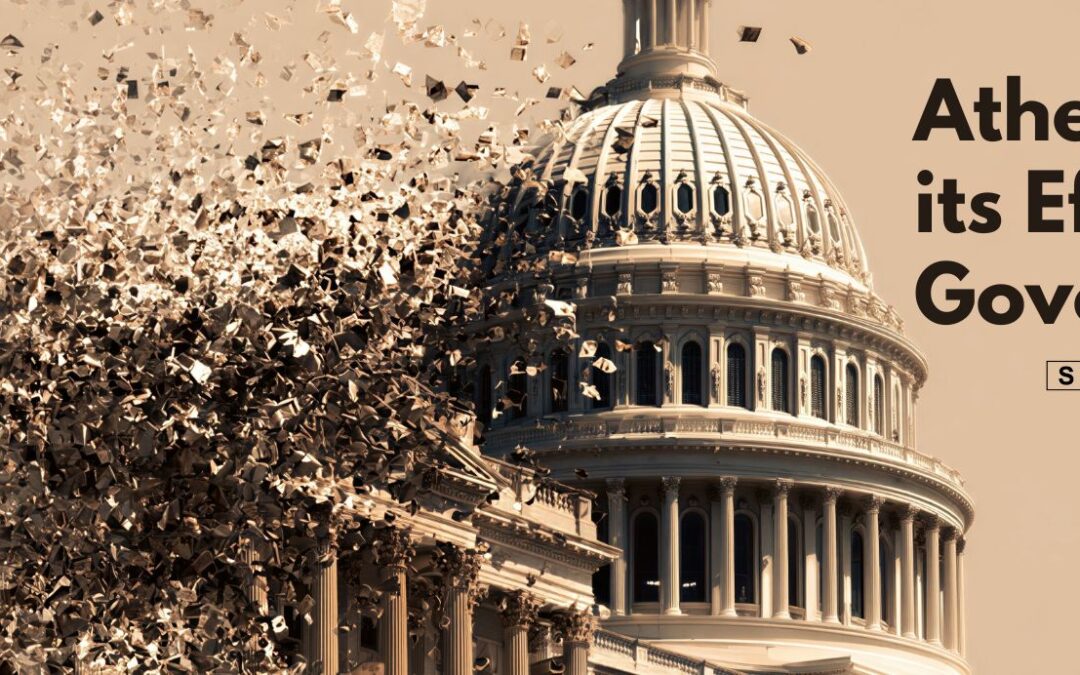

Atheism and Its Effect on Governance
May 7, 2026
Host: Hon. Sam Rohrer
Guest: David New
Note: This transcript is taken from a Stand in the Gap Today program aired on 5/7/26. To listen to the podcast, click HERE.
Disclaimer: While reasonable efforts have been made to provide an accurate transcription, the following is a representation of a mechanical transcription and as such, may not be a word for word transcript. Please listen to the audio version for any questions concerning the following dialogue.
Sam Rohrer:
Hello and welcome to this Thursday edition of Stand and the Gap Today, where today it’s also our bimonthly focus on the Constitution and American history with constitutional attorney and historian and author and speaker David New. Now, our primary theme today is to examine our history and our constitution as it relates to atheism. That’s right. And atheism’s attempt to impact our constitution. So we’ll talk about how that’s connected. The theme is atheism and its effect on governance, specifically our governance, but we’ll talk about others beyond that. But interestingly, with a clear nexus to our focus is that today, today is the first Thursday of May. It’s also designated by law as the National Day of Prayer, signed into law as such by President Ronald Reagan in 1988. And by the signing of that law, each succeeding president must sign a proclamation each year encouraging Americans to pray on this day.
And every president since then, and actually before 1952, to be exact signed such a proclamation because the tradition did not start with President Reagan. He only made this observance observable on a set day, the first Thursday of May. Now, in reality, the tradition and the history dates the practice back to 1775 when the Second Continental Congress called for a day of prayer for the English colonies as they sought wisdom and unity in that very difficult time in our nation’s history. Notable prayers that are easily found online include a prayer for this country uttered by George Washington in 1783. And his prayer went like this. Here’s just a part of it. He said, “I now make it my earnest prayer that God would have the United States in his holy protection and that he would incline the hearts of the citizens to cultivate a spirit of subordination and obedience to authority, to entertain a brotherly affection and love for one another.” His purpose?
Well, it’s acknowledged that wordly was to pray for the preservation of this new union and for a spirit of brotherly love and unity among the citizens, a spirit which was absolutely required if this country was to actually begin. Abraham Lincoln in 1863 gave his day of humiliation and prayer. He called for a day of humiliation, fasting and prayer, stating that our nation had forgotten God and had become too self-sufficient, attributing its success to human wisdom rather than divine favor. His purpose, it was to seek national repentance by confessing as he said national sins and as he said, “Seeking God’s mercy and pardon to preserve the union in the throes of our great civil war.” Then 1944, Franklin Roosevelt in the height of World War II gave his famous D-Day prayer delivered as a radio broadcast while allied troops stormed the beaches of Normandy where he said, “Almighty God, our sons, the pride of our nation this day have set upon a mighty endeavor, lead them straight and true, give strength to their arms, stoutness to their hearts, steadfastness in their faith.” And his purpose?
Well, it was to provide a solemn act of faith beseeching God, divine aid for soldiers in the struggle to preserve our republic of religion and our civilization. Those were his words. So today we want to start this program with this reflection on prayer, thanking God for all he’s done and David and I will close this program in prayer today, reminding ourselves of what God has said to remember about prayer in America. Here are a few facts I thought would be of interest as we think about this. According to the most recent pew in Barna surveys, only about 60%, 60% of Americans self-identify as Christians. That number used to be like in the 90s, now it’s about 60%. Approximately two thirds of Americans say they pray, but at least sometimes. All right, so it’s not really prayer as we talk about here. It’s sometimes prayer. Two thirds say they at sometimes.
Of those who say they pray at sometimes, nearly a third pray to a higher power, not the God of the Bible. Of those who say they pray daily, a smaller number, 50% say they do not believe in the God of the Bible. Interesting, isn’t it? So from a biblical perspective, people historically we know are given to prayer, but prayer is not the important measurement, but the object of people’s prayers. People pray to the God they worship. Mount Carmel, remember the prophets of Baal prayed to their Baal idol. Elijah alone prayed to the Lord God above alone who had the power to answer prayer. So we, as we hear prayer referred to today or we hear people pray or to consider, to whom are they praying? And in reality, to whom or what do we submit ourselves each day? Whether we hear someone pray in Jesus’s name or refer to God, consider how they live their lives, make their choices and prove by their actions who their God really is.
So may we approach the God of the Bible, the only true God with fear and honor and humility and call upon him. And may we fear God and keep his commandments for when we do and only when we do that, will God hear and answer. All right. Now those are just a few comments. I just wanted to open this program today and reference prayer because the National Dare Prayer, a lot of places we could go. David, just a couple minutes left here. I want to bring you in now. Do you have any comments just about prayer, the national day of prayer or our nation’s historic relationship to the acknowledge of prayer? Anything here as we close out this first segment?
David New:
Well, prayer. Good morning, ladies and gentlemen, or good afternoon. So nice to be with you. Prayer is the most powerful communication in the universe. When you link up your soul and your spirit and your body to God, you have made the ultimate connection that’s possible. There’s no more powerful connection than that. And when you use that time to communicate with God and to pray with God, and sometimes you may not even know what you should pray for, but the spirit does. That is the most powerful communication and existence. And it’s an enormous asset that is available to people who are ready to accept God and repent of their sin and accept our Lord and Savior Jesus Christ.
Sam Rohrer:
David, that is wonderful. Ladies and gentlemen, as we close out this first segment as we go into the program, one prayer for sure all people can be confident about that God will hear and answer is the prayer. Lord, save me. God will hear that prayer. And I pray that that’s all where we start. So as we move from that into our theme today, atheism and its effect on government, it obviously has a reflection on not all people believe in God. We know a lot of people pray, don’t believe in God. There are impacts that we’ll talk about some of those influences on the program today. Well, as we continue the program today, this is our bimonthly focus on the Constitution and American history. And as we began the program today, because this is the National Day of Prayer, gave some background in history about prayer generally.
We just concluded that last segment with that and then some history about how this day came about and quoted some from some of the prayers that are more well known. George Washington’s prayer way back in the 1700s and Abraham Lincolns at the time of the Civil War, FDRs in 1944 and so forth. But I hope that you are a person of prayer. Some of the numbers I shared, many people say they pray, pray, but an incredibly small number actually pray to the God of the Bible. They think there’s more power in praying than it is praying to the only God who can answer prayer. That’s a big thing and it’s important to remember as we go through this day. Right. So as we shift now into our focus for today’s program on atheism and its effect on governance, it’s good to note that there is no commonality between atheism and prayer to God, right?
The two are mutually exclusive. Our nation’s history of recognizing the need to pray or even to reflect on the original intent for today as the national day of prayer. There’s no connection with that emphasis and atheism and we’ll learn more about that. But without dispute, had atheism as a worldview and approach to life been the majority in the past, our nations passed, we would have certainly no national day of prayer today. Yet atheism alone does not lead a people or a nation away from the God of the Bible. Idolatry does and idolatry in all shapes and forms, whether they be clear and open anti-Christ, anti-God, false religions that attack Jesus Christ as the only way of truth in the life as the Bible says, or actually far more deceptive false religions that masquerade perhaps as Christian or partially Christian, some cases being godly but denying the power thereof, something we know from scripture, those that walk in disobedience to God’s word by their deeds, manifesting that they worship actually a God made in their own image. That’s a practice so prevalent in our day in America when actually 94% of Americans actually identify with the religion of America today, that’s called syncretism, a little bit of Christianity, a little bit of Hindu wisdom, a little bit of this, a little bit of that.
So that is where we are. Keep that in mind because atheism as we’re describing is not the only thing that talks about or that refers to a view of life that walks in competition to the principles undergirding what we have in the Constitution. So that being the case, David, today we’re looking at atheism and what it just said there, its impact on governance broadly, but before we go into that and you describe why you are personally opposed to it and you provide evidence of what our constitution would not be had atheism ruled, would you just define that term today to get us on the same page? What is atheism as it impacts on our focus today and then further describe what it is and what you want to say about it before we get into it more.
David New:
Just before I do that, I wanted to say something about why presidents issue prayer proclamations. And if you want to blame somebody, you want to blame King Solomon. King Solomon is the reason presidents, American presidents, issue proclamations of prayer. In the first Congress, they were debating very briefly about asking the president to issue a national day of prayer to thank God for the Constitution. There was some objection. Generally at that time in American history, people felt only governors should issue prayer proclamations and not presidents. It was a bit of a controversial issue later on. Now, in response to these objections, Roger Sherman of Connecticut made the case for why we should have the president issue a prayer proclamation and he cited King Solomon. When the temple was dedicated to God, when it was finished, King Solomon held a prayer service, a celebration, and Roger Sherman of Connecticut used that as the basis to justify what George Washington and succeeding presidents would do.
So we know who to blame for prayer proclamations. Don’t blame the Christian right, don’t blame conservatives or religious fanatics. Blame Kings Solomon. That’s where the fault lies. Now, when it comes to atheism, the word atheism consists of two things. It consists of the word alpha and it consists of the word theist. A theist is a person who believes in God. I’m a theist. Sam is a theist. Gary Dole is a theist. All of these people that work in this ministry are atheists. If you go to church, just about everyone there is a theist. Now, in Greek, when you want to say the exact opposite of something, you put the first letter of the Greek alphabet, alpha, or an A in front of it. And that means atheist means no God. So it’s just that simple. An atheist is somebody who does not believe in God.
Now, why do I not like atheism? Well, aside from all the spiritual reasons, there are, shall we call them secular or non-spirit or non-religious in particular. Let’s talk about some of those. First and foremost, if you’re an atheist, you don’t have a future.
There’s no future for an atheist. Your future is very, very bad. When you die, that’s it. It’s over. You’re gone. Never to be heard from again. Now, people, some rich people, famous people, educated people. I listened to one of my favorite Atheist shows this week, and a guy who was a scientist came on and says, “I have no problem with that. When you die, you just die.” But you see, he’s looking at it from somebody who has been very successful and has had a good life. Supposing you don’t have a good life and you have to struggle for every meal that you get, you have to struggle for every clean cup of water you get. Do you want to just die? That’s the end of it. No, you want the next life to be better.
Then the second problem with atheism is that the universe is extremely unjust. Very, very unjust. Atheists don’t think about this, but they should. What happens to the Hitlers, the Stalins and the mouths when they die? They just die. That’s it. It’s over. Do they ever have to give an account for the millions of tens of millions of people they’ve destroyed and are responsible for their murders and their death? They never, ever do because they simply die. They don’t die in a horrible way. They don’t die in any way that’s different from anybody else. There’s nothing unique about their death. They simply die. So what happens? What does it mean? It means there is no accounting for justice. There is no justice in an atheistic universe. If we are here simply as a cosmic accident, the universe is a very cruel, very ugly, and very unjust world because the evil in this world never get punished.
The next thing, human life. In an atheistic world, human life gets devalued enormously. Why? They can’t help but devalue human life. Why? Because they don’t believe man or human beings are made in the image of God. We are valuable. We have immense eternal value. What shall a man give in exchange for his soul? Because we are made in the image of God. Well, if you’re an atheist and you don’t believe in God, then abortion is perfectly fine. Euthanasia of old people who are taking up space and food is perfectly fine. The degradation that homosexuality brings to a human being, a very unhealthy lifestyle is perfectly acceptable. The next problem. No morality. One of the most fascinating things that I listen to when I listen to atheist shows is how they explain how they are moral people without God. How they can be good at moral and decent people.
This is an absolute joke. These people are nuts. They’re practicing Christianity without knowing it. If you are an atheist, if there is no God, there is no such thing as good. There is no such thing as evil. There is no reason to be moral because there are no morals. It makes total nonsense for these people to want to be good. There’s no reason I can say that Hitler is wrong. How can you say he’s wrong? Without God, all things are possible. You may have heard that before.
Sam Rohrer:
And David, hold that. I think you’ve got a couple more points to conclude on that. So let’s do that when we come back in the next segment. All right, ladies and gentlemen, you’re listening to Stand on a Gap Today. Our theme, Atheism and its effect on governance. That’s our connection here on our constitutional program. Well, if you’re staying with us here, if you’ve been with us from the beginning, please stay with us. We’re halfway through right now. And looking at this theme on this bimonthly program where we consider the constitution in American history, we’ve talked about prayer at the beginning of the program because this is the National Day of Prayer and a little bit of history, how we got that in place and things about that. In the last segment, David defined atheism and his very specific and excellent reasons of the real difficulty, the difficult life that if atheism as a concept prevailed would bring to humanity.
But it goes beyond that. Let me just mention this before we go into David sharing how our constitution would be different if atheism had prevailed and some other things about that. But when I was doing some research on it, in addition to what David said, which was totally, all everything was true, atheism in America today, as it would be discussed in a modern American discourse, atheism frequently aligns and does align with a worldview that emphasizes not just that there’s no God, but it emphasizes a material world as the only reality. For an atheist or anyone who’s not a believer, the only thing that’s real is what’s in front of you, right? But they’re not the only ones there because when the application of that, which is behind the atheist directed more broadly to say, what other similar beliefs are there that may not be called atheism, but they actually embody the same thing and taking it to the Constitution would be those isms, put it that way, that would refute the concept of a creator God as referenced in the Declaration of Independence, or that the Creator God is the source of inalienable rights that that document says.
There are a number of other isms, and they’re all secular, secular religions, because they together provide a comprehensive moral and authority structure that sits outside or tries to sit outside what the Bible says about God as the author of all authority, and underneath of that, all authority and all of human civilization will bow the knee one day to God as being unaccountable to him. I’m just going to mention these quickly and then I’m going to move on. Secular humanism, one we hear about, what is that? That’s the God of man’s reason. Secular humanism takes God off of the throne and puts man’s reason on it. Statism is another one. That’s where God is taken off the throne as creator and he and government is made the God. How do we see that? I mean, we really see that, don’t we? Scientism would be another. That’s where God has been taken off the throne and replaced with the God of methodology.
And that gets into what we’ve talked about in this program, some of the program with the technocratic state that is developing, and we’ll be talking more about that in the future program. And then there’s another one that’s often referred to as the therapeutic moralistic deism. That’s the modern religion of America, syncretism. A little bit of God, it’s moralistic, has nothing to do with the God of the Bible. So those isms. So I just put it out there. Atheism is not the only ism, atheism that is counter to God’s way. All right, David, that being the case, I just threw that out there, but let’s go here. Based on our history and our laws, why do you believe Congress could not have in the past, nor could now even in the future admit a new state into the union if that were to happen, if an official atheistic state was actually our ruling governance system?
David New:
If a state wanted to be admitted to the union, that is officially an atheist state. Say California said, “We are an officially atheist state and we want to be admitted to the union.” Could Congress do that? In my legal opinion, they cannot. Now, Congress passes laws. When a territory wants to become a state, they pass law called the Enabling Act, Enabling Act. And that law gives that territory the requirements for it to become a state. For example, Ohio wants to become a state. It became a state in 1803 and Congress passed an enabling act and it basically said that they had to comply with the Constitution and they had to comply with the Northwest ordinance that said religion, morality and knowledge being necessary to good government. They had to comply with the Northwest Ordinance. That was for Ohio to become a state. By the way, the person who signed that law was Thomas Jefferson.
As president, he signed that law with the requiring Oregon, I mean Ohio to comply with the Northwest Ordinance. So people who think that Thomas Jefferson wouldn’t approve of the Northwest ordinance are very much mistaken. Now, move on further down history. Abraham Lincoln is president and he wants to be reelected. So what he decides to do is to pass an enabling law for the state of Nevada to become a state. And of course, when new states become into being with the court occupant of the White House being there, they very frequently will favor that occupant and that’s why Lincoln did it. He made Nevada become a state. It became a state on October 31st, 1864, just eight days before the election, the reelection of Lincoln. And of course he got 59% of the vote. Ah, but listen, can a state be officially atheist? Well, when you read this law for the state of Nevada, Nevada wasn’t under the Northwest order, this had nothing to do with it.
And look what the Enabling Act said about what the people, the territory of Nevada had to do to be admitted to the Union and see if you can find room for atheism anywhere in it. Here’s what it basically said. The people of Nevada have to adopt the US Constitution, number one. Number two, they must have a Republican form of government. That means they cannot be a monarchy. That means they cannot be a dictatorship. And that also even means they can’t be a theocracy. It’s got to be Republican form of government. That means the right of the people to vote must be protected. And then number three, the territory of Nevada, the people of Nevada must pass a constitution that must have a constitution that is not repugnant to the US Constitution, quote, “Or the principles of the Declaration of Independence.” Very few people know the powerful rule the Declaration of Independence had in informing the United States of America.
22 states had to comply with the Declaration of Independence in order to become a member of the Union. Well, what does the Declaration of Independence talk about? What are the 35 most powerful words in the whole world outside of the Bible? They are these. We hold these truths to be self-evident that all men are created equal, that they are endowed by their creator with certain unalienable rights, that among these are life, liberty, and the pursuit of happiness. There are no more powerful words outside of scripture than these 35 words, and they all say one basic message. Our rights come from the creator. So can a state say we officially are an atheist state and we want to be admitted to the union? Not if they have to comply with the Declaration of Independence. I don’t think very many people know that the Declaration of Independence is one of the most important reasons why religion goes from coast to coast.
Sam Rohrer:
David, that was a good reflection and look back, but the point that you’re making and what we talk about oftentimes is that evidence is so compelling of how we as a nation began of those founding principles that we’ve talked about so much. Our founders debated that found its way into producing the foundation under girding, everything from the pilgrims, the Mayflower Compact, to the Declaration of Independence, to the various state constitutions, which actually preceded them to the US Constitution. No one who is honest can look at those things, David, can deny that the fear of God was well known, understood, and acted upon. Right?
David New:
Well, I’ll tell you, those 35 words, if anybody asks me, where can I read about America? Where is America? It’s those 35 words we hold these truths. That is America. And those 35 words change the world. This declaration doesn’t belong to the United States alone. This is a statement of human rights, the ultimate human rights statement, and it belongs to all peoples of all times, everywhere.
Sam Rohrer:
And ladies and gentlemen, it distinctively comes off the pages of scripture. So, all right, with that in case, stay with us, come back. We’re going to conclude some concluding thoughts and then hence for him. Well, David, this has been a very interesting program. And as always, when we’re covering things relevant like we’re talking about today and looking back in the history and always working into it, God’s word and principles from scripture, which when you talk about the Constitution and our history, it’s impossible not to do, honestly, to talk about it and not to do. But as we wrap this up here, take a couple of minutes and you shared some things in the last segment to demonstrate that under our law, flavored and underpinned by biblical principles, the humanists of the world, the atheists, those who have no value for God on the throne, they’ve taken God off of the throne and replaced it with, whether it be atheism or as I referred to these other areas of humanism or statism or scientism or moralistic deism.
All of these things which take and replace that which is, as defined by God, replace it with something that man wants it to be. But in addition to that, you said that you could give some examples. So just take and do that of what our constitution, for instance, would not be had one of those is atheism prevailed at the time. Make it apparent for people who are listening as a way of helping us to be even more grateful for what we have.
David New:
Ladies and gentlemen, if there’s one area of the Constitution I would like you to become very familiar with, it would be Article one, Section eight. Article one, Section eight. Now, if somebody asked you, “Can the federal government constitutionally do this and that and this and that? ” The first place you want to go is Article one, Section eight. This is where the powers of Congress are laid out. There are 17 powers. Some say there are 21, some say there are 22, depending on how you count it, but it’s right there. And if you can’t find in Article one, Section eight, something remotely close to what the federal government is doing, then they probably shouldn’t be doing it.
Now, this isn’t the only area where the powers of the federal government exist. I mean, for example, Article two, the president is the commander in chief, so he can basically control the Congress. The Constitution gives him the power to control the military. He’s the commander in chief. Civilian control of the military is one of the pillars of freedom in a free society. But look at Article one, Section eight. Now forget about the details of what it says. For the moment, let’s forget about that. Listen to what this article one, Section eight is really telling us. Listen carefully. It’s listing the powers of the federal government of what Congress can do. Why is that important? People do not realize how important atheism influences government.
They don’t understand it. They think atheism is just a way to think about God or the lack of one. It is not. It has a powerful political consequence. Look at Article one, Section eight. What’s it telling us? It’s limiting the power of government. Now ask yourself. I don’t believe in God. I don’t believe there’s life after death. I believe when you die, you die. Okay. What does that mean? Does that mean I want to have the government to have limited power? No. You don’t want the government to have limited power. You don’t want the government to be limited in any way whatsoever. Because if you get in trouble, either because you get sick, financial, whatever, if you get in trouble, you’re going to want your government to come and rescue you.
That means the idea of limiting the power of government is not something atheists as a general rule aren’t interested in. Remember, when we approach the Constitution, we want to live in government so God, we can live our lives the way God wants us to. When an atheist thinks about the government, he does not think of it as something interfering with the right of God, the right of the people of God to live their lives the way they want to. He thinks the government, he sees no other salvation for him other than the government. So Article one, Section eight, and an atheist ideology, if that was the ideology of the framers, they would have never included Article one, Section eight. They would not be limiting the power of government.
Sam Rohrer:
Okay. David, I think because of time, I’m just going to limit it right there. I think you brought it right to a point. And ladies and gentlemen, it comes back to our view of God. Humanism shifts the authority of truth and morality from a creator to human reason and scientific inquiry. Statism shifts it to government as God, exactly what David’s talking about. Scientism replaces divine revelation, the word of God, with scientific consensus. And the moralistic dualism of our day, the religion of our day, shifts the focus from the will of the creator to the happiness of the individual who then determines on how they feel what the religion will be. Think of the implications. And it all comes right back to what we’re talking about here. With that, David, why don’t you pray and then time left, then I will close in prayer as we close out this program here today on our national day of prayer.
David New:
Dear Father, the name of Jesus, we come to the this morning, this day through the blood of the lamb. We pray for the forgiveness of our sin. We thank thee for America and we pray for America. We have done many things we should not be doing. And we ask that you would send your grace and give us light to our young people, to all the citizens of this country, that the source of freedom is you. Forgive us of our sins. In Christ’s name, we ask this.
Sam Rohrer:
And Heavenly Father, as we continue on this program today, we thank you upfront. And as we always do, Lord, that you’ve made this platform available for David and I on this program and others to communicate literally around the world to millions of people. For that, Lord, we thank you. I pray for our country today on this day of prayer. Lord, there are many things for which we could pray. I pray for those who are in positions of authority. You tell us to pray for them. Why that we may lead a quiet and peaceable life. Lord, I would pray that those who are in positions of authority would understand fundamentally that they will give an account to you one day for what they do. And that it is are you and your word that is the top authority or it is them or something else. Lord, may they replace truth, replace pragmatism that they’re using with truth.
Replace the unmoving sacredness of your holy word. May they embrace that and replace their thinking, which leads them to think that they are God. Lord, these are the temptations of government and those are in positions of authority. And I pray that our citizens as a nation of all, Lord, would recognize that all that we have that is good didn’t come from government or some policy. It came because there were people who went before us who understood who you were and they submitted themselves to you. And I pray that we would do that even today. We pray in Jesus’ name. Amen. Ladies and gentlemen, thank you for being with us today. David and you, always a pleasure to have you in the program and for this focus today. And ladies and gentlemen, stay with us through the bounce of the day. Stay with us before God in prayer.
Join the program tomorrow. Isaac Crockett will be with you.

Recent Comments