
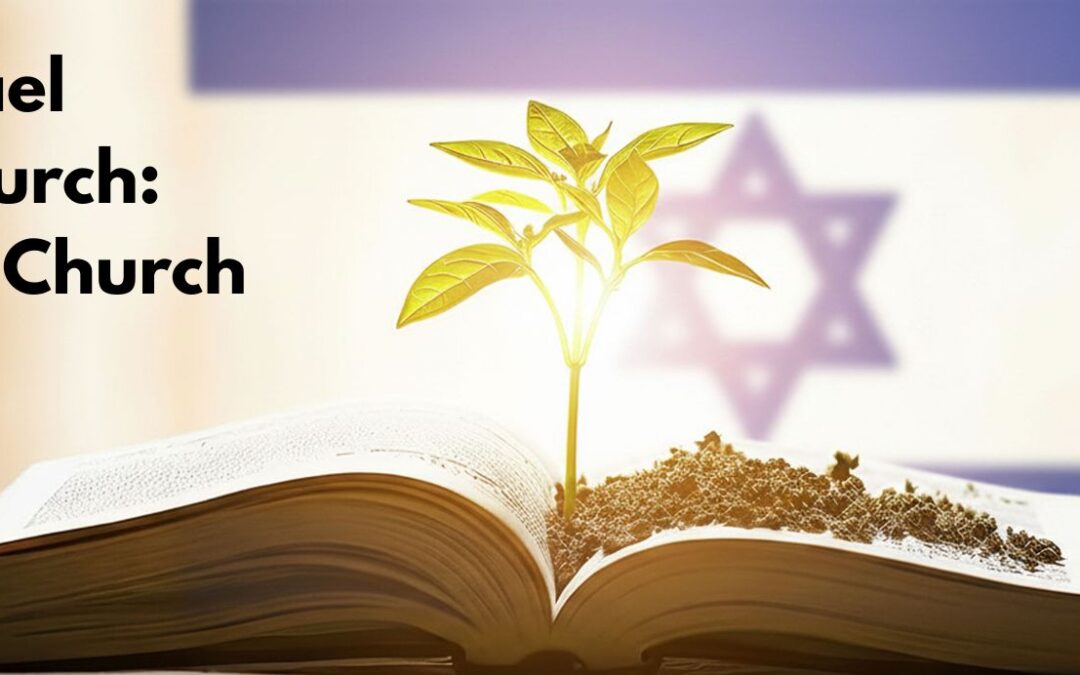

From Israel to the Church: From the Church to Israel
May 6, 2026
Host: Hon. Sam Rohrer
Guest: Dr. Carl Broggi
Note: This transcript is taken from a Stand in the Gap Today program aired on 5/6/26. To listen to the podcast, click HERE.
Disclaimer: While reasonable efforts have been made to provide an accurate transcription, the following is a representation of a mechanical transcription and as such, may not be a word for word transcript. Please listen to the audio version for any questions concerning the following dialogue.
Sam Rohrer:
Hello and welcome to this Wednesday edition of Stand in the Gap today. And it’s also our bimonthly focus on Israel, the Middle East and biblical prophecy. Now today I’m glad to have back with me Dr. Carl Broggi, senior pastor of Community Bible Church in Beaufort, South Carolina, where he not only leads that wonderful church, but also the host of his own radio program entitled Search the Scriptures where among other things, he answers questions from listeners, great questions, great answers, and a lot of that information with related sermons you can find at his website at searchthescriptures.org. And I’ll give that again in the program. Now, truth I’ve often emphasized on this program, including the program just this last Friday, just some days ago with Dr. George Barna, is that as Dr. Barna has concluded over his 40 years of research of American’s values and views about God and God’s word, it is this.
People do what they believe. People do what they believe. Now, that bottom line finding of George’s research I think is reflected in current research, which finds that as of today, only 4%. 4% of all Americans reflect a biblical worldview. They hold a biblical worldview. And why 94% of all Americans self-identify with a religion of syncretism. They don’t call it that, but that’s what it is. It’s idolatry. It’s where they determine that truth. Well, they determine truth not on thus sayeth the word of the Lord as truth, but on how they feel. Thus, over 74% of Americans say they’re Christians, but they are clearly not based on what they believe, hence that low percentage of 4% with a biblical worldview. Now, these findings apply. Obviously, when you take that information and apply it across the spectrum of American life, it’s the average person that we meet, including churches, church leaders, government, and politicians.
And that’s why this mentality, I believe in my estimation, as I view it, so clearly visible in Washington today with a president who envisions himself as a Messianic savior and faith team members who defend blasphemous behavior in biblical terms because people do what they believe. Now, because of God’s overarching plan of redemption, which is his story, biblical prophecy was provided to guide those with eyes to see, provide hope to those whose hope is in the Lord, and prepare, not scare those who fear God, understand his plan, and await the return of Christ busy in the process, the return of Christ in the rapture, and anticipate the second coming of Christ, and the long awaited 1000 year millennial kingdom for which the disciples and the prayer Jesus gave to them said, “Thy kingdom come, thy will be done.” It’s appropriate to look forward to that. Now that being said, how one views God’s plan and shapes laws and policies and establishes one’s priorities day by day arise from what they believe.
And that includes the understanding of the role of the church, the role of Israel in these end days and all that we talk about on this bimonthly focus. So the subject of our day program is simply, I’m entitled this from Israel to the church, from the church to Israel. And if you listen, stay with us in the program, you’ll understand what that means. But with that, I welcome to the program right now. Carl, Carl, thanks for being back with me.
Carl Broggi:
It’s a pleasure, Sam. Thanks for having me.
Sam Rohrer:
Carl, on past programs, we’ve talked about how people embracing such theological positions, what we believe, what people believe, as held by those, for instance, within replacement theology or dominion theology, and there’s some others, that are actually fueling the rise in antisemitism in an age when Jesus said that that would actually increase. And we see that. We see that all around us. Now, in this segment, I’d like for you, if you don’t mind, to lay the foundation for today’s conversation more, the 10,000 foot overview of God’s plan of redemption from Genesis to the first coming of Christ, to the present day, to the second coming, and the theological tension that is existing now, such as what I just mentioned about the role of Israel and the role of the church.
Carl Broggi:
Well, Sam, it begins, of course, with the creation of the world and God makes a man and a woman to have a friendship with them, but he makes them as free moral agents with the capacity to make choices on the inside. They’re not robotic. And of course, we with Adam and Eve, because what Adam sinned all sin, we’re in the loins of Adam, we rebel against God. And so in Genesis 3:15, God makes the promise of a savior of a coming seed that will crush the serpent. We often call it the first gospel. And so God begins to unfold that promise, beginning with what we call the Abrahamic Covenant, where God appears to Abraham and he isolates in chapters 12, 15 and 17 of Genesis, a people of land and a global blessing that he’ll bring through the Jewish people. And he even speaks as he unfolds the Old Testament of this Davidic covenant that many of the prophets address when Israel becomes a vessel, not only by which God brings a redemption, but through which he will rule the world.
So Christ comes at his first coming in the fullness of time. As Paul says in Galatians, he proclaims the promises that God had made to Israel. They officially reject him and he’s crucified, dead, risen, but salvation through the seed of the woman comes. But those promises concerning the coming kingdom have not yet happened. And so the Lord begins because of the rejection of Israel’s leadership and most of the people who follow with them, that he’s introducing a mystery. A mystery, of course, is something that was not revealed in the Old Testament, but God has now revealed. And so in Matthew 12, they commit this heinous sin where they officially reject him. And in Matthew 13, he speaks with a new kind of veiled parable. And Jesus says to you, it has been granted to know the mysteries of the kingdom of God. And so we’re in this timeframe where God has not abandoned Israel.
John Calvin, because he saw the church in the Old Testament, as much reform thinkers do today, say, “Well, God just changed hands. He’s done with the Jewish people, and now he’s running his kingdom through the church.” But that’s not true. God is a promise keeping God. And while he has postponed the kingdom for Israel, he hasn’t canceled it and nor has he replaced his plan. And so right now, God is working through this international community, Jew and Gentile alike in one body called the body of Christ not revealed in the Old Testament. And that timeframe will end with the rapture when God removes the church and then he begins to work again through Israel, a timeframe known as the great tribulation where God focuses on bringing Israel to Christ, it’s prophesied in Daniel nine, it’s unfolded in the Olivet discourse, culminating in the second coming where Jesus returns and literally fulfills his promise of a kingdom.
Sam Rohrer:
Thank you, Carl, for that. Ladies and gentlemen, you’ll get the idea that the title of it from Israel to the church, from the church to Israel. We are in the midst and we’ll explain that further in the next segment, how that all fits together, what the Jews, the Israel of the Old Testament knew, what Jesus revealed, what we should know and what we should anticipate. All of that will begin to break out in further detail in the next segments. Stay with us and we’ll be right back. If you’re just joining us right now, welcome to the program. Our theme today is this. Here’s the title from Israel to the church, from the church to Israel. My special guest, again, with me every month here and has been for years now is Dr. Carl Broggi. He’s the senior pastor of Community Bible Church in Beaufort, South Carolina.
He has a program where he answers questions online and you can find information about that and a lot of other things on his website at searchthscriptures.org. Now, what are we focusing on today? Well, this bimonthly focus is on Israel, the Middle East and biblical prophecy. We do this. We’ve done it since the inception of this program years ago. Why do we talk about Israel and prophecy? Because God’s word does. Why do we talk about the things we’re talking about today? Well, it’s because Israel and the church and how people think about scripture is forefront in exactly everything that we’re seeing unfolding. As we said in the last segment, a person does what a person believes. You and I do what we believe. So we’re going to walk through this entire program today, talking about the prophetical aspect, what God said about his plan of redemption, Israel, the church, where we are, what happened, what’s happening.
And I’ll just give you a heads up here. In the next segment, we’re going to go into some detail about something that ties into this that you may not have thought about. My guest, Carl Broggi preached a sermon recently, and it’s on the parable of which we’re all familiar, a parable of mustard seed. All right, you remember that? I’m sure all you listen to me know that, but it pertains precisely to what we’re talking about here right now. And you say, “Really?” And the answer is yes. Stay with us. We’ll explain that in the next segment. But Carl, all students of biblical prophecy understand that God’s plan of redemption involved a coming Messiah who we know as Yeshua, the Christ. You talked that in the overview last segment. All true believers also know that Jesus, the Messiah, pulled back the curtain on what Old Testament Israel did not understand and revealed the mystery, as you mentioned earlier, formerly concealed, but which then Jesus identified as the church that he said he would build.
“I will build my church, “he said. Yet Israel of Old Testament, they didn’t understand what we know today about the church, and unfortunately, most Jews of today still don’t believe what Jesus revealed at his first coming. Even more so, I think is that many professing Christians of today misinterpret or don’t want to believe what Jesus said about the church and God’s ongoing role of Israel in his redemptive plan. So that’s the focus of today. So take the segment now and if you would connect the pieces necessary to understand God’s plan, what you gave in an overview last segment of from Israel to the church and from the church to Israel. Now put some flesh on the skeleton that you identified last segment.
Carl Broggi:
Well, God made some promises in the Old Testament to the people of Israel. And so when Jesus sends out the 12 and Matthew, of course, which is a Jewish gospel written to Jewish believers, he gives us what we typically call the limited commission. He says,” Don’t go into the way of the Gentiles. Don’t enter any of the cities of the Samaritans. Rather go to the lost house, the lost sheep of the house of Israel. “About 400 years ago, someone came up with the term, we don’t know who we call the Great Commission in Matthew 28, where it’s now to all nations, but initially he comes to the Jewish people. Why? Because God is a promise keeping God and he wants to underscore that the promises he made to Abraham, Isaac and Jacob will be kept. Of course, when you come to chapter 12, you discover they reject this coming, the Messiah himself and therefore the kingdom that he was offering them.
The occasion, if most people remembers, Jesus does a triple miracle. They can’t deny the miracle. It’s obvious what he did. So they attribute the miracle not to Jesus and the power of the spirit working in him, but to the devil himself. And Jesus warns them that they are on the verge of committing an unpardonable sin. He says,” Blast me against the Father. It can be forgiven. Bless me against the son. It can be forgiven, but blasphemy against the Holy Spirit can never be forgiven either in this age or the age to come. “So he exhorts them to make the tree good. Matthew 12:33 with its fruit good or make the tree bad and its fruit bad because the tree is known by its fruit. So he’s pleading with them. And of course, their last possible witness was the spirit. They rejected the testimony of the Father through men like John the Baptist and the prophets.
They rejected the testimony that Jesus made of himself. The only one left who could speak to them was God the Holy Spirit. And now they were saying,” That’s not the spirit at work. That’s the devil at work. “And so when you come to Matthew 13, you discover why God is now beginning to transition from Israel to a future entity called the church. And so he begins to speak to them in a series of eight parables. And in these parables, he speaks of this interim time because of the unbelief of Israel. When you come to Matthew chapter 16, Jesus revealed something that had never been revealed before. He says,” I say to you, you are Peter, and upon this rock, I will build my church and the gates of Hades will not overpower it. “It’s a future tense, which indicates the church did not exist prior to this.
It’s not in the Old Testament. If you put a number of passages together, you can identify the birthday of the church as the day of Pentecost. So God hasn’t canceled the promises he made to the Jewish people. He’s just postponed it. And in these mysteries of the kingdom of heaven in Matthew 13, he unfolds what is going to happen during this interim phase. And so God has moved from Israel to what he starts as the church, but then he’s going to move back to Israel. So there’s just a remnant of believing Jews, the exact number, only God knows. Some say there’s as many as 100,000 in Israel, maybe 300,000 worldwide born again, believing Jews who acknowledge Jesus to be the Messiah. I don’t know the number, but comparatively speaking to say 15 million Jews on the planet, it’s a small, small amount. And so the next phase is the church, as we mentioned, will be removed.
And God is going to unfold in Matthew 24, the great tribulation. But what’s so interesting, he comes on an appointed day that was prophesied by Daniel. We call it Palm Sunday. They say,” Hail him, hail him. “And a few days later, they’re going to say,” Nail him, nail him. “And he weeps over the city. And he says,” Behold, your house, Matthew 23:38 is going to be left to you desolate. “He’s talking about the temple. He’s talking about a prophecy found in Daniel 9:26, and then he makes Sam this remarkable statement. “I say to you, from now on, you will not see me until, and the word until implies a change is coming. Until you, you, the Jewish people, that’s the audience say. And he quotes this Messianic Psalm, Psalm 118,” Blessed is he who comes in the name of the Lord. “And so while the rapture could happen today, the second coming word, Jesus comes back and he establishes his kingdom, that’s a prophetically driven event.
And one of those prophecies is because God has not abandoned or replaced the Jewish people. One of the prophecies is the Jewish people have to acknowledge Jesus is Lord blessed as he referring to Jesus who comes in the name of the Lord. So God hasn’t stopped his playing. He’s just changed the focus for this interim period.
Sam Rohrer:
That’s an excellent thing. And ladies and again, from Israel to the church, from the church to Israel. And that’s the reason for that because that’s exactly what is taking place. Now, Carl, let’s broaden that to the day. When we know that the religious establishment of Israel at Christ’s first coming, as you said, they rejected Christ even to the point of accusing him of getting his power from the devil. Wow. Well, today, as I look around, I think there’s a mindset that is within those who hold to dominion theology, replacement theology, the theology of the new apostolic reformation embraced by, for instance, the president’s pastor and the White House faith team director, Paula White, and many within the faith team representing, I’m going to say, the religious establishment of our day. But these theological positions, they believe that the building of the church and the pursuing of political dominance seems to be up to man rather than understanding that Jesus said that he would build his church.
And there seems to me that there exists a different but a similar type of problem where there’s a man effort almost to reject the Christ of the Bible and God’s prophesied plants because these groups are also messed up on the role of the church and Israel, which we’re going to talk about in the parable of the mustard seed in the next segment. But any comments on that and why this is happening?
Carl Broggi:
Yeah. There’s a rejection of the people of Israel and a future for them. And so they view themselves as the new Israel. It should be like basic theology. You got Apollo White and these NAR people who say that they are living apostles, there are no apostles today. To be an apostle, you had to have seen the risen Christ. Paul says,” Have I not seen the risen Christ? “Speaking to those who denied his apostleship, he reminds them that to be an apostle, you had to have been hand selected. He reminds them of his hand selection in Galatians one: one, and then he reminds us that if someone has seen the risen Christ and been personally chosen by him, two Corinthians 12:12, they’ll do the signs, wonders, and miracles that only an apostle can do. So right off, you should say this is really some weird theology.
There are no capital A apostles today because no one has seen the risen Christ. No one has been personally selected and no one is doing the signs, wonders, and miracles that only a true apostle could do. So we should put our thinking caps on and be very cautious.
Sam Rohrer:
Thank you, Carl. Ladies and gentlemen, okay, that’s why we say here always, let the word of God be the word of God. Let the authority of scripture be the authority of scripture. And when we consider it in the context and all that it says, there can’t be two opposing perspectives coming off of what God’s word says. We’re going to consider that now in the parable of the mustard suit. Stay with us. Carl, in a recent sermon that you preached, and I referenced it in the last segment, took it from Mark chapter four, I believe, although it’s referenced in other places, but it has to do with the parable of the mustard seed. And I know that our listeners have read that no doubt, maybe have heard sermons preached about it, but this will be a little bit different because when I listen to you preach that and I did further research, I have found that this parable is interpreted in totally different ways depending on one’s theological view.
For instance, in other words, those who hold to, and I’ve already referred to it, but to, for instance, dominion or replacement or reform theology or new apostolic reformation theology, they’re all kind of in there together, in their view. And they have significant influence, I would say, in an historic way in this age in which we’re living. And I’m going to suggest that in this administration, because they’re all through the current administration in DC on all levels, but again, people do what they believe. So I would submit that much of what we’re seeing is what people believe. But the sense of that is that they believe that the church is in a dominant role in the world and thus helping to drive their view of the church. I believe that’s what the parable speaks about and that Israel and it flex that view and the role, especially using the power of government to bring about what they believe to be a dominating power by the church that brings back the second coming of Christ, counter to what you just said, scripture says.
Now, the other view, which you expressed, and which I embrace as well, is that this parable, rather than to be a picture of a goal to which those in the church age drive, and it’s a positive thing, it’s actually a parable of warning, and that is a little different than what most people think. So ladies and gentlemen, stay with us because you may not have considered this, but would you explain this parable Carl by first putting it into context and then explaining what Jesus is saying? The two ways is it being interpreted and why you believe that it’s a warning, not a goal to be striven for.
Carl Broggi:
Well, I’ve turned over here to Marx account and Jesus said, “How shall we picture the kingdom of God or by what parable shall we present it? ” He’s already told a few parables, as Matthew records. He says it’s like a mustard seed, which when sown upon the soil, though it is smaller than all the seeds that are upon the soil. And then he goes on to describe that it grows into this large tree. A couple of issues, smaller than all the seeds that are upon the soil, or you could say on the earth, and earth or soil can refer to a localized portion like in Mark four, verse five, where he speaks of seed that falls on the rocky earth, or it can refer to the whole planet, like in the Revelation kingdoms from all across the earth nations and tribes, but he describes this mustard seed.
And if people know mustard, it’s strong, it’s got bite. And Jesus, of course, on one occasion spoke of the blind, leading the blind. We live in a day where we have the bland leading the bland, where people have lost confidence and the power of God’s word, which is why there’s so much confusion. And so we think we need smoke and lights and spectacle and skits instead of the power of the seed, which Jesus is defined as the word of God. But it is true that it is the smallest of all the seeds. If you go to Israel, and if someone goes to my website, they can actually watch the sermon where I have a lot of visuals. Sometimes you’ll see an entire field covered in mustard plants, but then you’ll have one abnormal mustard plant, which is actually a tree that is 25, 30 feet tall.
And if you take a mustard seed and you break it open, women used to wear them around their neck in the 70s as a sign of a proverbial sign if you have faith like a mustard seed. But if you actually break it open, it’s filled with dust. And if you take that dust and you plant that dust, you see people think that that little seed they wore around their neck was the seed. No, that was the pod within a pod. The dust inside was the seed and you plant it, it grows, it sprouts. In fact, one of my professors grew one of those into a feet at the Bible church he pastored Dr. Dwight Pentecostal to a tree 25 feet in height. So we’re not denying that it starts small, the church. Jesus is born in a little tiny village. He’s raised in a despised town.
He recruits a lot of people that folks would consider Hicks, and it grows from a handful on this occasion in Mark four, they’re all fitting in a house. At the resurrection, there’s 500, there’s 3000 on the day of Pentecost and it grows and it grows and it grows. But I don’t think that this is simply an illustration of growth, but it’s a warning of what’s going to happen during the church age. And I would argue that for four reasons. First, a mustard seed typically grows into a herbal plant. And so technically in terms of biology, it’s classified as a herb and herbs don’t produce wooded trees, but you can have an aberrant mustard seed that produces a tree that has all of these branches. In any reason in the first century, when they would walk through a field and they’d see this one gigantic tree, but covered by thousands of mustard plants, they know that’s an abnormality.
And that’s what Jesus is describing here, something that is very unnatural. In addition, I think you have to contextually interpret the parable. He describes this tree where the birds of the air can nest under its shade. Contextually, the birds are not viewed as something positive. Back in the same chapter in verse four, he speaks of the seed that’s sown that the birds eat up. And then in verse 15, when he gives the interpretation, he describes the birds as Satan and his demons who takes away the seed that has been sown. And then in the broader context, he’s been speaking of very odd responses to the gospel and he gives the parable the Sower, which he has to interpret. Three soils are bad, one are good. He gives the parable the wheat and the terrace, which he has to interpret where believers are mixed with unbelievers.
The next two parables, he doesn’t interpret. Why? Because he doesn’t have to, because it was obvious to anyone to have a little mustard seed produce a gigantic tree, which is a picture of what Christendom has grown into this organized, massive, structured organization instead of these localized churches that are autonomous and independent. And that’s kind of where we are at today. Then he tells the Parable of the 11, and again, it’s not positive. Every time leaven is used in scripture, it’s used negatively of Egypt’s corruption and Exodus, of the leaven of the Pharisees, their false teaching, the leaven of heroin and so on. It’s always used negatively. And so if you interpret the parable, the mustard seed wrong, you’ll probably interpret the parable of the leaven wrong, but leaven in all these parables fit a growing theme here. And the birds of the air that can nest under its shade is actually an Old Testament quote that comes from the book of Daniel where this vision of this coming Babylonian kingdom is given and Babylon is never seen as positive, but is very, very negative.
So it’s actually a warning here. It’s a warning of what is going to happen during the age of the church, that things in the end will grow towards apostasy, towards a rejection of truth, towards an organization that God himself does not endorse. Now that’s the short answer. I spent an hour on that very point in my sermon on Mark chapter four.
Sam Rohrer:
Okay, that was excellent. And you did boil a lot down into that. So if one approaches that, that the tree, the mustard tree, an anomaly from the mustard plant filled with birds typified by actions of Satan, if that is a description of the church, then build out what that says about the time in which we live. And you’re almost describing to me what, again, I referred to it as the religious establishment of our day. Build that out just a little bit
Carl Broggi:
Further, please. Beyond the cults like Mormonism and Jehovah’s Witness, forget those. You have these institutional churches like Roman Catholicism or the Orthodox Church. It’s massive. It doesn’t represent true Christianity. You can be wrong in a lot of things and still go to heaven. And there are born again, Roman Catholics and Russian Orthodox and Greek Orthodox, et cetera. But what those who are born again understand salvation by grace alone through faith alone in Christ alone, something that both institutions definitively reject. They reject the plan of salvation. Add to that, what has now happened in Protestantism is this liberal slant of theology has walked right in the front door. And we think that bigger is better, that we need these massive churches. And so what have we done? We’ve compromised the message where people are no longer called to genuine faith in the Lord Jesus Christ. And we have the largest churches, even in American history, with the least amount of impact.
They’re more worldly than they’ve ever been. Why? Because we’ve lost confidence And the seed that we’re supposed to preach. And we’ve replaced it with a lot of showmanship and lights and smoke and all kinds of things. Everything contrary to the admonitions in the New Testament church to preach the word in season and out of season.
Sam Rohrer:
Okay, Carl, ladies and jump, we’re at a break here right now. When I come back, I’m going to ask you just to make one connection before we go into the application of these things and how it should shape how we’re living. But if the tree, as described with the mustard plant, that tree full of birds is a description of the church of our age that has gone heretical. Tie that into the end of the church as we talk about Israel to the church, and then the church back to Israel. Okay. Ladies and gentlemen, stay with us. We’ll be back in just a second. Well, as we go into our final segment now, ladies and gentlemen, if you did not catch the beginning of this program, I strongly encourage you to go to our website, get the program again, get the link, or pick it up from our app, free app, stand in the gap.
With it, you’ll be able to get a transcript and actually read and then listen to the program again, which I think is very, very helpful. But Carl, let’s go to this. I’ve got to ask you one more question before we go into the application now of how should all that we’re talking about here shape our witness and our walk. Again, back to the concept of we do what we believe. But that’s back to here. Since that parable, I’m going to say, and you’ve said on the mustard seed in the context of all that Jesus was saying is a warning, not a take heart and be happy about the birds in the branches of this mustard tree, which is an anomaly clearly, but rather a warning of what that tree and all sides, all theological sides believe that that actually refers to the church. If it’s a warning, how does that warning tie into other aspects of scripture, prophetical aspects of scripture, and help us to understand how God is moving from Israel to the church, you’ve already gone through that, from the church, back to Israel.
Carl Broggi:
Well, when you put all those parables together, Sam, there’s seven unless you count the householders at parable eight in Matthew, one that’s not mentioned in Matthew, but found in Mark’s gospel. So you have eight or nine parables, but they all point towards a movement culminating in the end of the age with Jesus’ return from heaven. And the rapture precedes that. So as you see apostasy growing this abnormal church, our eyes should be wide open because not only does this parable, numerous other places remind us that as we move towards the end of the age, things will go from bad to worse, that apostacy won’t shrink, it will grow and it will multiply. And there’s coming to time, Jesus refers to the times of the Gentiles, which is a period of time that began with Nebuchadnezzar until he comes and reigns. And Paul also mentions the fullness of the Gentiles.
And he says when the fullness of the Gentiles has come in, Romans 11 in verse 25, then Israel is going to be brought front and center and they’re going to turn to faith in Jesus. And so I think we’re approaching that time because the average Gentile believer no longer is engaged in active evangelism and winning people to Christ. And the things that we’re doing in many of these so- called evangelical churches is really not effective in term of bringing about genuine conversion. And so if the church isn’t going to do it, God’s going to basically say at some point, enough is enough. I’m going back to the Jewish people. And of course, we know from the revelation they will fulfill the great commission. This gospel, the kingdom shall go to the whole world and then the end shall come. So the Lord is looking towards that end date where things are going to radically change.
Sam Rohrer:
All right. Thank you for establishing that because I think ladies and gentlemen, that helps us to understand, at least it helps me to understand as I think this, that God in his plan of redemption, first telegraph there in Genesis 3:15, everything that we read in scripture, Old Testament to New Testament to the Book of Revelation yet to take place is all about God’s plan of redemption. And at the end of the day, what do we realize? Man’s heart is sinful, depraved, and it runs away from the will of God and the way of God, rejecting the word of God, the truth of God. That has been the history of human civilization. And yet in the midst of that, God calls to himself a remnant. Old Testament, New Testament, tribulation yet to come, but it should impact. How we view this will impact how we live.
And here I want how I conclude. I want you to conclude, Carl, and then I’ll just tell you upfront, watch your clock and then end in prayer here. And that is these things should shape our witness. It should shape our walk. And if we view as we’re looking today, that it is a warning this parable, then it will cause us to do one thing. If we believe that it is a heyday and it’s not a warning, then it will cause us to do something else. Put this in perspective and then for those who fear God, how it should cause our behavior.
Carl Broggi:
Well, Sam, about 40 years ago, evangelicals began to ask people, they actually did surveys in communities. What would you like to see in a church? And people came back, unbelievers, short sermons, a church that doesn’t talk about sin, about hell, about the devil. Certainly never mentioned money, more of an entertainment kind of thing, things that are uplifting, visually stimulating. And so you had a couple of major churches in the country that created this new paradigm and it saw a massive expansion and thousands of evangelical churches across America bought into it. Instead of teaching the whole council of God, because it’s too offensive, it’s countercultural. We don’t want to alienate people. Certainly you don’t want to sing a sin like a hymn like amazing grace, at least the stanza that says, who saved a wretch like me. You don’t want to mention the blood of the Lord Jesus.
You don’t want to alienate people. So we have a tree, a monstrous tree as unfolded in this parable as seen in Roman Catholicism and Eastern Orthodoxy and Protestant denominations, and it’s walked right into the front door of the church. We just saw this last week, this guy, this Episcopalian, Sam Alberry, and how he had to resign from his church. And he’s in this church where some of these guys who are leading it, it’s like they’re so far from the truth, but he was espousing. It was okay to be homosexual in your heart as long as you didn’t act on it. Well, it ends up, he ended up acting on it. Look, that’s a form of covetousness, but people were embracing this and you had guys like Tim Keller behind the Revoice Movement. And this is the kind of aberrant theology in the day that we live in.
So one, not all growth is good growth. We need to pause and think about that. And nor should we be alarmed by abnormal growth. We don’t want to be a part of it, but nor should we be alarmed by it because God said these things would happen. And in addition, we just need to be wide open in our thinking to the alerts of Satan’s counterfeits because they’re everywhere. And the only way you can know the counterfeits is to know the word of God. And this is why it’s essential for pastors to do expository preaching. Prophecy is not fulfilled in a vacuum. God will often set the stage. It’s like a chessboard of world events that often have to be arranged before the match can actually begin. And God is actually arranging the pieces on the chessboard and Satan has his false religion and pastors are to guard and shepherd the flock.
They should equip their people in spiritual bird watching so that they don’t get caught up in some of these aberrant forms of Christianity. And I would just say to anyone listening to me today, if you don’t know Christ, you don’t want to be out on one of these limbs of this tree that represents a false faith. You want to come to the Lord Jesus and the true salvation that he brings.
Sam Rohrer:
And Carl, would you close us in prayer just a few seconds left?
Carl Broggi:
Our Father, we thank you for your kindness, for your word, a lamp of our feet and a light to our path. Help us to be alert in the day that we live in. Help us to know your word well and help someone today who’s listening somewhere in the world who’s never met Christ. They have no assurance of salvation. Help them to know that the free gift of God is received by faith based on a finished work. Help them to say, Lord Jesus, save me.
Sam Rohrer:
And heavenly Father, we thank you and I offer this up as well for this pulpit to communicate around the world. And we thank you for all that you’ve done. Carl, thank you so much for being with us today for the clear exposition of scripture. Ladies and gentlemen, I hope and I trust that you have been blessed, that you’ve been edified and challenged by this focus today. All of what we’ve talked about is all around us. May we embrace God’s word, stand upon it firmly and let our lives reflect what God has said. Thanks for being with us. Carl’s website, searchthescriptures.org.

Recent Comments