
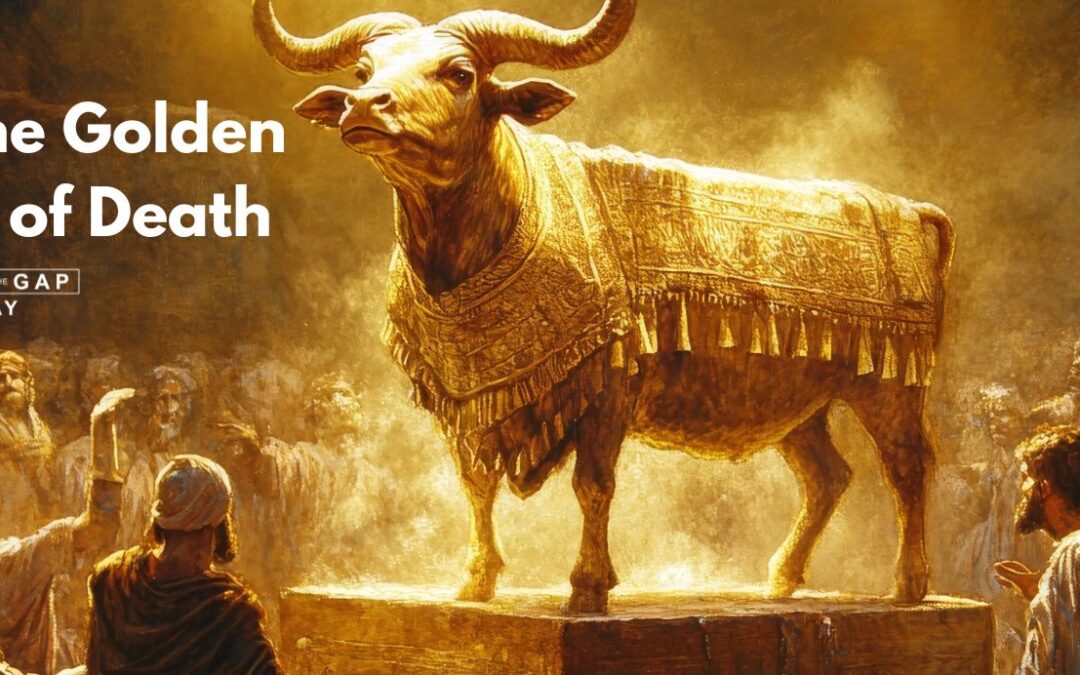

Idolatry: The Golden Handcuffs of Death
June 8, 2026
Host: Hon. Sam Rohrer
Guest: Dr. Renton Rathbun
Note: This transcript is taken from a Stand in the Gap Today program aired on 6/8/26. To listen to the podcast, click HERE.
Disclaimer: While reasonable efforts have been made to provide an accurate transcription, the following is a representation of a mechanical transcription and as such, may not be a word for word transcript. Please listen to the audio version for any questions concerning the following dialogue.
Sam Rohrer:
Hello and welcome to this Monday edition of Stand and the Gap Today. And it’s also our monthly focus on apologetics, biblical worldview and education with Dr. Renton Rathbun, regular speaker for BJU Press on issues related to biblical worldview. Now, in addition to that, he’s also a pastor and he’s been a college professor for over 20 years on both Christian and secular institutions. In addition to that, he also serves as a consultant to BJU Press, the largest and most biblically focused provider of biblical worldview centered Christian K-12 curriculum. I had to put all those words in there because they’re all important, but you got the idea. I’m glad to have him back with me today. While there are many places that I could go today regarding commentary on headline news, which is what I try to do on these programs, on very big place it could go is they could go right to the Middle East, which we often do where war is exploding again, but I’m not going to go there.
I’m going to go instead to what should be a leading headline in America today and throughout the world, but it is not and you’re not going to see it as one. Our focus today will emphasize what is not and won’t be emphasized, but should be an incessant warning, a clarion wakeup call starting first in the pulpits of America, but then demonstrated by every person in political office lived out by every business owner by every parent and by every citizen as declared by God himself through history. And what is that warning? What does that headline use that ought to be there? Well, it’s the message that should be proclaimed from the walls of the city by the watchmen. It’s the warning against idolatry, the incestuous relationship of man’s heart and life with anything other than the word of God, the will of God and the way of God.
It is the rampant evil in the Old Testament seen in the rebellious heart of Cain, the defiant world at the tower of Babel, the fornicators before the golden calf, or the fawning false prophets in the groves of Baal. It’s the siren attractions of anything other than God as described in the New Testament. It’s the strategy of Satan identified in the writings of John Bunyan, the sermons of George Whitefield, Charles Spurgeon, D.L. Moody and Billy Sunday, all of whom cried out in their day against the enslavement of idolatry, which presented itself in the enticing form of, well, most of the time, many times, prosperity and wealth. In the end, Jesus makes it clear in Revelation 21: eight and 22:15 that the costly nature of idolatry and the commensurate point of no return ends in the eternal separation of the soul from God because there in those verses it says, “No idolater will have a place in the new heaven and new earth, the new Jerusalem.” The title I’ve chosen to frame today’s serious focus chosen in part from a sermon referenced by Charles Spurgeon is this, “Idolatry, the golden handcuffs of death.” And with that, welcome to the program Renton, Rathbun.
Thanks for being back with me.
Renton Rathbun:
Oh, thanks for having me for this important topic.
Sam Rohrer:
Renton, in this segment, let’s get going here with how the word of God defines. Let’s go to definition. How does the word of God define idolatry? What is it? And if there’s a difference between the understanding of what it is in the Old Testament and the New Testament, also make that clear.
Renton Rathbun:
Well, it all begins I think in Genesis three where it’s illustrated, but let’s start at Exodus 20: two through six where we have a commandment that lays it out pretty clearly for us. Verse two begins, “I am the Lord your God who brought you out of the land of Egypt, out of the house of slavery, you shall have no other gods before me. ” So already you see in that very clear statement, anything other than that is going to be idolatry. So no other gods. You can’t have some gods, you can’t have just one other thing, it’s nothing else. And if you’re unsure about what extent that is, verse four says, “You shall not make for yourself a carved image or any likeness of anything that is in heaven above or an earth beneath or that is in the water under the earth.” And then he goes into this, “You shall not bow down to them, you should not serve them.
For I, the Lord your God, I’m a jealous God.” He actually gives you a characteristic of himself to demonstrate how evil this is. He says, “This goes against my character that you would do this. So I will visit the sins of the fathers on the children, the third and fourth generation of those that hate me. ” So now we see idolatry is a way of demonstrating hatred for God, but he is a good God who will show steadfast love to thousands, and this is referring to generations, thousands of generations of those that love me and keep my commandments. So when we see, what I want you to understand as we start out is we are talking about governance, how God governs his world and governs us and he says, “Do not try and choose or go to another governor.” Genesis three talks about how the serpent challenges the governance.
The serpent says in the garden, he challenged the governance of the garden itself by saying, “Did God actually say thou shalt not eat of any tree in the garden?” And then so she says, “No, it’s just this tree.” And he says, then the serpent says, then he questions the rationale of the governance, you will not surely die and even says there’s a better governance out there. For God knows that if you eat of it, your eyes will be open and you’ll be like him knowing good and evil. And so you have this sense that this idea of who’s going to govern me has this sense of, if I am displeased with that, if I am ungrateful for that, I will then move toward a different governor. And in Romans 1:24- 25 demonstrates this as well. Therefore, God gave them up to the less of the heart, to impurity, to the dishonoring of their bodies among themselves because they exchange a truth about God for a lie and worshiped and served the creator rather than the creature rather than the creator.
So I want to give you a definition that will help us start out our conversation on this whole thing that really when we’re talking about old and New Testament forms of idolatry, it really does in its essence ends up being the same thing comes down to, am I grateful for the governance of my creator? So a definition of idolatry is this. Idolatry is placing one’s hope in a created governor while rejecting the creator’s governance. And if we think about that as our conversation moves forward, I think we’ll have a good understanding of idolatry.
Sam Rohrer:
All right. Excellent, Dr. Renton Rathbun. Excellent. Ladies and gentlemen, if you’re just joining us, our theme today is this idolatry, the golden handcuffs of death. And with that imagery, we’ll get some ideas of how we’ll work into it because idolatry is one of those things that will it besets us all, it’s deathly, it looks good oftentimes, but it’s not. The price is high. We’ll talk about those things when we come back. If you’re just joining us, welcome aboard. This is Stand to End The Gap Today. My special guest today once a month generally here with me is Dr. Renton Rathbun. He has a program that he does called the Renton Rathbun Show. It designed from an educational perspective, Christian educational perspective to help parents walk through the various challenges that are coming before all children who are in any form of education today because they’re being assaulted from all sides.
One of the realities of life that assaults people in all ages is this matter we’re talking about today, which we rented and I thought bore some, what I say, the justification, the reason for detailing a bit more, and that’s this matter of idolatry. So to give you an idea of where we’re going, we defined it in the last segment. We’re going to illustrate and explain it a little bit more in this segment. In the third segment, we’re going to talk about the consequences. They’re all deadly, by the way. And then the last segment we’ll talk about, is there a prescription against an antidote, antidote for idolatry? We’ll talk about those things. So give you an idea of where we’re headed. But throughout scripture, there are many examples of physical idols, because that’s generally where our minds go. The tower of Babel was a large idol.
The golden calf, the statues of Baal or Astros, but that’s only where idols are frankly indisputable because nobody can really dispute that, but idolatry goes much deeper than that. It’s far more sinister. John Bunyan compared idolatry in his pilgrim’s progress book to his vanity fair. He allegorized it and gave a picture of it where he had a year round bizarre where everything from houses, lands and honors to the souls of men he said were bought and sold describing this matter of idolatry. George Whitfield identified idolatry in his sermons and the profile of the “the moral person but who lacked true spiritual life.” And he compared that person to the self-righteous moralist and the idolatry he compared that to. All right Charles Spurgeon, Prince of preachers, illustrated idolatry in his day and called out prosperity, one big one, but he also called out one a prevalent form he said that was in his day.
He called it household darlings, household darlings. What do you mean by that? That’s what he said was happening in that generation when parents were actually turning their children into as what he described “as little deities.” And he was warning parents then against overindulgence with their children, idolatry. Billy Sunday then railed from the pulpit and warned that idols always start by something offering incredible results, an incredible thing for a very small price only to escalate their demands and he would mock what he called the swell-headed, or as we may say today, the fat-headed intellectuals were the wealthy tycoons who in their pride would speak of their lack of need for anything. All right, you get the idea. So Renton, finding examples of idolatry has never been hard to do, though its exact form may change from era to era, it remains very much the same. Would you take some minutes now and explain the enticing nature of idolatry?
What makes it so enticing?
Renton Rathbun:
Well, if we remember from our definition, idolatry is placing one’s hope in a created governor and as you just named some governors that people put their hope in, whether it’s their own children, whether it’s in prosperity, whatever it is, intellectual endeavors, anything that will govern their lives in a way that they can put their hope in. Now to do that, you have to reject the creator’s governance. He said, “There’s already a way that I have said things ought to be, and we have become dissatisfied with that. ” What makes it so enticing really comes if you read James 1:14 and 15, it talks about temptation. So it says this, “But each person is tempted when he is lured and enticed by his own desire. Then desire when it has conceived, gives birth to sin and sin when it’s fully grown brings forth death.” Think of that in terms of idolatry.
Idolatry begins when we are lured and enticed by our own dissatisfaction. It’s the dissatisfaction of the governing of our Lord who governs all things, Isaiah 45:7. Then dissatisfaction when it’s conceived gives birth to this longing. It’s a longing for a new governor, something else that we can turn to other than the governor and this longing and a longing when it is fully grown, brings forth a hope in something other than our God. It’s this new thing. And if you see that it’s talked about in the Old Testament in a sensual way because it’s so tempting. Hosea, idolatry is portrayed as an unfaithful wife and Jeremiah repeatedly the Judea is repeatedly accused of spiritual adultery. In Ezekiel, you see all these relational type models of how idolatry is played out and what it comes down to is idolatry is enticing because it suggests a pathway forward for you to indulge in your sin while attempting to maintain a clear conscience because the God you created will allow you to do it.
Sam Rohrer:
Okay, excellent. Let’s move from that into this. Illustrate now the pervasive nature of idolatry, let’s be very practical in America today and perhaps identify where and how idolatry in America today may differentiate itself, perhaps that the nation is large and maybe the same thing and within the church. Is it possible that there could be idolaters within the church?
Renton Rathbun:
Yeah. So we have all kinds of examples of idolatry. You look at abortion and how many babies we kill every year despite what happened with the Supreme Court, despite that all these conservative, quote unquote, conservative legislatures now have the ability to do something and they won’t, we still have tons of abortion happening. And you look back at Ezekiel, Ezekiel 16:20- 21 where it’s actually talking about idolatry and says, “You took your sons and your daughters whom you had born to me and these you sacrificed to them to be devoured. Were you horroring so small a matter that you slaughtered my children and delivered them up as an offering by fire to them.” And this is speaking of Malach, the God, one of the adulterous gods they worshiped that would demand a baby being burned alive. It’s still happening today. This Malach now takes the form of freedom of my body and my rights to do what I will.
You have CRT, this worship of the skin. You have race realism, worship of white skin. And what you have in James chapter two, verse one, “Warning us, my brother, show no partiality as you hold the faith in your Lord Jesus Christ, the Lord of glory.” This idea that we keep rejecting the governor that says, “Do not be partial. We want to worship something other than the governor, the one who governs all things. We don’t want to give him glory. We want to give our skin glory, or we want to give something that makes us unique glory.” The same thing is with the LGBTQ community, where Romans one is telling us, for this reason, God gave them up to dishonorable passions for their women exchange natural relations for those that are contrary to nature and the men likewise gave up natural relations with women and were consumed with passion for one another, men committing shameless acts with men and receiving in themselves the due penalty of their error.
And what we see over and over is that these desires become focused on a way or a God or something that will govern them away from the true governor so that they can indulge their sins and have some kind of a clear conscience because God built that in us. And sadly, this all comes and this is probably going to be controversial, but I say this all comes by permission of the church because all of this started with the church accepting many, many idols of the world into its own, starting with feminism. And so with feminism came this desire that we are not so strange. We’re like you. We don’t see a big difference in the roles. And we started to be embarrassed about the roles that were ordained by God between the husband and the wife and what’s happening in the home. We began despising those verses in Ephesians that told us there were roles that were divinely ordained for the woman, the roles that were divinely ordained for the man.
We began to despise one Timothy two that said there’s roles for men and women are forbidden to have authority over men in the church. And we thought that was demeaning to women because we didn’t like the way the governor was telling us to govern our church and our home. And so we gave in to the feminism of the day and said, “No, we’ll get rid of those roles.” Well here’s the thing, and let me be clear about this, Go made our bodies for those roles. And so if you ignore those roles, you’re ignoring the body and it’s no wonder we are here today in the chaos of this world that has made our bodies an
Sam Rohrer:
Idol. Ladies and gentlemen, idolatry. Are you an idolater? Am I an idolater? We fight it. We must. Is America an idolatrous nation? Well, by definition, well, hard to say we’re not, right? Next segment, we’re going to talk about the consequences. What are the consequences of embracing idolatry in any form? Renton, as we go into the next segment, before we get into consequences of idolatry, and I’ll say front ladies and gentlemen, there are no good consequences to idolatry. In your definition, Renton, you’ve positioned the concept of idolatry as being anything that would be other than the governance of our creator and you kind of put it in that context and you said governance, which is authority by definition. So we put that in there. But I want you to make a connection here because some would say, “Well, if idolatry could be my children, or if idolatry could be my wealth or prosperity, or if idolatry is or could be anything else, where does worship come into this?
” Could you make that clarification there and explain that part of it and why God views anything other than himself idolatry and any form to be so reprehensible?
Renton Rathbun:
Well, what we find in Ephesians chapter five is that we are to be imitators of God as beloved children and walk in love as Christ loved us and gave himself up for us as a fragrant aroma. Now that’s a tough thing to do and this is speaking to the church. This is how the church is to act. They are to be imitators of God. Well, that seems really hard. How are we supposed to do that? There’s actually, and we’re going to talk about this in the last segment, there’s actually a pathway to do that and that is being filled with the spirit, verse 18 of chapter five, “Do not get drunk with wine for that is the butchery, but be filled with the spirit.” And so that is the means by which we are able to imitate God in our churches in worship, because this is what it will lead to.
It will lead to addressing one another. These are the three participles that are the result of being filled with the spirit, addressing. So that’s the first participle. Addressing one another in Psalms, hymns, and spiritual songs, singing and making melody to the Lord with our heart. The next participle, giving, giving thanks always for everything to God, the Father in the name of the Lord Jesus Christ. And here’s the third participle submitting to one another, and that is laid out for the next verses in that chapter and into the next chapter of wife submitting to the husband, the child submitting to the parents and the servants submitting to the master and all that submission work is all part of the, how do we do this governance of our churches? It goes all the way back home. And so this is our command, imitate God by being filled with the spirit.
Anything else is adultery or idolatry, which is this is anathema to our God because the only way to him is through his son and the only way to imitate him is through the power of his spirit. And so there is nothing else out there for us other than obedience.
Sam Rohrer:
Okay. Right. And you can build it out a little bit more because I think people may be listening say, “Well, I can see falling down in front of a altar, a Baal.” I can in my mind’s eye see the people gathered around the tower of Babel and raising our fists and obviously pursuing something because we can see it, but they say, “Do I worship my children? Of course I don’t worship my children. Do I worship my bank account?” No, no, no, no. It’s important to me, but I don’t worship it. I want you to build that a little bit to make that connection, but let’s go into the consequences of it because ladies and gentlemen, throughout scripture, God warns repeatedly of the consequences of idolatry we’re talking about that temporal and certainly eternal, personal and national. The pursuit of idolatry is recompensed and manifests itself in the lives of nations and kingdoms in the here and now in eternal in the life of the soul.
Now that’s what the Bible says. And while the consequences, as I’m saying, are many, none of them are good, which is why it is so important. Renton from the pages of scripture, what does God say are the consequences of idolatry for the individual and work that into it for the nation as well and build into some of that worship part of it if you can.
Renton Rathbun:
So in Isaiah 44:16- 20, we see Isaiah almost mocking how strange it is for someone to turn their desires to be governed by the Lord, to be governed by some little block of wood. And so he talks about how in 16, the guy is using wood for fire to warm himself and to feed himself. Then he uses some of it to make an idol and then he bows down and says, “Deliver me for you are my God.” And still, later on, he’s probably going to burn it because it’s just a block of wood. And we look at that and we just think, “This is so strange.” Well, there’s a reason why idolatry is so irrational. Romans 1:21- 23 tells us the consequences of idolatry, for although they knew God, they did not honor him as God or give thanks to him, but they became futile in their thinking and their foolish hearts were darkened, claiming to be wise they became fools and exchanged the glory of the immortal God for images resembling mortal man and birds and animals and creeping things.
And this goes to your question about, well, I don’t bow down to a bird or a creeping thing This is the foundation of bowing down to birds, animals and creeping things and a block of wood. The foundation is although they knew God, they did not honor him or give thanks, that’s what led to the futile thinking and the futile thinking is always going to be extremely irrational and crazy and people are going to wonder, how did we get here? It’s because the consequences to rejecting your God by not giving him thanks or honor. And then think about that. When I put other things before God, what am I really saying? I am saying I am unthankful. I do not want to give God honor. I want to give something else honor. I want to give something else thanks. And that’s why that’s what leads to this kind of punishment, which is your heart becomes darkened.
You become foolish in your thinking because you are actually breaking from the reality of who your governor is. Ephesians 4:17- 20 talks about the same thing. It says, “Now, this I say and testify to the Lord that you must no longer walk as the Gentiles do in the futility of their minds, they are, ” and here’s the same Greek word there, darkened in their understanding, alienated from the life of God because of the ignorance that is in them due to their hardness of heart. They have become callous and have given themselves up to sensuality, greedy to practice every kind of impurity, but that is not the way you learned Christ. And so what we see here is this punishment comes from a heart issue. So it doesn’t start with bowing down to a piece of wood. It starts with a heart issue before God saying, “I don’t trust you.
I want to trust something else.” Then you start getting to the craziness because that’s part of the judgment.
Sam Rohrer:
All right, there’s some time left. So consequences a person individually we can embrace, we have to either choose to worship God or we choose using the governance phrase, who’s an authority, we put something or someone else in authority, which means we follow what that says or who it is or what it promises, could be wealth, it could be whatever, more than what God says. So there is a recompense in this life, is there not and then quickly nationally I mean, what does the Bible say about nations that embrace idolatry and reject God?
Renton Rathbun:
Gave before our speaking to mankind itself. Now imagine an entire nation made up of people who have rejected God or at the very least have constructed a quasi-Christian God into their own image that he might be more palatable for their worship. I mean, if anything describes America best, it’s a group of people that like parts of our Christian God from the Bible, but not all of them. And so they take some parts of it that suits them, rejecting other parts that do not suit them. And this is another kind of idolatry. In other words, if you can imagine an entire nation that’s composed mostly of these kind of idol worshipers, you would have a nation in absolute chaos. You would have a nation that would dictate an entire … They would dedicate an entire months to this twisted sexuality of transgenderism and homosexuality. You would have a woman on the Supreme Court that would not be able to define what a woman is.
You would have men dressing up like women to compete in women’s sports. You would have an entire denomination like the PCUSA that recently decided the only requirement they will make for their pastors is that they are in a monogamous relationship, not whether or not they are the marriage between a man and a woman. You would have Southern Baptists still arguing whether or not you should have a woman ordained as a minister. You would have so much chaos saturating every piece of media that is grooming our children to accept the idols of this world. The social media would be grooming Gen Z women to be atheistic liberals and you would have all this corruption because this is all blindness that is a judgment upon our nation. They are not confused because they are dumb. They are confused because their minds have been judged.
Sam Rohrer:
Excellent, Renton. And ladies and gentlemen, as someone who’s been in office before, I will also say anybody who stands up and says, vote for me because I will make all things good. I will bring a golden age. I will bring prosperity and my policies can guarantee it. Anybody who stands and talks like that is exactly what we’re referring to here. It is across the spectrum of life. Well, before we go into our final segment here again, my guest is Dr. Renton Rathbun. One website that he has, I’ll give it again, rentonrathbun.com. It’s where you can find the podcast that he does, which are basically taking various challenges that are rampant in our culture today where biblical worldview through various things. It could be from policies to narratives that are put out there publicly to things that could be in the law, could be whatever, that are bringing challenges to a biblical worldview that are confronting our children.
And it’s in that context that he deals with things that’s really geared for parents and for grandchildren, for parents and grandparents rather who have children that would be in the educational system. Very good, but you can find things there that I think may be of interest. I’ll give that to you and to say, as well as we get into conclusion here on this program today, Idolatry: The Golden Handcuffs of Death, which is what I’ve entitled it. I want to reference back to the fact that last month we did a program on sinless temptation. That was the whole aspect of the release of Sam Alberry and his position on thinking that lusting after a man, as an example, is not a sin unless you act upon it. That was last month’s program. You can find it by going to our website and looking for it. But back in November, November 17th to be exact of last year, Renton and I did a program on this matter of idolatry, but from more of a preventative perspective and we entitled that program, Gratitude, the Antidote to Idolatry.
We’re going to talk about that in the conclusion part of today’s program, but listening to these programs together will help to give a more full understanding of, this matter what idolatry is or the cause of it and all of those kinds of things, because it’s not possible to deal with it comprehensively in the one hour program. So I give that to you and would encourage you to go and link them together. Now, that being the case, it’s this matter of the prescription for idolatry, putting it in a medical term. If idolatry is a sin and evil, it’s a sick position caused by sin, let’s put it that way. An antidote, is there one? Well, that’s the concluding part of this program. Now Renton, in my title for the program, I’ve already given it, golden handcuffs of death being idolatry. The concept came from a sermon or some sermons by Charles Spurgeon who identifying the idolatry of his day as he looked across the city of London, which was in the heyday of the British Empire, he saw the captivating idol of prosperity, a nation and a city that was just thriving and he said idolatry.
He saw idolatry and he compared it to a golden handcuff or golden handcuffs and how people were being fooled into being willing to be captured by shiny golden handcuffs. But the same people would scream in agony if the handcuffs were made of rusty iron and just demonstrating how idolatry can become something that controls and has very costly consequences, but if it is shiny enough, we’re okay. To me, that was a great illustration, but taking his illustration or anything else you want to refer to and anything else we’ve talked about in the program today, what is the prescription for idolatry and then speak to the antidote for, you’ve already been talking about a little bit, but the vaccine, so to speak, of idolatry.
Renton Rathbun:
So one thing that I think will help bring all of this together really comes down to, and I think it’ll come back to that question you had of no one would say that they’re just falling down before a piece of wood or an actual idol or something like that. They just might concentrate too much on their kids or their money or whatever and is that idolatry? So I’ll put it this way. Psalm 121: one and two says this, “I lift up my eyes to the hills from where does my help come?” Now you have to understand when you’re in war or you’re looking up at the hills, you’re in trouble because being on higher ground is the place of real advantage, but he’s in a place of disadvantage. He’s in a place where he’s looking up at the hills and so the enemy is on the hills.
Where does my help come from? Verse two, “My help comes from the Lord who made heaven and earth. In the end, what we’re talking about is where am I putting my hope?” I mean, that is at the heart of this Psalm. Where do I put my hope when I know that I’m surrounded by the enemy? We live at a time where you are surrounded by the enemy. This is war and idolatry begins when I decide my hope is in my child. My hope is in my money. My hope is in my comfort. My hope is in my race. My hope is in my marriage. My hope is in my sexuality. My hope is in my acceptability to the world, or my hope is in a politician, or my hope is in a political movement. Whatever it is, real idolatry, going back to our definition, idolatry is placing one’s hope in a created governor while rejecting the creator’s governance.
Once I put my hope into anything other than the Lord, even if it’s in my own child or my money, a complete different set of rules go with that person or thing that you put your hope in that are going to contradict the creator’s governance. It always happens. This is at the heart of the prescription of this whole thing. The prescription of idolatry comes down to this. Romans 1:21- 23, “For although they knew God, they did not honor him as God or give thanks.” And so here we are reminded again at the heart of idolatry is a lack of gratitude and honor to the one that is governing all things, the creator of heaven and earth. And that is why we are punished with having our feudal hearts darkened
Sam Rohrer:
And
Renton Rathbun:
Our futile thinking. The antidote of all this comes down to that very question that you asked just a minute ago, which is, what is the thing that’s going to be controlling us? Am I going to be controlled by an idol or am I going to be controlled by something else? The command in Ephesians 4:17, like I said before, is do not walk as the Gentiles do, but how do I keep from walking as the Gentiles do and be idle worshipers like the Gentiles? Well, Ephesians five: one and two, just down the road a little bit, therefore be imitators of God as beloved children. Well, what would that do? Well, it make you walk in love as Christ loved us and gave himself up for us as a fragrant offering and sacrifice to God. That’s what will happen.
But by what power do we have for this? Where does this power come from? Well, don’t be controlled by wine. Don’t be controlled by getting drunk because that’s debauchery, verse 18. But be filled with the spirit, be controlled by the spirit. That’s how we obtain this power to be able to be loyal and loving to our God and thankful to our God. And this gives a result. If you are filled with the spirit, verse 20, this will cause you to give thanks always for everything to God, and that is how we will find an antidote to all of this.
Sam Rohrer:
And with that, Dr. Renton Rathbun, thank you so much. We’re right at the end of the program. Thanks for being with me today. What a topic and we have just really touched on it. Ladies and gentlemen, I hope that some things have been shared at least to make us all wonder and to think and go to God’s word and say, are we worshiping, finding hope, finding satisfaction in anything else other than obedience to the will of God, the word of God and the way of God? What a question.

Recent Comments