
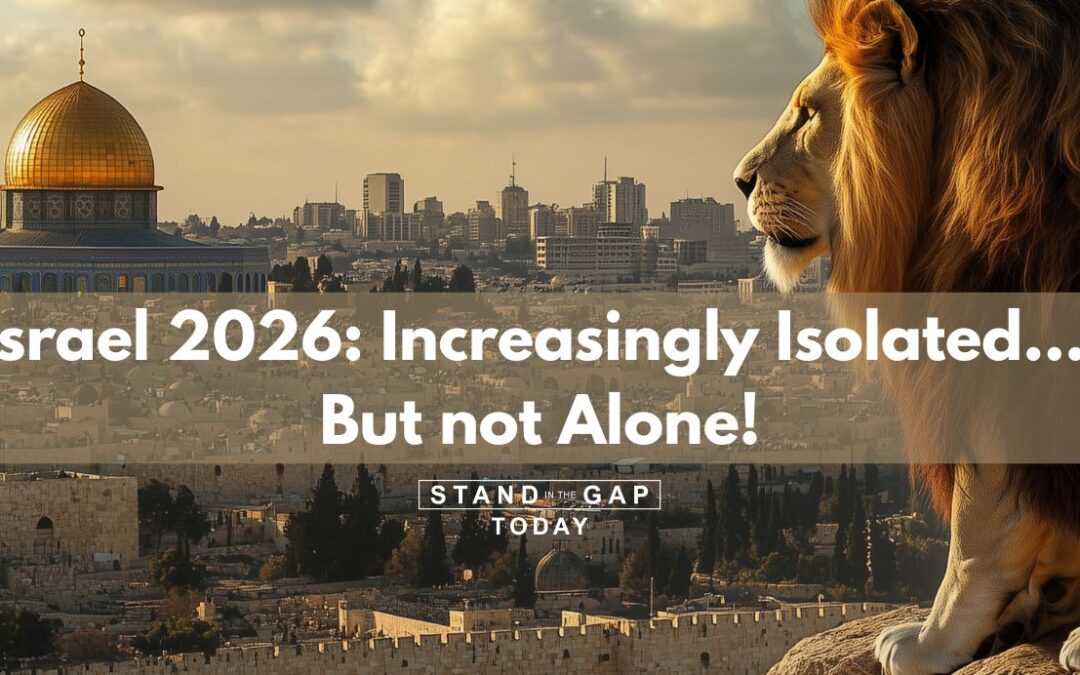

Israel 2026 Increasingly Isolated…But Not Alone!
June 22, 2026
Host: Hon. Sam Rohrer
Guest: Bill Koenig
Note: This transcript is taken from a Stand in the Gap Today program aired on 6/22/26. To listen to the podcast, click HERE.
Disclaimer: While reasonable efforts have been made to provide an accurate transcription, the following is a representation of a mechanical transcription and as such, may not be a word for word transcript. Please listen to the audio version for any questions concerning the following dialogue.
Sam Rohrer:
Hello and welcome to this Monday edition of Stand in the Gap today. Over the weekend, like almost every weekend it seems we’ve talked much about it, how things happen like this, but events occurred this weekend as well that continue to shape the world. Happens on the weekend when most people aren’t looking around as much as they normally are during the week, but in particular there’s a series of, I’m going to say choreographed type events because things just don’t happen by accident in the realm of politics and public events. But there were events that happened that reshaped and it is reshaping the global landscape. And at the center of all of that is the widening fallout from the Trump Iran memorandum of understanding, the Trump deal, the Iran deal that’s referred to, a deal that’s fundamentally altered the US and Israel relationship. In my words and my thinking triggering intense bipartisan opposition in Washington and it’s leading to a high stakes last minute postponement, which happened over the weekend and then a resumption of a very tense diplomatic mission to Switzerland involving Jared Kushner, Middle East envoy Steve Witkoff and Vice President Vance and all that was hanging under the umbrella of a renewed threat by the president to begin bombing Iran again.
Now coupled with unprecedented Ukrainian drone strikes on oil refineries in Moscow, that happened over the weekend too. The world’s sitting on a powder keg, but I’m not going to go to Moscow or the Ukraine. We’re going to go right here on Israel. Focus on the Israel component and the unfolding consequences of the very controversial Iran deal and the related startling comments from the Trump administration, and I’m going to play a couple of those in just a moment. But joining me for a very frank discussion is Middle East expert, author of the book Eye to Eye, and we’re going to talk about that in the third segment and founder of World Watch Daily and he is a White House correspondent and has been for a long time, Bill Koenig. He has a website at watch.org. I’ll give that again for all the latest news that is happening in the Middle East.
But our focus for today’s conversation is this. Israel 2026 increasingly isolated but not alone. And we’ll build that out as we get into it. But Bill, thank you so much for being with me today. It’s always so good to have you on the program.
Bill Koenig:
Thank you, Sam. Great to be with you as always.
Sam Rohrer:
Bill, the global spotlight has been obviously locked on the Middle East since I’m going to say the Hamas attack two and a half years ago. Hard to believe it’s been that long ago, but it is. It’s continued to heighten in my opinion since then, but it seems to have been placed on steroids since the joint US-Israel strikes against Iran back on February 28. And then after 39 public promises, not 39 was what it was added up to at that point, but after 39 public promises from that February 28 date, President Trump made definitive peace deals saying there was just 48 or 28 hours away. We finally get to the MOU, but that may be fracturing also. Now in the single week, Bill, before it was announced, a massive rift tended to open up between the Trump administration, actually the president himself and Prime Minister Netanyahu.
And in my view, recent statements from both the President and Vice President Vance are actively fueling a dangerous isolation of Israel. At least it’s precipitating that, not just globally, but I think right here at home, prophetic implications of this shift I think are profound and that’s where I’d like to go today. But in order to set this up a little bit upon which I want to get some comments from you, I’d like to just to play the one clip in particular from Donald Trump where he said and declared that Israel would not exist without the United States and specifically without him. And then ladies and gentlemen, so listen to this. I played it last week on a program. I’m going to play it again because that was a real trigger statement and then a second one occurring after it, a short just a minute clip from Vice President JD Vance delivering a parallel warning to Israel basically to get in line and accept the terms of the Trump deal.
So Tim, if you would play those, we’ll play them back to back. First the president and then a second statement then by JD Vance.
Donald Trump:
Without us, without the United States, there would be no Israel. Without me, there would be no Israel because no other president was willing to do what I did.
J.D. Vance:
What I will say, and this does bother me, is that you have seen people within Bibi’s cabinet who have come out and attacked the deal and in some ways very personally attacked the president of the United States. And I guess my message to them would be twofold. Number one, Donald J. Trump is the only head of state in the entire world who is sympathetic to the nation of Israel at this moment in time and he happens to be the head of state of the world’s superpower. If I was in the cabinet of the Israeli government, I might not be attacking the only powerful ally that I have anywhere left in the entire world. And the second message I would give to some of those cabinet members, Bibi, to his credit, has not gone down this path, but to some of these cabinet members in Israel who are attacking the President of the United States, the other thing that I would say is that over the last three months, two thirds of the defensive weapons that have protected your homeland have been built by American hands and paid for by American tax dollars.
The problem for Israel is not Donald J. Trump and anybody in Israel who thinks their biggest problem is the president of the United States needs to wake up and smell the reality of the situation that country is in.
Sam Rohrer:
All right, Bill, you’ve heard those before, but what are your thoughts? To me, they’re clearly linked, but how do you think that that is if you do fueling a broader alienation of a rift between Israel and the United States, between the prime minister and the president, but it’s doing something. What are your thoughts?
Bill Koenig:
Well, a couple of things here. President Trump is, I say this all the time, Sam, many times in your program that President Trump has done more for Israel than all our presidents combined. It’s just moving the embassy from Tel Aviv to Jerusalem, getting out of the original Obama nuclear deal, sovereignty over the Golden Heights Israel’s right to have settlement communities in Jude and Samaria. Great things, but the bottom line is a key component of the MOU is the fact that Israel must move out of Lebanon. In other words, that empowers Hezbollah. That’s Israel’s greatest concern is the fact that the Iranians are emphasizing that Israel must leave Lebanon to be part of the deal. Matter of fact, it’s right behind the nuclear. The nuclear number one negotiation is the number two, even with this administration. Number two is Israel moving out of Lebanon, which would be crazy.
It’s just like living in Maryland and Virginia and continuing to take drones and rockets from an enemy landing in Washington DC. What’s Washington DC going to do? They are not going to allow that to happen, Sam. And the other thing is J.D. Vance, unfortunately this is part of that part of the … We can hit after break, but that part of the White House, we’ve got to keep it going to continue to pray that they will understand biblically and significantly
How Israel stands. All
Sam Rohrer:
Right, Bill Koenig, thank you for everything so far. Ladies and gentlemen, stay with us. Bill Koenig, White House correspondent and founder of watch.org is with me today. Our theme is Israel 2026 increasingly isolated but not alone. And we’re talking about now in the next segment consequences inside Israel, inside America as a result of these fallout and all of that from the Iran deal. Well, if you’re just joining us, Bill Koenig and I, Bill is a former and currently actually as White House correspondent. He’s authored a book Eye to Eye. We’ve talked about it before. We’ll talk about that again in relationship to some of what’s happening seemingly between the relationship of the United States and Israel, between our president and the prime minister in particular of Israel. And that’ll be in the next segment. But Bill also has a website watch.org where you can go.
You’ll find the latest news events, mostly dealing with the Middle East, Israel and that. So just call that attention to you. But in that regard, there are biblical truths as we know. We talk about it all the time, but whatever is in the word of God does not change because it’s truth. But there is an unchanging biblical truth, a couple of them that actually govern the rise and fall of nations. And we talked about that last Friday on a program, Dr. Carl Broggi and I did. But in the word of God, God’s plan leaves us and leaves nations only two paths, two choices. In Deuteronomy chapter 30 and verse 19, God presents a clear condition for national blessing. Now it said, “I call heaven and earth as witnesses today against you that I have set before you life and death blessing and cursing. Therefore, choose life that both you and your descendants may live.” Now that as we talked on that program, that was part of the Mosaic covenant.
That promise given by God was to Israel, but as to any nation that would believe in God and fear God, but choosing life in that context that brings blessing means fearing God and walking in obedience to God’s commands. God laid down though another critical marker through his unconditional covenant with Abraham, Isaac and Jacob, where he said, “Bless Israel and you’ll be blessed, curse Israel and you’ll be cursed.” And that was to the Gentile nations, but that was a promise to them. And both of those that I just gave, eternal principles, they carry an absolute warning, choices have consequences. And as the geopolitical landscape shifts and it is shifting, nations including America and including Israel must be exceedingly careful to align their choices, their statements with the standards defined by God. I’m going to lay those two down as basic premise here. Bill, as a result of the Iran deal, and you may want to talk on a further because we don’t have much time in the last segment, but the president’s comments that Israel owes her existence to him and to America and the vice president’s threat, that’s how I took it, that Israel better fall into line because they get their money from us are all things that are putting things ahead of Israel and certainly their relationship to God.
Now here’s my question. To what extent is Israel as a consequence of these things, to what extent are they responding to those statements and perhaps increasingly looking to Hashem God, knowing that they can no longer rely on a person, a Donald Trump or a nation, America, or frankly anyone to defend or protect them.
Bill Koenig:
Well, Sam, I tell you, first of all, JD’s Vance’s comments are reprehensible. I mean, he doesn’t understand the significance. Two things. One, the natural significance of how much blessing that the United States receives when we give them equipment or F-15, 500 suggestions how to improve that. The F-35, they figured out a way to put fuel tanks inside the F-35 to give it greater distance. Bunker busting bombs are more effective because of Israeli technology. The Iron Dome, which was a joint venture between the United States and Israel, I mean, the benefit goes on and on and on and two thirds of that money or almost three-fourths of that money stays in the United States. So yes, the United States taxpayers are putting out three, three and a half billion a year for Israel, but the benefit that comes from that, plus the fact we have the greatest intelligence arm in the world, the Mossad that has kept many Americans from dying and has kept us all over the world.
I mean, the Massad has been such a great partner, that investment is minuscule compared to the blessing and the benefit that we get from that property or from that investment with Israel. Sam, we know that Genesis 12: three, the scriptures you’ve read here, the Genesis 12: three, those that bless Abraham, Isaac, and Jacob and their descendants, they will be blessed. And that means anybody that blesses Israel, the Jewish people. And if you curse them, you come against them, there will be consequences. And to even think that Israel only friend in the world may be true. I mean, there are a couple of small countries in the South Pacific that support Israel and South Korea, Brazil are very supportive, not necessarily the leadership, but the people of those countries is unbelievable. I mean, how can you come against Israel when Israel only wants to be left to be a productive nation?
Look what they have brought the world in terms of technology on and on and on. And for the United States, for the White House to come and say these scathing comments, there will be consequences and it’s just hard to comprehend, but I mean, Israel’s not the problem with the Middle East. It’s called Iran. That’s the biggest problem in the Middle East.
Sam Rohrer:
All right, let me follow up on that and just ask you, because you didn’t actually say it, I didn’t actually say it, but when I listen to those words, the president’s words, J.D. Vance’s words and words similar to that which says and implies just like what JD said, “We’ve given you all your money so you are indebted to us.” There is no concept of God in the middle of that. That’s kind of throwing something in over top of that where the presidents say, “You don’t exist without us.” To me, I look at that and I say, “Those are words of cursing, not blessing.” Do you interpret them that way? Because they’re serious. They seem to be.
Bill Koenig:
Exactly, Sam. And I tell you what the blessing that did come from this, Ambassador Mike Huckabee took it strong. He talked about Israel, the biblical right, the blessing that we get from Israel, the Jewish state, he really took it on strong. So for what President Trump and Vice President Vance said, Mike Huckabee hit it hard and just was so spot on. I don’t have the quote in front of me. And then yesterday he spoke at a conference, J&S conference in Jerusalem and he said, “I woke up the next morning to see if I’d been fired because President Trump has a tendency to fire people at night.” But he said, “I still have my job.” I guess.
Sam Rohrer:
I did. I did, Bill. I did see that I almost had it out to play it because he said it in a humorous sense, I’m still here so all’s good, he said, at the moment, but you know what? I agree with you. I thought his comments were so well balanced and they were true. They did not take a political spin to them. It was just a flat out recognition of what we’re just talking about. And to me, that part of understanding the role that the Bible plays, the promises that God plays with Israel, any politician, any person who does not understand and look at all that’s happening through that runs the risk of cursing Israel, I think.
Bill Koenig:
Absolutely. Again, Sam, like you, I was so proud of Ambassador Huckabee. He’s done such a great job how God has uniquely positioned him last year during the 12 day war and the influence over that big quick US hit on Iran and then just this week twice. He is standing with what the word of God says and he doesn’t care. Even his boss, the president of the United States, he tells it like it is biblically and prophetically and we got to keep praying for Ambassador Huckabee because he is doing a superb job biblically and prophetically.
Sam Rohrer:
We do indeed. I absolutely agree with you on that. One other question here is that consequence of these things that we’re talking about. All right. We talked about it from an Israel perspective, but are you finding a move within Israel? I mean, because I’ve heard some say it, but to say, “You know what? We’ve got to move more clearly, more purposely for our dependence upon God above Hashem, because all of this is proving that even though they may have a friend for a while, a president of the United States or America, it won’t be there necessarily when they really need it. ” Is that happening? You see that change happening?
Bill Koenig:
Yes, yes. And more and more and we’re hearing more of that in Israel and even Prime Minister Netanyahu even alluded to the fact that in another short year or two, we’ll be fully able to take care of herself. We won’t need any kind of aid from the United States or anywhere else in the world, that they are moving in that direction and also the Orthodox and the conservative Jews in Israel as well as commentators and people involved in the government fully understand that Israel has to do everything they can to be accountable only to the Lord, their Lord and continue to move in that direction and not become reliant upon anybody, even their best friend, which is the United States.
Sam Rohrer:
One minute you can have, Bill, before we go to the next break, there’s a very prophetic element to what we’re talking about in that and you see God’s hand at work as well, right? I mean, not clearly.
Bill Koenig:
No doubt about it, Sam. All our presidents have a prophetic role. President Trump’s prophetic role, first term, second term is accelerating final day events to the point that Israel will have to fully rely on their God for their covering protection and support the future.
Sam Rohrer:
Ladies and gentlemen, stay with us, we’re going into the next break. Bill Koenig is my guest today, White House correspondent and he’s the founder of watch.org where you can go for the most current events, the headline news items and so forth relative to Israel. But as a result of the Iran deal, the statements by the president, the statements by J.D. Vance make it very, very clear that things are changing American attitude toward Israel. But there’s another response and attitude I really want to talk to Bill about in the next segment and that is, what does God think about all this? And that’s going to tie into the book that Bill was led to right sometime called Eye to Eye. Stay with, I think you’ll enjoy it. All right, Bill, let’s continue in the conversation here. Consequences to the Iran deal, which is dominating everything being talked about relative to Israel.
It is shaping almost a reshaping perhaps political alignment out of the White House, particularly the president as an individual with the prime minister, Netanyahu as an individual and then nation to nation. The people are all over on what they think about it, but it seems in hardly any case, maybe except for Iran, believes that that deal is good for America or good for Israel. I want to talk to you about eye to eye and what God thinks about it, but just give me your thoughts overall if you don’t mind to the deal itself. What does the deal as we know it accomplish if anything for good, what do you think the deal is accomplishing not for good?
Bill Koenig:
Sam, the main thing is trying to get that straight if removes opened. 20% of the world’s oil goes through there. A large percentage of the urea that is used for fertilizer goes through there. There’s some chemicals that are extremely important to come from there. Liquid LNG, liquefied natural gas, Qatar is at 20% of the world’s daily use of LNG comes out of that area straight over moves. So the main thing is to help the economies get their oil, get their fertilizer, get the chemicals that they need to come from that region. That was number one because it was creating an inflationary problem here in the United States, but especially in a lot of ways, we’re self-reliant now on fertilizer. We get a little bit from Canada, but also oil and gas. We’re number one provider of that in the world now. So what happened to Sammy, you got Asia getting anywhere from 30 to 50 to 80% of their oil from the Middle East.
That was hurting them. Also, the countries in Europe get a fair amount of oil from the Middle East also from this area through the Strait of Hermus. And so that was the number one motive. The second thing Iran very effectively said, “Okay, if this war continues, we’re going to hit the desalinization plants in Kuwait and the United Arab Emirates and Doha or Qatar and also Saudi Arabia, which 75 to 85, 95% of their water comes from desalination.” So that was a big fear. The other thing is Iran threatened to hit the refineries, further hits on their refineries, which also would affect the amount of oil they got through the Persian Gulf and Strait of Ramus. So those were the two main components. Unfortunately, Trump didn’t do anything about the missile. That’s just hadn’t been talked about stopping missile development. The focus has been on two things primarily is number one is that Iran will not become a nuclear power and supposedly that uranium is so buried there, probably couldn’t get to it anyhow.
Number two is, as we said earlier in the program, getting Israel out of Lebanon. So Hezbollah could continue to grow and become a bigger burden and a bigger problem down the road. And the other thing is the release of a tremendous amount of money. I mean, we understand the Emirates already gave Iran $3 billion. We’re going to possibly give him up to 20 billion. Also, I think we were hearing anywhere from 50 to 75 billion that was frozen Iranian assets were going to be released and even the real estate guys, Kushner and Witkoff were going to come up with a $300 billion redevelopment plan for Iran with SUNY governments or SUNY nations that are on the Persian Gulf and all of the United States. So it’s all over the place. A lot of
Sam Rohrer:
Promises.
So obviously it’s very, very clearly apparent that there’s nothing really binding yet when the president says we may start bombing you again. All of this to me seems extraordinary nebulous. There’s nothing binding about it and it certainly does not make Israel pleased. I don’t know of anybody else that makes pleased either because it’s almost not enforceable. But that being the case, let’s swing back just for time perspective because there are consequences of that, which strengthens Iran. It limits Israel really because of Lebanon, a number of things that are taking place and then the comments by the president, the comments by J.D. Vance official. These are the highest official words from American government. So it’s no small deal. Right. You talked about a little bit of response from Israel. What about God’s perspective? We talk about cursing and blessing. You wrote the book eye to eye.
Take just a couple minutes. Why did you write that book? What’s it about? And then tie it into how you believe perhaps what’s in the deal and the comments by the president and the vice president equates to perhaps a trigger for divine response.
Bill Koenig:
A couple things here, Sam. I documented eye to eye, 126 plus events. Well, we apply pressure on Israel to divide their covenant land. We have enormous catastrophes the same day or within 24 hours and that’s 126 in eye to eye, and we’ve had another 40 since then, which are posted at our website, watch.org. Also, another concern that we had too, Tanya and I have been writing about the concern of throwing open the doors of America to Islam. When President Trump, May 13 through 16 was in Doha, Abu Dhabi and Riyadh last year, he was talking about these trillions of dollars of money that was going to come from the Middle East into the United States. My concern, again, Tanya’s concern was throwing open the doors of America to radical Islam. The other thing, Sam, when you talk about anything that can affect Israel’s security and safety, we have periods of disruption.
This happened during George W. Bush’s term. It happened during his father’s term. It happened during Obama’s and also Trump. When you do anything like a peace deal, an MOU or anything like that, you’ll start having political problems, you’ll start having military problems, you’ll start having national problems. Everything gets disrupted. You start talking about anything that affects the covenant land of Israel, whether it’s the consequence of trying to divide the land or anything that puts Israel a danger, you have the periods of disruption. And we’re in a period of disruption right now when you look at President Trump’s last week to 10 days, had a lot of things happening that he was having to defend along with his G7 meetings and et cetera, et cetera. So we’re going to be in a period of disruption and also I know we’re going to get to Abraham Accords.
That’s going to start being brought up too and that will also have consequences.
Sam Rohrer:
All right. Are you suggesting, Bill, as you’ve studied the various things that previous presidents have done, these 126 citations and former programs, we’ve talked much in depth about some of these, but are you suggesting, as you just said there, that confusion at home, political confusion, confusion on the ground or the kinds of headwinds that the president is running in, he makes trouble for himself by the comments that he makes that happened at the G7, it happens everywhere, but the world is turning against the United States, turning against him. Are you suggesting that that kind of reaction is perhaps a part of the response to what you write about in the book?
Bill Koenig:
Yes. That’s a period of political disruption, national disruption, things that just happen in our country that can affect him personally, his political party, our nation, just things just don’t go normal. All of a sudden weird things, whether it’s weather related, whether it’s political related, whether we have a beat 25 bomber just right after he announced the MOU, a B-25 bomber crashes on takeoff. Just weird things like that, Sam, you can kind of feel in your example of the G7 and the aftermath of G7 and some of the political problems he’s having right now, his pro- Israel Republican party, there are some people in the political party right now, Lindsey Graham, Ted Cruz, and a few others that are not happy at all with this deal he’s cutting with Iran. Another example of political fallout from touching or even having anything to do with the state of Israel.
Sam Rohrer:
You know, Bill, I’m looking at Deuteronomy chapter 28 right now and in the second half of that chapter, and again, I’ve referred to that multiple times, but God says, when you turn away, tells a nation, this was Israel, but really any nation by implication, because this is part of the mosaic covenant here, conditional, but he says, “Once you no longer fear me and you turn away and do your own thing,” he says in verse 20 of 28, “The Lord shall send upon you cursing vexation and rebuke in all that thou set us thine hand to do until you get to point you be destroyed and until you perish quickly because of the wickedness of your doings because you have forsaken me. ” Bill, in that passage, God says to any nation, “If you walk away from me, I’m going to cause these things to happen.” That’s from just walking away from God generally, but when you take and you combine it with what we’re talking about here in effect cursing Israel by the things we’re talking about, it seems to me there’s almost a double judgment that falls down and that’s really almost what we’re seeing today.
It’s what you’re describing.
Bill Koenig:
Exactly, Sam. And the greater the pressure on Israel to comply with the Lebanon deal as part of this, the more consequential it will become for the Trump administration and also have an effect leading up to the midterms in November.
Sam Rohrer:
And see, that’s interesting. Ladies and gentlemen, think about it. Choices as leaders have consequences on those who are underneath of them. National leaders, when they do things as we’re talking about, affects the nation, that’s what we’re seeing. That’s what the Bible says will happen. When we come back, I want to conclude by talking about this concept of peace and peace, Abrahamic accords because the president brought that up too just before the Iran deal. Bill, I’m going to talk about that. Okay. Before we go into our final segment, just a reminder, you can get headline news, current things on my guest’s website, watch.org, easy to remember watch.org. There are things there, almost all of them, not exclusively, but mostly pertain to Israel, the Middle East, and that part of the world. I think you’ll find that that’s a good and reliable place to go for this focus.
I’d encourage you to do that. Biblically, as we conclude, I’m going to talk to Bill just a minute about the Abraham accords, but here’s just a little bit of a though about this because from a prophetical perspective, scripture records a number of different places, but they refer to the time in which we live now in particular. It’s called the time of the Gentiles and that time will come to an end from the fall of Jerusalem in 78, which is when Jerusalem fell and that was a part of what Jesus told the disciples in Matthew chapter 24 would occur. He says in Luke 21:24 that Jerusalem would be trodden down, which it was then, starting then and controlled by the Gentiles until the time of the Gentiles be fulfilled. So there’s an ending point for that time period. But into these closing days we’re in now, scripture speaks that coming soon will be a seven year period of time called the tribulation and that particularly is a time of tribulation, a time of wrath specifically geared to the Gentile nations, enemies of Israel.
Ultimately at that point in time, there will come a time when there will be no nation, including America, that will come to the aid of Israel. And I’m going to submit that perhaps we’re watching that transition even now. But when it comes to Israel’s perspective and scripture referred to it as the time of Jacob’s trouble because at that point it’s God working in fulfillment of his unconditional Abrahamic covenant will bring a remnant of the Jewish people to a point where they will cry out and say, “Blessed is he who comes in the name of the Lord.” And that’s what Jesus said before he left this earth. “You will not see me again until you say, blessed is he who comes in the name of the Lord. “And that is what triggers the second coming of Christ who will then come and obviously set up the millennial kingdom.
Now we talk much about that, but that’s kind of a setup. But Bill, before the seven year period of time, there will be talk of peace, though a false peace. And we’re told that there will be someone, a deceiver who will step forth and affirm an agreement with Israel for seven years. Well, this Abrahamic accord could be the framework, don’t know, but it certainly is floating in there. And I thought it was interesting telling, let’s put it that way, that seemingly out of the blue, the president brought up that agreement right before the Iran deal. I’d like your comments on that because he said Saudi Arabia needs to join it. They’re not a part of it. And he also said about Iran. Iran, it would even be great for you to join the Abraham Accord telling me and I’m expecting that somewhere in the midst of all that is happening that this is going to surface that or some aspect because we know a peace deal is going to come about.
But anyway, speak to me about what you know about that, what you think about it and do you see that Israel perhaps is moving because of everything that’s happening towards accepting such an affirmation when it comes forth? Well,
Bill Koenig:
Sam, I might add that we do a weekly news report every Friday at williamkoenig.com and it’s 15, 20 pages a week and it’s world news that happen each weeks biblically and prophetically. And we’re really watching this closely, the Abraham accords closely. Tanya and I write about that. And I think what was interesting a couple weeks ago, President Trump had all these Middle East leaders, including the leader of Turkey Erdogan, talking about his deal plans with Iran and he said,” I expect you all to support this effort and also in the process of this effort, I want you all to become part of the Abraham Accords. “And there was no response, none from any of the Sunn countries that have developed better relationships with Israel, definitely not Turkey and Erdogan and even floated the idea that we’re okay we want Saudis, the Qataris, the Emiratis and the Kuwaitis.
Well, the Emiratis are already in it, but with Kuwait, Doha, Qataris, Saudis, we want you all in the Abraham Accord deal, no response. And there was seven or eight leaders, including Egypt who was on that call as well. So Sam, they don’t want to be part of it, but it’s going to be the White House is going to pressure that. And how will Israel respond? I don’t know, but we did put an open letter out to President Trump last July. We wrote it, Tony crafted it and we put it together. We had many, many people sign it and it was a letter to President Trump. We support the Abraham Accords only if it has nothing to do with any of the covenant land of Israel. In other words, you will not be blessed if you include the covenant land of Israel in any future Abraham Accord negotiations.
So Sam, we’re going to be watching that very, very closely and pray that Israel will not go along with it. They do not favor the two state plan now because of what they’ve been through with Hamas and Hezbollah, but there could be pressure from the White House for Israel to comply. But the good news, for the lack of a better word, is the Sunn countries don’t show a lot of interest in becoming part of the Abraham Accord.
Sam Rohrer:
All right, but ultimately there’s going to have to be enough because a deal will be brought forth where it will be affirmed a framework, Bill. So we are watching something prophetically unfold here, I would say, without a doubt, aren’t we?
Bill Koenig:
Daniel 9:27, it might not be called the Abraham Accord, but there will eventually be a deal, a covenant deal, a seven year deal and that’s what you’re alluding to, that’s Daniel 927.
Sam Rohrer:
Okay. I want to have just about a minute and a half left. Let’s go back to Lebanon for just a second. Do you think Israel is going to agree to vacate Lebanon and give up that, well, I think they’re inside six miles or whatever at this point and what are your thoughts about that?
Bill Koenig:
Sound like it. The Defense Minister Katz, Benjamin Nahu kind of alluded to it and some other members of the military community in the IDF. They don’t want to give it up. This was hard earned land. It’s critical where they are right now for their own defense purposes. So Sam, I mean it’s will they back off at all? I hope they won’t. Will they back off a little bit? That’s possibility, but they are not going to leave Lebanon at this point. It’s too important and they’re a really important part of Lebanon right now in order to stop Hezbollah’s expansion at the same time get into their tunnels, knock out their rockets, rock out their launchers. So long answer to your question, Sam, I don’t think they’re going to move. They might be pressured. Another pressure factor that could have consequences from this White House.
Sam Rohrer:
Yeah. Well, the White House pressured them on Gaza. We talked about that in other programs. They were not able to clean up that mess. It almost sounds like the same thing happening with Lebanon.
Bill Koenig:
The pattern, Sam, I mean, Israel’s never been fully allowed 2006 with the war with Hezbollah. The recent war with Hamas, they’ve never been … And also the recent conflict with Iran, they’ve never been allowed to finish the work and that’s what gives a lifeline to some of these enemies of Israel that I’ve mentioned.
Sam Rohrer:
Bill Koenig, thank you so much for being with me today. Ladies and gentlemen, again, that site he has watch.org and bill was williamkoenic.org.com as well, right?
Bill Koenig:
Yeah. Williamcoening.com. Thank you.
Sam Rohrer:
Okay. Ladies and gentlemen, both of those you can go to and then our website, pick up the program, the transcript you can find available on our website or on our app and forward it to a friend. Perhaps they would benefit from hearing this program as well. Thanks for being with us and we’ll see you back here tomorrow in the balance of this week.

Recent Comments