
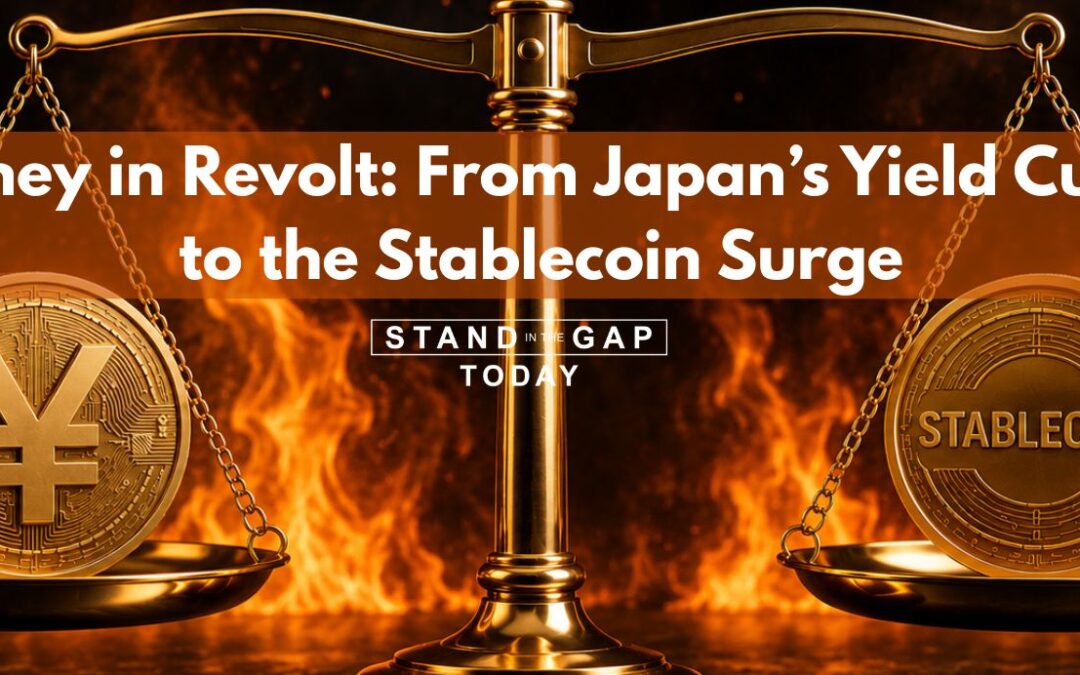

Money in Revolt: From Japan’s Yield Curve to the Stablecoin Surge
July 30, 2026
Host: Hon. Sam Rohrer
Guest: David McAlvany
Note: This transcript is taken from a Stand in the Gap Today program aired on 7/30/26. To listen to the podcast, click HERE.
Disclaimer: While reasonable efforts have been made to provide an accurate transcription, the following is a representation of a mechanical transcription and as such, may not be a word for word transcript. Please listen to the audio version for any questions concerning the following dialogue.
Sam Rohrer:
Hello and welcome to this Thursday edition of Stand and the Gap Today. And it’s also our monthly focus on economics, finance and biblical stewardship. And my guest again on the special focus is David McAlvany. He’s the CEO of the McAlvany Financial Group and they have a website at mcalvany.com. And I’ll give that again as we go through the program. But we look around the world as we speak here today, right now as we’re doing this program, the world is focused like laser on war and rumors of war. And behind it all sits the indispensable component of money and economics and finance and our day all sadly driven by a preponderance of greed, the pursuit of power and a means of control. But since scripture speaks so much of finances and our relationship to money and stewardship, I’ve chosen to spend at least one day a month on this theme of finances broadly to help believers better understand how the arena of finance and money actually works and to better interpret what we see happening around us.
Now today, David McAlvany and I are going to tackle a profound shift that’s occurring across global financial markets. You may or may not be aware of this depending upon your area of interest, but it is happening. It’s a moment in time where the traditional, I’m going to say the mechanics of central planning, and we’ll describe that a little bit more what that is, but how that’s colliding with the harsh realities of debt and inflation about which we hear a lot. Our overarching theme for this broadcast today is titled it Money in Revolt From Japan’s Yield Curve to the Stable Coin Surge. Give just a little idea of the subject we’re going to converse about here today because things have happened. They’re happening on Wall Street. Things have happened regarding yesterday’s latest federal open market committee meeting of the Federal Reserve. You may or may not heard about that, but it goes beyond that because while Federal Reserve Chair Kevin Walsh and his group signaled a desire yesterday to keep interest rates steady or actually lean toward future reductions, there is that area also called the bond market.
And that delivered a very swift and dramatic counter verdict, put it in that sense. Rather than long-term borrowing costs falling as the president, for example, is pushing so hard, we saw a sharp steepening or an increase of the yield curve. And that’s in regard to long dated treasury yields. We’re going to talk about all of that. Now, I want to go from there to this aspect of this whole thing. David, welcome me in right now because they have a lot to talk about, but thanks for being back with me. You’re an expert in this area and we’re looking forward to getting clarification from you.
David McAlvany:
Sam, always great to be back with you. I can’t believe time has passed so quickly since our last conversation.
Sam Rohrer:
I know. And there’s so much has happened. That’s one thing about the mark I think of where we are, whether it be prophetically or financially or economically, politically, things seem to be in high speed. But that being the case yesterday, there was a Fed meeting. It happened there more than significant, I think, but probably a little reported and understood because it’s being overwhelmed and overshadowed by other things. But tell us what happened and explain this, I’m going to say push and pull between central bank policy, Federal Reserve, and bond market pricing. And you may need our listener’s benefit, just explain just briefly what’s different about those two.
David McAlvany:
Yeah. So we have the second meeting with a new Fed chief, Kevin Warsh. And he made very clear in his first meeting that inflation targeting and controlling the rate of inflation was going to be absolutely central to his leadership. And so what was expected coming into this meeting was some evidence that he was going to be in man of action. As it turns out, it was a lot more words and not a whole lot of action. And with inflation being an issue which is impacting households on a fairly dramatic basis, and we’re not talking about double digit rates of inflation if you’re looking at CPI, PPI, PCE, the various measures of inflation. Nevertheless, it has compounded over the last four or five years and has put households in a difficult place, particularly at sort of the lower end of the economic spectrum. It’s an issue of running out of money before you run out of months.
And so it’s a real concern amongst the general public. And the bond market needed to see evidence that he was going to do something significant to address this issue. And it was just a lot of words. And it was frankly, if you listen to the tone, very pedantic. And so what we had as a response was plenty of volatility in the stock market as we went to the Q&A. And most significantly, we had the long bonds move above 5.2%. For most people, that’s probably not super relevant. But if you look at a chart of yields, you’ve got short dated bonds, what we call bills, and then you’ve got notes in sort of the middle section. And then as you stretch out 20 and 30 years, this is where you’re financing debt. You’ve got IOUs with 20 and 30 year dates on them. That’s where the action was happening.
And the bond market was basically sending a signal to the Fed, you’re going to have to do something, not just talk about doing something to tame inflation. And I think it’s ironic that at the same time, we’ve got the Bureau of Economic Analysis and the Bureau of Labor Statistics talking about reconfiguring how they weight and how they measure inflation. And of course, the changes that they’re anticipating making and implementing by September will make the inflation number look that much better. Goldman Sachs estimates it’ll take at least 20 basis points off of those measures of inflation. And it’ll look like Kevin Warsh is doing a great job. We’re seeing the movement lower in inflation when really all they’re doing is changing how they calculate the statistic. All so they look like a hero.
Sam Rohrer:
So David, in essence, what you’re saying there again is we’re playing games. We know, you know, I know from being in the legislature, you just changed the numbers and everything can appear better, but in fact, there’s no more money left over at the end of the day for the people who are running out of days as you talk about it. As this whole thing is going on, pull, push, and tug, is that the end of the day? Is this more we’re dealing with a crisis of perhaps trust? Put it that way or are we dealing with more fundamental things that are real? But what you’re talking says there’s no trust. We’re playing games here.
David McAlvany:
I think that’s exactly right. I mean, what holds our financial markets together is confidence. When you look at the stock market, it depends on people believing that tomorrow is going to be better than today. And therefore they’re willing to put their hard earned savings at risk. If you look at the bond market, if you look at the currency market, you see measures of confidence. And when confidence fades, when there is a crisis of trust, when there’s institutions that are called into question in terms of their strength, stability, reliability, prices begin to change. And in this case, it’s very significant because we’ve got $40 trillion in debt. As interest rates go higher, it makes that debt less and less affordable and temps fate with a
Sam Rohrer:
Bond. Okay. And with that, David, you’re going to have to hold that. Ladies and gentlemen, stay with us because we’re going to come back, continue this conversation, because it’s not just here. We’re going to go to Japan because things are happening there too. Well, for just joining us today, welcome aboard. This is our Thursday edition of Stand in the Gap Today. And it’s also our monthly focus on economics and finance and stewardship. All of those things are important to each of us and to anyone who fears God, understands the word of God, and just lives alert to what’s happening around us because those things involve everything that we do. And it’s certainly coming forward in our day as matters of debt continued to climb and references to interest rates climbing and not having enough. Our money doesn’t go as far as it used to go.
All of those kinds of things. And that’s where our focus is today. Our chosen as a topic here, money in revolt. Things are happening in the financial markets. We’re talking about some of this today. My special guest, David McAlvany, return guest. He’s the CEO of the McAlvany Financial Group. And they have a website at McAlvany.com. And if you enter that and go there, mcelvany.com/stand in the gap, there will be something there for those of you who would want to go that direction and encourage you to do so. Now, in that regard, in our first segment, David McAlvany, my guest here today again, look at how domestic bond markets, those are challenging the Federal Reserve’s credibility. We just touched on that a little bit. We’ll break it out a little bit more here. But there’s the bond market, the money that the Federal Reserve prints. And there’s a fight that’s kind of going involved right now.
And I’m going to ask David to explain that just a little bit more. But it’s not just happening in here. It’s not constrained to just Washington or New York or Brussels or anywhere else. It’s a global phenomenon. It’s happening globally. And nowhere, I think, is that pressure more acute at the moment other than here in the United States than it is in Japan, Tokyo. Because for decades, the Bank of Japan suppressed. They held down long-term Japanese government bond yields, what they would pay for borrowing money there. And they held it near zero. Today, that dam, put it that way, that dam has broken. And the Japanese 30 year bond yields, which is long term obviously, they’ve surged to multi-decade highs. That’s forced the Bank of Japan into effectively an impossible trap, meaning they either have to print massive amounts of yen, their money to buy up failing bonds, people who don’t want to buy bonds there, which wrecks their currency and it fuels their domestic inflation or let interest rates shoot up, which then risk popping a multi-billion dollar, if not more, global investment bubble and sending world debt costs through the roof.
Okay. Now, David, I just made just a couple of observations there, but before we go into the sovereign debt aspect and what that is, I want to ask another question. Explain just briefly who buys the bond. In other words, somebody who buys bonds. What are they buying and why? And how does that juxtapose or interrelate with federal reserve policy and interest rates? Put some of that together, please, for explanation purposes.
David McAlvany:
Yeah. Somebody who’s buying a bond is basically lending money to that entity. It could be corporate bond, could be a sovereign bond. And they’re doing so to receive an income stream. That income stream is attractive if it is a higher income stream than the current rate of inflation. So let’s say inflation’s 4% and the current yield is 4%. The yield on that bond, you’re getting paid for, but you’re losing four. You basically are making nothing. And you’re taking credit risk, you’re taking a variety of risks to do so. Obviously that’s not very attractive. So what’s really important to a bond investor is where inflation is at to see what they have at the end of the day. Net of inflation, net of inflation. And so that’s why these interest rates and inflation rates are so important. In Japan, you’re mentioning that rates have gone considerably higher.
We’re now sitting at 30, 40 year highs. And we went through a period following the late ’80s, early ’90s and the big boom in Japan. We went into a deflation in Japan. We did not have inflation. So the bond investor didn’t have to have that much income coming in to justify having a position in those bonds. You were getting some income and you didn’t have to worry about inflation. Now, the bond investor in Japan has to worry about inflation as it creeps higher. And they are now in an inflationary cycle. Part of that is because of their import dependency on liquid natural gas and crude oil. Japan is, I mean, we’re talking about importing between 95 and 98% of all their fuel needs. So as we have higher pricing, obviously that impacts them dramatically. Inflation passes through to a number of other consumer goods. And across Asia, this is a fairly common characteristic.
South Korea imports between 94 and 98% of its fuel needs. The Philippines, 95%. India between 85 and 90%. Thailand, closer to 70%. But this import dependency is huge because whatever happens to the price of liquid natural gas, LNG, or crude oil has a dramatic impact, not only for supply chains, but also for the cost of producer goods. And of course, just getting around town. If you’re filling a gas tank, it has a direct impact. So we have a changed environment. One of the important factors in Japan is that because rates have been low for so long, it has been a source of funding for leveraged speculators in what is called a carry trade, where you borrow at very inexpensive. So now you could go and borrow money in Japan at near 0%, take those borrowed funds and invest them for a higher yield someplace else.
That is a leveraged speculative bet. Hedge funds love to do this. They do it to the trillions of dollars. And the issue is when you start having major currency volatility and interest rate volatility, that brings a tremendous amount of pressure to the carry trade. So people are borrowing in yen, people are borrowing in euros, people are borrowing in Swiss francs. Wherever they can find cheap rates, they’ll borrow the money. And then all of a sudden the dynamics begin to shift and it creates a tremendous amount of financial market volatility when those carry trades unwind. And I think we’re seeing that now. We’re beginning to see much more of an increase in currency volatility and interest rate volatility. And the yen is smack dab in the middle of this.
Sam Rohrer:
Okay. Now take and tie together, David, what was happening there in Japan? Because Japan, obviously a very large economy, but they, because of what you’re talking about, because of their whoever, people, corporations, government itself, perhaps whoever, who could borrow money at almost 0%, did they not take and actually buy US debt, US security, US Treasury, that as an example. They bought our debt and they helped us finance deficit spending. But if they’re going to bring all their money back home, what’s the connection to that potential impact on them? Not just Japan, but on us here in the United States?
David McAlvany:
Yeah. In the post Brettonwood era, we’ve had a really unique system where at first it was known as the petrodollar recycling where we arranged in the 1970s as we were dealing with the currency crisis, we arranged for all oil globally to be traded in US dollars. That forced people to carry dollars as reserves. And in order to avoid their local currencies from increasing in value, they would take revenue and recycle it, invest it into US treasuries, which would basically fund our deficit. We spend more than we produce. We consume more than we produce. So we have two different forms of deficits and we’re getting the benefit of this sort of recycling into treasuries. In the last couple of years, there’s been less of an appetite for US treasuries and a move away from this treasury market recycling, which is putting some pressure on the treasury market.
So it’s not just inflation that’s driving interest rates higher. It’s a supply and demand imbalance. We have lots of IOUs, which the treasury is ultimately going to say IOU nothing. That’s the way we’re going to view those treasuries at some point.
But the appetite is waning. The supply continues to increase. So we have more supply than demand, and that’s a natural pressure point for interest rates to go higher. So I think that’s a significant issue. One thing I want to mention is that the biggest buyer in recent years of Japanese government bonds has been the Japanese Central Bank. They’re the largest holder of those bonds. And they now carry losses on those bond holdings of $282 billion. There is more in losses accrued than there is capital at the bank. And the Federal Reserve has done the same thing. We’ve been big buyers through our quantitative easing programs. We’ve expanded our balance sheet. The Federal Reserve has $210 billion in losses on their bond portfolio, on their US bond portfolio. That’s about five times their total capital. And so I mean, technically, if they were a publicly traded company, they’d be bankrupt.
They’re totally insolvent. We don’t tend to see them through a corporate or commercial lens. So they’re not forced to take those losses, but technically they’re insolvent. And so these have been big sources of buying too, and it’s not clear that they can continue to do that.
Sam Rohrer:
Okay. David, that is excellent. Ladies and gentlemen, stay with us because obviously what we’re talking about, the nations of the world, the Japan of the world, the United States of the world, and other countries too, have spent way beyond what they have had. They’ve had to borrow. The debt is high. And now the chickens are coming home to roost. There is a problem that is developing. We’ve touched on that. Now the next segment, we’re going to talk about a recent item, an item called stable coin. Y’all heard about it? It’s being pushed a lot. We’re going to talk about that. We’re at the middle of our program here today and our theme, if you’re just joining us, is something that affects us all. And I have a term of the program today, money in revolt from Japan’s yield curve. We just talked about what’s happening in Japan.
And in the first segment, we talked about what’s happening here in the US bond market and the Federal Reserve. And these things work together. And we’ve just touched on a part of them. But there’s another album we’re going to touch on now, and I’m calling it the stable coin surge. Not long ago, no one ever heard of the word stable coin. What in the world is a stable coin? Is that compared to an unstable coin? Or what are we talking about here? And that’s what we’re going to look at in this segment. And my guest, David McAlvany, CEO of McAlvany Financial Group is back with me again today as we are once again focusing in a monthly emphasis we’re doing at this point on economics, finance and stewardship. But we talked about what is happening a little bit in that the traditional money system, the Federal Reserve, the bank that we would call the Central Bank and bonds.
Those are mechanisms of the issuance of debt that our nation puts out, but all countries do it as well. And these have worked together and they work together. But there becomes a problem when debt government spending goes too high, exceeds the ability of taxes to collect, for instance, or whatever. And there’s nobody who wants to buy the debt anymore as bonds. Those are the bonds, the debts that the people would buy. And when nobody wants to buy them, they demand more interest on them. The yield, they demand more pay. I’m not going to invest in that if I don’t make any money. So that is what is now at hand and the dilemma that is occurring. Because the Federal Reserve is saying on one hand, we want to hold down interest rates. The president is saying a hold down interest rates because the hold down interest rates you incur spending.
But the problem of it is with that spending and the way we’re spending money here, $40 trillion in debt in the United States, that’s debt. Somebody’s got to own it. Bonds, treasury bills, those kind of things. But nobody wants them unless they get paid more for them. But if we pay more for them, the federal government here doesn’t have the money to pay for it. Therein, I summarize in a little bit, the dilemma because it is a major dilemma. Now into all of this has come this concept of stable coins. Hundreds of billions of dollars actually have quietly migrated out of the traditional banking aspect, the bonds and market funds and that kind of thing. And that’s what investments people put in the market. And they have gone into what are called digital tokens. And David’s going to explain that, but they’re connected almost like an umbilical cord to government issued currencies, predominantly the US dollar.
So the question is, what are stablecoins? Are they simply a convenient digital high tech upgrade for twenty four seven global transactions? Or perhaps is it emerging as a shadow banking network designed to bypass traditional financial structures? All of these things could be happening, but there’s a connection there. David, let’s demystify a little bit what appears for so many to be perhaps an emerging parallel financial system. Is that what’s happening? And for instance, why were stable coins created them? Who created them? And how do they operate under the hood, so to speak?
David McAlvany:
Yeah. They are a parallel financial system. And it’s interesting. I mean, first of all, the dollar is today a fiat currency. There is no currency today that has something real backing it. Fiat just means it’s backed by nothing. A stable coin is a digital token designed to maintain a stable value by being tied to an underlying asset. So what is commonly backing a stable coin is a fiat currency or a short term T-bill. And so you’re basically saying, we’re content with fiat currency. Now we want a synthetic version of it. Which to me is. I kind of have to scratch my head on that because I’m not entirely comfortable with fiat currency, which can be inflated away or a synthetic version of it. But ultimately what’s backing the currency or backing the stable coins is cash, short-term T-bills. Those are the most common backings. Tether is actually experimenting with doing a partial backing with gold.
What you find is these stable coins do increase the demand for those underlying assets. So they’re hoovering up lots of T-bills. They’re hoovering up some gold, hoovering up lots of cash. And it’s just a synthetic version. Two problems with this. One is that monetary policy makers, folks at the Federal Reserve, the Bank of England, are going to have to deal with a change in how monetary policy is transmitted into the economy. And stable coins dramatically alter monetary policy transmission mechanisms. That is a significant issue. It is a major downside and a major risk that monetary policy will become less effective. We get into a recession, we get into depression. The classic tools that a central bank will use to gin up economic activity and support an economy which is flailing now all of a sudden do not directly transmit. So that’s one problem. The second problem
Is with commercial banks in a fancy term, intermediation, which is basically banks take in deposits and then banks make bank loans, which promotes economic activity. And when they create a bank loan, they’re basically, because of the nature of fractional reserve banking, they’re able to multiply the amount of money that is in the economy. So stablecoins, they undercut. They basically are challenged to the traditional commercial banking intermediation process. And so I think you’re going to find a huge lobbying effort to challenge the use of stable coins by your commercial banks. It would completely change our banking system for stable coins to continue as they’ve been promoted thus far.
Sam Rohrer:
Okay. Let me ask you quickly here, David. So I want to get two things. I want to talk about the risk of this as compared to like putting money in a standard bank account or a money market, but I want to ask you this first. Who is already primarily investing in stable coins? Because I noted that even in what’s happening in Japan, they, from what I read yesterday, are floating the idea that they need to come up with some kind of a stable coin to compete what we’re doing here. So speak just a little bit about that. Who’s investing in stable coins?
David McAlvany:
It’s mostly people who are interested in this sort of parallel economy. And the benefits of stable coins are much faster settlement for transactions. So these are dollars quickly moving over blockchain networks. And that’s very useful for payments and trading and remittances. The cost to do that using stable coins versus sort of your classic Western Union, if you’re thinking of remittances. Costs are compressed and the speed of those transmissions is greatly enhanced. So it’s an improved technology. But as I mentioned, the cost of broad adoption is within the commercial banking sphere and for monetary policy makers. So the Bank of Japan may be talking about adopting it mainly because they don’t understand the implications and they just feel like they don’t want to be left out. It’s the newest technology and they don’t want to be seen as sort of anachronistic or left behind and everybody’s doing it.
Meanwhile, the Bank of International Settlements, which is sort of like the central bank to central bankers, has expressed grave concerns about their adoption. And I think a part of that is, again, sort of the shifts and change to commercial banking, what that means for controlling growth in the economy or influencing growth in the economy
Through that intermediation process. So yeah.
Sam Rohrer:
Okay. So let me ask you this question. So from your perspective, are stablecoins a credible alternative to say standard bank accounts, money market funds, as it would pertain to the average person who may be listening and/or perhaps in the commercial and only? And then this question, if it is something that the average person could consider as an alternative, should they view them as no risk, low risk, high risk, or perhaps unknown risk?
David McAlvany:
Yeah. I mean, I think the verdict is out. They haven’t existed long enough to know for the investor, a conservative investor to know how they behave under stress. So under the best of circumstances, there are enhancements, which we talked about. Working on the blockchain network, very useful for payments, trading remittances, speeds things up, compresses costs. Under normal circumstances, they are an iteration, an evolution of money, which is very attractive. But we don’t know how they behave under market duress. Imagine sort of the global financial crisis. Is there liquidity? Who is the liquidity provider for stable coins? Who is the ultimate sort of buyer of last resort for stable coins if there is mass liquidations? And this is where I think we may discover that they enhance the volatility in the bond market. They enhance pressure on the currency that they’re denominating Or even for Tether and its gold position may enhance volatility in the gold market and not in a positive way.
Until that time occurs, they are accumulating quite a bit of gold. They are a new source of demand for gold, which today is great. It would help stabilize the price and push it higher. But I do wonder if there’s stress and strain in the global financial markets, what the liquidity dynamics are.
The verdict is out, we don’t know. So my short answer is for the person listening today, are they an alternative to bank deposits, dollar deposits, short-term T-bills? No.
Sam Rohrer:
Or at least not yet.
David McAlvany:
Not yet.
Sam Rohrer:
Okay. All right, ladies and gentlemen, stay with us. We’ll come back for the next segment. We’re going to conclude this by offering, I’m going to ask David for some stewardship thoughts about now all these things being talked about here, what should the God-fearing person who’s concerned about biblical stewardship? Well, as we go into our final segment here now, just one more time, I’m going to give you the website of my guest today, David McAlvany. And he’s been with me now multiple months here as we try to devote a program at least once a month to the area of economics, finance and stewardship. And I’ll say, if you’ve been listening to it, the whole program, I know that many of you have been listening to say I’m not into finance and economics and all of that. And I know that. That’s why I’ve tried to make things as simple as possible because at the end of the day, we are all, if we fear God, what the Bible says, we are all going to give an account for how we steward those things, stuff.
And you can measure it in value of dollars, but it’s a value, it’s a measurement to some degree. We’re going to give an account for how we deal with that. The Bible speaks a great deal about finances. So that’s one reason. The other reason is, is that in reality, everything that we tend to get us concerned. You go to the store, you’re dealing with economics and finance. You’re talking about money. Do I have enough to buy this food that I need? Do I have enough? Can I pay the mortgage payment? Do I have any money to leave behind to my children when I die? Or whatever it may be. The point being, I felt it necessary to deal with the components of what actually makes what’s impacting us actually work. And today we’re dealing a little bit with the bonds and what’s happening in Japan, what’s happening in the Federal Reserve.
And now stable coins, we’ve brought that into it because that is out there. So hopefully if you’ve stayed with us, you can see how some of these are working together, but it’s for the purpose that I just laid out. Now, as we summarize here today, when it comes to the crucial question, how reliable are these digital assets, stable coins? We’ve talked a bit about that. And how should wise stewards, when I’m talking about the biblical principle of stewardship, how should we as wise stewards respond in these days where in fact, there is significant dwindling trust in our fiat money, that paper that we carry in our hand called dollars or any other place around the world where people may be listening right now. It’s different. You may not use dollars, but you use something else. Same idea. When you combine that with undisciplined and I’m going to say arrogant political leaders who think that money is God and they view the control of money as more desired than integrity and living in the fear of God, don’t we see that all about us?
That complicates things. And somehow it makes it more simple when we look at it. But when it comes to stable coins, not all stablecoins are created equal. They range. There’s differences, tokens backed by physical cash, short-term treasuries. David mentioned gold, Tether’s getting into that. But in any regard, all of these things are working together. They may be complicated, but we’ve got to net it down. And David, I want to ask you, we’ve considered some major topics here today, emerging new financial concepts that seem to have within them the motivation to consolidate power by a few perhaps, or postpone the inevitable consequences of overspending and debt and all that goes with that. So share with our listeners how you would consolidate this information today. I would say into an actionable response framed for the person who fears God, who understands the need to follow biblical stewardship principles and to be wise here on the earth while we’re here, but also know that real wealth is actually laid up in heaven.
David McAlvany:
Well, Sam, I appreciate you framing this in terms of stewardship because we do have to acknowledge these are, at the end of the day, whether it’s savings, investment, retirement accounts, these are things that we rely on to take care of our families. They’re an expression of the work of many decades. And we do have a stewardship mandate attached to that. I think another theme that I regularly hear in your program is understanding the times. And there is both the understanding the times piece, which is theoretically what’s happening, but also the second part of that scripture is knowing what to do. There is an action piece. And I think it’s important for people who generally delegate their investment decisions to recognize the majority of financial advisors are using conventional wisdom. And that conventional wisdom is based on a look in the rear view mirror. It’s what has happened in the past, not necessarily what is happening today or is expected to happen in the future.
So we’ve talked about interest rates, we’ve talked about bonds, we’ve talked about things that for many people would say, how does this matter for me? In a period of rising interest rates, financial assets have more headwinds. And so typically people will say, okay, well, if I want to take less risk, I’ll just reduce my stock portfolio and increase my bond portfolio. Except that bonds in a period of rising interest rates are not an offset to risk in a stock portfolio. So let’s get down to brass tax in terms of a recommendation. I would reduce your equity exposure. I would reduce your bond exposure. That is your fixed income exposure. And that includes sovereign debt. It includes corporations that if they’re also borrowing money in the form of bonds. I would increase a cash allocation and I would balance that cash position with an inflation hedge because when you move to cash, it is subject to a loss of purchasing power.
So balancing a cash position is a part of a liquid asset position. Balance that cash with an inflation hedge. Gold is the very best. Silver would be secondary. And one of the best places to do that is in IRA and retirement accounts. Precious metals position in those kinds of accounts. It offsets market volatility. One of the unique aspects, particularly of gold, is that it has low correlation to stocks and bonds. And in periods of stress, it has negative correlation, meaning that it performs well when they are performing poorly. So it actually is sort of an engine of growth in the context of pressure in those larger markets, the financial markets, traditional assets. So it’s a great way to basically infuse an insurance policy into your total mix of assets. So when you think about savings, when you think about investment, when you think about retirement, why is all of this relevant?
It’s relevant because you are a steward of these resources. And again, to the degree that you’ve partnered with or delegated those responsibilities out to a financial advisor, you’re expecting them to be the professionals. I just want to caution you that, again, conventional wisdom, the way that they govern their decisions and thinking about the markets, it’s based on a look in the rear view mirror where interest rates have been coming down for 40 years. Interest rates move in long-term trends. I would suggest to you that we have an interest rate trend, which is going to last many decades, and that represents headwinds for those traditional asset classes. You have to use something more than conventional wisdom in the years ahead.
Sam Rohrer:
All right. And we have less than a minute left here. So David, I’m just going to let it there I think at this point, ladies and gentlemen, in a future program, stay tuned here and don’t miss a day when you’re with us because David and I are going to go a little bit further and probably build out what he was just talking about there a little bit further. That was easy to understand, David, but more applicable in a way that I think more of us can take advantage of it. But we need to think in terms of what David just laid out. And that’s what Lord says. If you need wisdom, let him ask and I’ll give it to you. And that’s what I’m going to do right now as we close. Heavenly Father, I pray that on all these things we talked about today, that you would grant to the hearer, those with ears to hear, and who have interest in the things we talked about, to give and grant wisdom and discernment for how to interpret these things that we’ve talked about today so that we can stand before you one day and hear the terms well done, good and faithful servant.
And it applies to these things, Lord, we know. We pray in that’s in Jesus’ name. Amen. David McAlvany, thanks so much for being with me today. Always a wealth of information. Pardoned upon a wealth of information. His website, McAlvany.com. And if you do, McAlvaney.com/standinthegap, then there’ll be something there for you specifically to which you can take advantage. Well, thanks for being with us today. God bless you all. And Lord willing, stay tuned. Isaac will be leading the program tomorrow. You won’t want to miss that program.

Recent Comments