
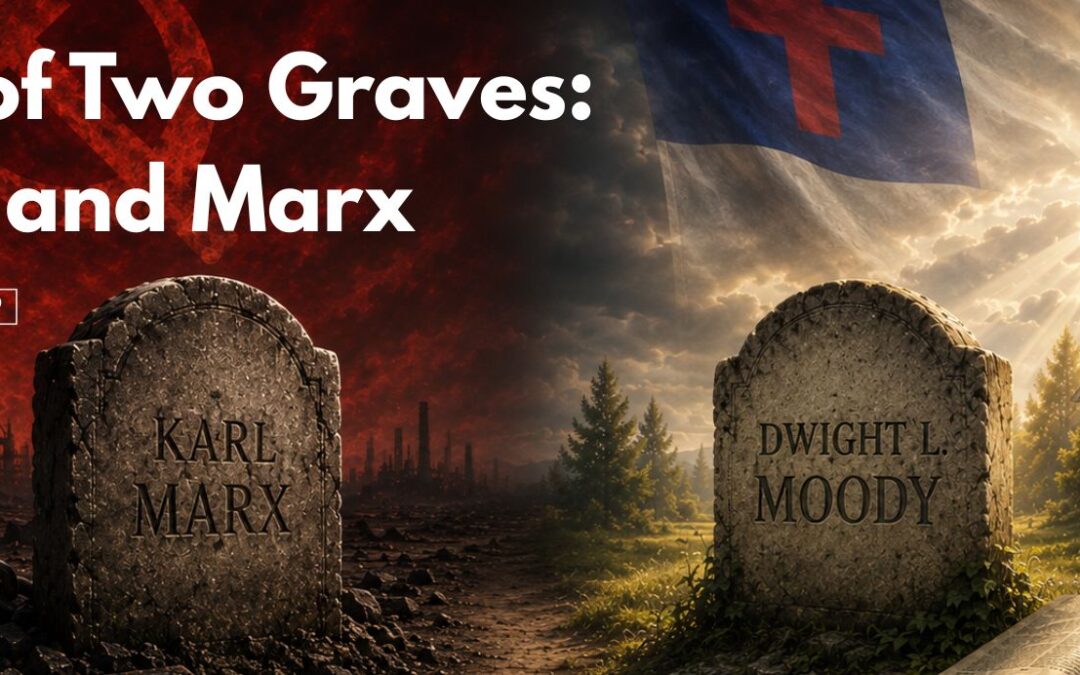

A Tale of Two Graves: Moody and Marx
August 25, 2026
Host: Dr. Jamie Mitchell
Guest: Dr. Erwin Lutzer
Note: This transcript is taken from a Stand in the Gap Today program aired on 8/25/26. To listen to the podcast, click HERE.
Disclaimer: While reasonable efforts have been made to provide an accurate transcription, the following is a representation of a mechanical transcription and as such, may not be a word for word transcript. Please listen to the audio version for any questions concerning the following dialogue.
Jamie Mitchell:
Well, good afternoon. Welcome to Stand in Gap Today. I’m your host, Jamie Mitchell, Director of Church Culture at the American Pastors Network. I’m not the type of guy who tours graveyards, but I’ve learned that you can find some amazing things as you walk around and read tombstones. Such one is found at Highgate Cemetery in London. The headstone reads this way, “Workers of all the lands unite.” And just below it, the philosophers have only interpreted the world in various ways. The point, however, is to change it. That tombstone belongs to Karl Marx, and it summarizes what his life is about. Now, in contrast, if you were to travel to Northfield, Massachusetts and walk around the round top cemetery, you’d find a tombstone that says this, “He that doeth the will of God abideth forever.” One John 2:17. That belongs to the great American evangelist, D.L. Moody.
What a difference. Marx wanted to promote a man-centered world to force equality, and if necessary, take from the privilege and give to the oppressed. The other man, Moody, wanted to promote a God-centered world where doing his will was the greatest accomplishment anyone could ever do. That contrast couldn’t be more different. One man devoted himself to changing the world through a humanistic ideology. The other devote himself to changing the world through the gospel. What fascinating is that both of these lives were in the same time of history and they were keenly aware of each other. And today we want to investigate these two men, how their lives crisscrossed in history, and also consider the relevancy of understanding what they were promoting and how it affects us today, especially here in America. Title of today’s program, A Tale of Two Graves: Moody and Marx. And our guest is about to release a book by that title on the topic of these two men’s lives.
It’s none other than Dr. Erwin Lutzer. Dr. Lutzer, welcome back to Stand in the Gap Today.
Erwin Lutzer:
Jamie, I’m glad to be with you. And just to clarify, actually, the title of the book is Marx and Moody. It is true
Jamie Mitchell:
That the
Erwin Lutzer:
Subtitle has the word tombstones. Two contemporaries, two gospels, two tombstones, and one choice. But you’re absolutely right. Their worldviews were in total contrast with one another. And I’d hope to point that out and the implications of Marxism. I also want to point out right at the beginning that it’s actually dual authorship. I wrote the section on Karl Marx. A professor who used to teach at Moody Bible Institute by the name of Greg Quiggle wrote the section on Moody where he showed that Moody had a heart, not just to preach the gospel, but also huge burden for social concerns. And he sure did a lot more in that regard than Karl Marx.
Jamie Mitchell:
Well, Dr. Lutzer, when you were on our program last spring during one of the breaks, you mentioned about the Marx and Moody book coming out. Without hesitation, I said to you, “We got to get on, discuss these two men.” What was the motivating factor behind writing this book? And probably even more, why do you believe that understanding these men, Karl Marx and D.L. Moody, at this time in our history is so important for believers in Jesus Christ?
Erwin Lutzer:
Well, first of all, what happened is I was helping lead a tour to the sites of the Reformation in England. And my wife and I went there early with a camera crew because I was going to give a lecture at the tomb of Karl Marx. As I was preparing the lecture, it dawned on me that he and D.L. Moody were contemporaries. And so it was really a lecture on Marx and Moody. And then afterwards, I learned some other things. Moody was preaching to large crowds 20,000 a night in England for six weeks, if you can believe it, especially there in London. Well, that was the time that Marx was there. Now, we have no evidence that Marx attended a Moody meeting, but to Frederick Engels who helped write the communist manifesto, he helped. He attended a Moody meeting, a Moody revival meeting, and told about it in detail, which is in my book, and argued that this is the way in which the bourgeoisie, that is the ruling class, uses religion.
He describes Moody and so forth, but we don’t have time to go into that. But here’s the interesting thing. Not only that, but before Engels died, Marx had already died. And Engels is reminiscing as to why England didn’t become communist. After all, the manifesto was published in England already in 1848. He concluded it was because of revivalists like Moody and Sankey and the dangerous aid of the Salvation Army. In other words, what he said was in effect that Christianity was too deep in England for there to be enough thugs and thieves and criminals who were willing to destroy and steal to bring about a communist revolution. But it was a backhanded compliment that these men, they’re the ones who prevented England from becoming communist. And by the way, speaking of this Moody here in America when he was preaching, he said, “If we do not evangelize the cities,” he said, “The leaven of communism and infidelity will take over and we will experience a reign of terror.” Those are his words.
“A reign of terror, the likes of which we have never seen. “So yes, they were contemporaries for 46 years. They didn’t have any direct communication with each other, but they were aware of each other and all of the implications.
Jamie Mitchell:
Dr. Lutzer, we got about a minute left. Why do you think this book is so important to believers right now and to the church in America right now?
Erwin Lutzer:
Well, all that you have to do is turn on the news. One of the longest chapters is on democratic socialism. That’s in the book. But in addition to that, Jamie, I explain how there was a plan by Antonio Gramsci and how he even was planning to use churches to promote the communist cause. So all of these things, how Marxism came to America and so forth are very important as we think about what’s happening in America today and why it is that it’s so attractive. Why is Marxism so attractive? What is it about it that seems to draw people? So all of that is in the book and also of course its implications for America. Yeah. Well, we’ll talk about it on the other side of the break, but this is very, very important.
Jamie Mitchell:
Friends, today we’re so pleased to have Dr. Urman Lutzer. We’re going to be talking about his book, Marx and Moody. And the reason why we’re bringing this to you today and why it is so important, because socialism, communism, Marxism, it is on the rise here in America. It is becoming more and more popular. Yet the question is, what do we really understand about that ideology? And do believers understand? Do pastors understand? And are they ready to address these issues with their people? D.L. Moody did. A matter of fact, Karl Marx and his people understood the message of the gospel and what D.L. Moody was preaching and promoting was pushing back the advancement of communism during their time. Now, when we get back, we’re going to start to unpack both Marx and Moody. First up, Karl Marx, don’t go anywhere. Stay with us here at Stand in the Gap today.
Well, welcome back. We’re so privileged to have Dr. Erwin Lutzer, Pastor Emeritus of the Great Moody Church, author of 70 books, including a soon to be released, Marx and Moody. And that’s what we’re discussing today. Erwin, as we see the rise of socialism within the United States political world and the espousing of Marxist principles, I had to ask myself, do people, especially Christians, really know who Karl Marx was and what he believed? You can certainly help us first give a context of who Karl Marx was as a person, his background, which led him to become the father of communism.
Erwin Lutzer:
Well, first of all, let me say he was born of Jewish parents. His father converted to Lutheranism when Karl was six. Six was, excuse me, Karl was baptized in the Lutheran Church at that time and attended a Lutheran school and said some very nice things about Christ. But at the age of 18, his father wrote him a letter in which he said, “I perceive in you that there is a demon not common to all men. Is that demon heavenly or is it Faustion?” Now in my book, I explained who Faust was. Not the Faust of the Middle Ages, but the Faust of the Enlightenment who made a deal with the devil for an infinite number of pleasures and then still won at the end. So Karl, as a result of that, he was very much into Satanism. Now, some people say, “Well, it’s not fair because this was before he wrote the communist manifesto.” But in my book, I have four or five poems written by him.
And I’m going to see if I can just remember some of them offhand. A couple of lines. See this sword. The prince of darkness sold it to me. My soul once true to God has been chosen for hell. And on and on it goes. They’re very dark, very satanic. And I think he wrote about 40 of them. In my book, I have four or five. So he was deeply. If you look into his mind, it was just like looking into a pit of darkness. And later on, of course, he wrote the communist manifesto, which is the primary focus of my book. But the point is that, by the way, his mother said of him, his father’s name was Frederick. His mother’s name was Henrietta. She said, “I wish that Karl would actually earn some capital rather than just writing about it.” Because he was constantly going to her for money and she wouldn’t give him everything he wanted and so forth.
His wife, Jenny, according to Frederick Engels, frequently said that she wishes she were dead along with all of their children because life was so hard. And of course, if you’re an atheist, death is really something to welcome because there’s no judgment. You just lie down and you disappear into nothingness. And all six children ended very badly. The last two ended with suicide and so forth. And it’s a very ugly picture. So he sometimes didn’t pay rent and so forth. And obviously he did not live by his own principles. And I go into that in the book. So he was then able to get money from Engles. He was evicted from his apartment because he was so unruly. So personally, it was not a good experience for him and certainly not for his wife. And Karl would say of his wife, Jenny, I don’t blame her for wanting to be dead.
Jamie Mitchell:
Wow. Erwin, how would you summarize Marxism and what it promotes? And why is it dangerous to America and to evangelicalism?
Erwin Lutzer:
Wow. You’ve just asked me about the whole section of the book on Marx. The reason it is dangerous is because people judge it by its promises, not its results. And if you want to know why it is attractive, you’d have to read the communist manifesto. I summarize it, by the way, in six major points. For example, the fact that there should be no private property. And the reason for that is because people fight. They fight over who owns what, and I should get more. Well, if no one owned anything, then there’d be no ownership to fight about. And everyone would live together in peace and harmony. Isn’t that really nice? And then he says that the family has to be abolished. People have to understand this. And the reason is because Karl Marx believed that the world should always be divided into the oppressed and into the oppressor.
Always class struggle. Okay? And as far as he was concerned, the family was oppressive. Why? Parents oppressed their children. Fathers oppressed their wives. It was really an economic relationship. And children were taken to church and God was the ultimate oppressor. So you have to get away from God. The abolition of religion goes on to say, the abolition of the family clearly laid out. By the way, the communist manifesto is actually pretty clear about its intentions as I’ll show in a moment. And then another one, and we’re just scurrying very quickly here. He says that communism abolishes all eternal truths. It abolishes all religion, all morality, and all the social conditions. And then it says it doesn’t even put this on a different foundation. Why does he say that? It’s because you see, he believed that truth was constantly in flux. You couldn’t put it on a foundation because what was true yesterday may be very different today, depending on the ruling class.
Now, Jamie, you asked me a question earlier. Why is this important? Well, let me stop and just take a breath here. Parents send their kids to university. They come back and the parent says, “My children now think differently than I do. Yes, they sure do. And the reason is because of the fluctuation of truth. When you and I were growing up, truth was something that we believed was outside of us. We believed that it was true whether we believed it or not. We would argue as to how we could get there, but there was this objectivity regarding truth. Well, that’s gone because Karl Marx says we have to abolish all that. Without a God, truth is being made up day by day. And so it depends on how I feel. And that’s why the whole LGBTQ movement and so forth has moved so quickly is because now whatever I feel is right, feelings become facts.
And so I have my set of feelings. You have your set of feelings. So I have my truth and you have your truth. And there is no fixed reference point. And this of course is what progressivism is all about, as I explain in the book. Progressivism says that we have to move from one level of truth to the other. And truth basically is therefore socially constructed. It is constantly changing. And truth is whatever the ruling class uses to keep the proletariat, the workers in line. So in Russia, the newspaper is Pravda, truth. And truth becomes whatever the government now says truth is. So think of that. But then I have to hurry here. I’m getting near to the end of the manifesto. Just a real 30,000 foot view. Okay. Most people read the last line of the manifesto, which says workers of all lands unite.
What they forget is to read the line before that. And I’m paraphrasing it, but it’s a very accurate paraphrase. It says, “The communists do not want to hide its aims. We gladly admit that our ends cannot be achieved unless there be a forcible,” these are the words now, “a forcible overthrow of all existing social conditions.” And then it says that the ruling class might well tremble. And elsewhere, Mark says, “We have to be as violent as possible and not apologize for our violence.” What’s going on there? He knew that if everything was going to be taken away from the factory owners, from the landowners, if all that they had were going to be taken by the state, which of course is what he advocated, they weren’t going to freely give it up and say, “Oh yeah, you can have my farm.” There was going to be battles.
And the only answer is to kill the people that were opposing the Marxist utopia. And so he knew that all that was coming. And all social conditions, all families, all ownership be taken by the state. And who’s the state? Well, he believed it would be the workers. And they would just divvy out all the goods and do so, so accurately. And everyone would be happy. All right. So I’ve talked for a long time now. What’s your next question, Jamie?
Jamie Mitchell:
Well, Erwin, you’ve answered all my questions about Marx and about Marxism. And what’s amazing is as I listen to you describe Marxism, all we have to do is go to news tonight or to the newspaper because this is what is being promoted across our land. One of the issues, friends, that we’ve got to contend with in today’s world is that people are espousing Marx. They may hide it, but now they’re not even hiding it. They’re just doing it out in the open. And as believers, we have to be discerning. We have to listen carefully. We have to learn the hard and probing questions. When we return, what’s the counter side of this? Well, it was D.L. Moody. We want to discover who Moody was and why it was that Marx and his followers were so concerned by what he was preaching. And that’s the gospel of Jesus Christ.
Do not go anywhere. Stay with us.
Now, if you’re just joining us, you’ve picked a great day to be with us and to drop into Stand in the Gap today. Dr. Erwin Lutzer is our guest and we’re discussing his new book, Marx and Moody. Erwin, you pastored the great Moody Church. So I figured you know a lot about this great man of God. But I know there’s a whole generation who do not know, nor do they fully appreciate who he was and all that he accomplished. Can you give us a window into the life of D.L. Moody? Who was he and why was he so significant?
Erwin Lutzer:
Well, first of all, he was born in Massachusetts to a very poor family. His father died an alcoholic when he was eight years old. And so he was born into this situation. His mother read the Bible regularly. He went to Boston to sell shoes in his uncle’s shoe store. And his uncle says he can do it only if he goes to church. There he’s converted. He’s working in the shoe store and his Sunday school teacher comes over. Now D.L. Moody only had about a fourth grade education. He had to teach himself how to read. But he comes to Chicago. He has a great burden for the young children here, for the children on the streets in the worst areas of Chicago. And he begins a Sunday school. Now Moody was a very busy person. He was constantly had activity, if we can say it that way, enlisting other people to help him.
He ended up with a Sunday school of a thousand kids. Lincoln, on his way to Washington to be inaugurated, stopped because Moody had become that famous. But Moody began to preach. And the amazing thing is this, that even though he continued to sell shoes here in Chicago, he was overwhelmed. And I have to tell you this quick story. There’s one of his teachers who says he’s dying and he has to go back east. But he says to Moody, “I’m teaching five girls and they are so rowdy. None of them know Jesus.” Moody said, “Let’s visit them with my horse this coming week, horse and buggy.” Every one of them, I think the first one was Mary, every one of them was led to Christ personally. Sunday evening comes and they’re saying goodbye to the teacher. And lo and behold, they kneel in a circle.
The teacher prays, Moody prays, and he’s about to get up from his knees and one of the girls pray. And then the next one, the next one, the next one. Moody said, “Money could not tempt me again. He quits selling shoes.” He says, “Heaven came down to that little Sunday school place where five girls prayed with us.” And he began then a church. Why did he begin Moody Church? Because the other churches wouldn’t accept these rowdy kids. That’s the beginning of Moody Church, by the way. And he began to preach to large crowds. But here’s the thing. He became famous. He was in the British Isles for three years for a tour where he was front page news everywhere. Newspapers took down his sermons and then they printed them the very next morning. And yet he did so much. I mean, he was president of the YMCA.
He began help begin orphanages. Of course, he also began the Moody Bible Institute, orphanages and social work, visiting the troops in the Civil War, visiting both sides, giving them blankets, trying to help them. So Moody’s view was this, that social work is very important and all of us should become a, how am I going to put it? A charity of one. Every Christian had the responsibility of helping the poor, ministering to the widows, taking care of people’s needs. So his whole view was not that these social needs aren’t important. He saw the same abuses as Marx did, but it was not to be done by the overthrow of all existing social conditions, to quote the words of Marx. It was to be done by the proclamation of the gospel. And he believed that oftentimes poverty, it was a result of laziness or alcoholism. He saw the effects of alcoholism.
I mean, he knew it in his own home. His father evidently was an alcoholic. So he becomes the Billy Graham of the 1800s.
And that’s when he was preaching there in England. And 20,000 people a night. Imagine this, Jamie. 20,000 people a night without a microphone because they didn’t have them in those days. And people like Angels who helped write the communist manifesto, who attended one of the revival meetings, talked about the fact that 20,000 people had been jammed into agricultural hall. So he describes Moody, this American with a twang. And he said, “Not without humor.” In other words, D.L. Moody would throw in some humorous things. And his preaching was so simple and so imaginative. That’s why I can throw this in. I hope people buy the book, Marx and Moody, because they will get a view of D.L. Moody, the likes of which they’ve never seen. For example, talking about imagination. Okay? He said, “That soldier who pierced the side of Jesus, that ghastly deed, but ah, the bud covered the sword.
And if he had believed in Christ, he could have sat with Christ on his throne. The blood can cover the sword. He had three Rs basically ruined by the fall, which was different than Marx. I could talk about that in detail. You see, Marx believed that all evil was outside of us. And the only reason any person did evil is because people were doing evil against them. Just take away the oppression, as I mentioned a few minutes ago. And everyone is going to live in harmony and utopia. Marx, excuse me, Moody knew better. We are all sinners. And because we are all sinners, we are deeply capable of sin and only the blood of Christ. So you have ruined by the fall, redeemed by the blood, regenerated by the Holy Spirit was the only hope for mankind. And he saw what the gospel could do, which of course Marxism could never do.
Marxism can only destroy. I wish I could had time to explain that. There’s a line in Faust that says, “Everything that has been brought into existence is worthy of destruction.” And Marx loved that line. And here’s Moody saying, “That’s not the way to go. The way to go is through faith in Christ and the change that is brought about by lives that have been touched by God.” An amazing thing. Last thing, and then you have to go on to your next question. There’s no connection between his humble beginning and the fame and the great impact that he has left behind. And we’re still being affected even today.
Jamie Mitchell:
Erwin, what affected me when I heard about this book and as I’ve been reading it was that Angles, Marx, his right hand man, the man who funded Marx in many respects, he saw the threat that Moody and his preaching and his message was to the progress of communism moving across a nation. We’ve got a few minutes left to speak to that issue because I think that’s what is so relevant today that we as believers have a message to counteract the evils of communism. And I think we sell ourselves short. How did Angels and those look at Moody and his message?
Erwin Lutzer:
Well, Angels who attended a Moody meeting and then later, before Angels died, said the reason that communism didn’t come to England is because of revivalists such as Moody and Sankey and the Salvation Army. I throw this in also, of course it’s in the book that Angels hated Spurgeon, needless to say, because Spurgeon, of course, was in London during the same time. But the point is this, that Christians are not very good at going out and stealing other people’s property and money. At least they shouldn’t. Christianity prohibits that. And so how are you going You’re going to bring about a revolution if you have a Christian country. Well, you can’t. Very quickly, Jamie. All right. Here’s a guy by the name of Gramsci who writes out a plan as to how to bring communism to America. Number one is the destruction of the family. Very important to him.
He said, “We can’t move ahead without destroying the family.” Number two is capitalism and of course in general, Christianity. And so he works out a plan as to how this can be done. And the most interesting thing I think to our audience is the fact that he writes out how churches can be used to implement communism. So what you have is communism comes to America and then the implications are clear. And I hope we get a chance to talk about democratic socialism.
Jamie Mitchell:
Yeah, we will. Absolutely. We’re going to talk about that our final segment. Friends, the gospel is the power of God unto salvation as Paul wrote in Romans. And Moody knew it. He knew that the gospel had power it had in his own life and the others who he was touching with that message. Christ in us is the power to overcome everything we face in life. But Moody also knew that that gospel could bring freedom and liberation and joy. Moody was not the threat, the gospel was. But I want Erwin to speak on that and why pastors need to address this issue and they need to get this book. Marx and Moody, study it, prepare it, teach it, talk about it. Our culture and our day needs it. Stay with us for our final segment.
What an amazing hour it’s been as we’ve been so blessed to have Dr. Erwin Lutzer as our guest discussing his new book, Marx and Moody and the Tale of Two Very Different Lives. Erwin, one of my motivating factors of having you on to discuss these historical figures and this topic was the present day rise of interest and support of politicians who are espousing Marxist philosophy. We have seen in recent days the amazing electoral success of a number of these Democrat socialist candidates. It is a real issue throughout our culture. So let me ask you, the whole issue of DSA, democratic socialism and what we see happening today, is it a threat to our nation? And how should evangelicals respond?
Erwin Lutzer:
Well, first of all, I want to say a word to pastors. I think that as a pastor, I have never endorsed a political candidate or a political party, but I have spoken about issues which are deemed to be political, which are also biblical. And so what you have to do is to recognize that this has to be done carefully because the issue really isn’t all the political rhetoric that’s around us. The issue is what is the truth here? Generally speaking, when you’re talking about socialism, the reason it is so attractive is because people judge it by its promises, not its results. The dream is free, but the bill comes later. Have you ever noticed that socialists always talking about how to divide up the money? They never talk about how to make money because strictly speaking, socialism cannot make money. But imagine a pie, you divvy it up, everybody gets a piece.
But when the pie is gone, who’s going to fill the pie plate? All that you can do is to have inflation, print more money and so forth. The other thing, if parents, and by the way, why should we be interested in that? The reason that this interests me is because under capitalism, people say, oh, it doesn’t matter whether America survives. The work of God goes on. Yes, the hidden purposes of God are always fulfilled. But Jamie, it’s because of capitalism that America has funded missionary work around the world. I mean, I’ve been to Albania, Romania. We support ministries, of course, in India and other countries. Wherever I have gone, it is supported by American dollars. Now, not exclusively, many of these countries are beginning to support their own mission agencies. It’s America that has spent millions and millions of dollars to send missionaries around the world.
And so capitalism is important. And good government cannot save us, but bad government can lead us to destruction and it can shut us down as I show in the book. So now, if a parent wants to help a child understand socialism, what I suggest is doing this. How would you like it if a professor at a university said, “It’s just not fair that some of you are able to study hard and to get a good grade.” So what I’m going to do is at the end of the semester, all of your grades are going to be averaged because that is really what can be called leaving rugged individualism, which by the way, the communist manifesto speaks against rugged individualism. It says clearly they are putting an end to individualism. But anyway, and then at the end, everybody, and it’s the warmth of collectivism we have to share.
And some of you are smarter than others. Some of you work harder than others. What would that do to students? Would that give them encouragement or discouragement? People take advantage in socialism. A kabutz in Israel tried to use it and they had to end it because of all the abuses. And they said, “We became a paradise for parasites.” And I’m not sure how much time we still have because time goes quickly on this program, Jamie, but I can’t help but think of the words of Winston Churchill. The great vice of capitalism is the unequal distribution of blessings. The great virtue of socialism is the equal distribution of misery because of some economic principles. If the government intervenes, for example, and says, “We’re going to set prices and we’re going to put a cap on rent.” Are people going to invest in rental property? Of course not.
What you’re going to find is everything is going to go down the drain. There’ll be no incentive. There’ll be no incentive. If you have a grocery store that is run by the government and therefore the government can pump money into it. It undercuts all of the other grocery stores. They aren’t going to be able to survive. So they end. Farmers no longer grow vegetables because the price is set by the state and they’re not sure of it. All of this takes place. And people need to understand that if we want to continue to have enough money in the United States to share the gospel, and of course we have our own problems, $40 trillion in debt evidently. The fact is this, that these has huge implications. Furthermore, I discuss how free speech is part of the communist cause. And our first duty is to preach the gospel.
And our second duty is to try to do what we can to keep America free enough so that we can continue to preach the gospel. Because in the book, I give illustration of countries where the gospel was totally and completely shut down. Progressivism says we are going to begin the process. And then as we collect power, we are going to become stronger and stronger and bring about the great Marxist vision of utopia.
Jamie Mitchell:
Erwin, in your book, the one thing about Marxism that really set me back that I had missed, you hear about the economic evils and always talking about money and the wealthy and this and pitting everybody together with envy. But what people need to know, and if they read the book, they’ll catch this, that Marx hated the family and hated the family unit and would do anything to break apart the family because the authority structure of the family, how parents guard and protect children and keep their innocence and all of that. And what’s amazing is if you look what’s happening in the world today, the family, the family structure, parents, marriage, genders is all under attack. And it’s all really a part of a plan to unearth the family. We have about 30 seconds left, Erwin. That’s a bigger issue with Marxism than we even realized, isn’t it?
Erwin Lutzer:
And it’s coming here in various ways. Drip, drip, drip, but eventually the faucet and the spigot begins to accelerate. People need to understand. It’s not as if we think that preaching against Marxism is the gospel, but what we want to do is to help people to understand how incompatible it is with Christianity and how it has destroyed Christianity in many countries. And when I stood there at the grave of Marx, I was reminded that here is a man who still rules much of the world from the grave.
Jamie Mitchell:
Amen. Hey friends, I want to encourage you, get a copy. Go to Amazon and get Marx and Moody by Erwin Lutzer. Get your copy and get one for your pastor too. Hey, these are challenging days. We must be bold and unafraid. And to do that, we need to live and lead with courage. Until tomorrow, one will be together again for another episode of Stand in the Gap Today. You have a wonderful day. God bless you. And thank you, Warren Lutzer.

Recent Comments