
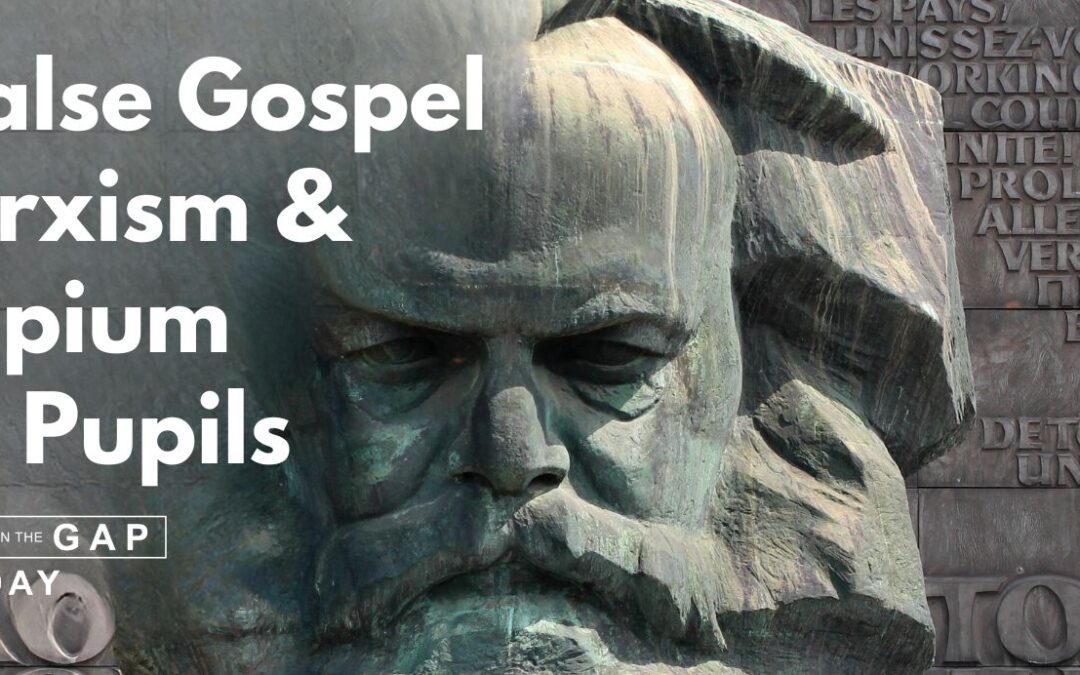

The False Gospel of Marxism & The Opium of the Pupils
August 19, 2026
Host: Hon. Sam Rohrer
Guest: Patricia Engler
Note: This transcript is taken from a Stand in the Gap Today program aired on 8/19/26. To listen to the podcast, click HERE.
Disclaimer: While reasonable efforts have been made to provide an accurate transcription, the following is a representation of a mechanical transcription and as such, may not be a word for word transcript. Please listen to the audio version for any questions concerning the following dialogue.
Sam Rohrer:
Hello and welcome to this Wednesday edition of Stand in the Gap today. And it’s also our monthly focus on creation, apologetics, and a biblical worldview because those things really, they all go together. And today we’re tackling a critical issue silently shaping the heart and the minds of the next generation. Our title for today’s program is this, The False Gospel of Marxism and the Opium of the Pupils. And I’ll connect that with our guest who is today, Patricia Engler. She’s been with us multiple times before. She’s an apologetic speaker for Answers in Genesis. And she’s also authored a book entitled Modern Marxism: A Guide for Christians in a Woke New World. Patricia’s recently also authored an eye-opening article for Answers in Genesis entitled, and it’s where I’ve taken part of the title from. Her title is this of this article, The Opium of the Pupils: How a Marxist False Gospel is Undermining Education.
And in that, she warned that public schools are no longer merely teaching academic subjects, but discipling students into secular activism. Big claim, and it’ll be proven today. So stay with us. Now, as I’ve addressed on previous programs, both of our established American political parties, Democrat and Republican, increasingly operate, and I’ve used this word and you’ve heard it used before by others, but I believe it to be true, a uni party. Together, they push primary common policies. And I’m going to put out a couple of those. Both sides do this. They will accuse each other of certain things, but certain things go forward, such as at the end of the day, what we are seeing is increasingly centralized federal power. There are recurring violations of our US Constitution reflected in such procedures. Here’s an example we’ve talked about before as unchecked spending. And how you say, “Well, how can that be?” Well, as I’ve talked in an earlier program, that’s evidenced and proven simply by one fact that there’s not been a constitutionally prescribed budget passed for over 30 years.
You realize that? Over 30 years. In fearing a loss of control, my sense is amid growing public backlash, leaders on both sides blame socialism and communism as external politically bogey men, even while pursuing practices and passing legislation that frankly implements those very same socialist and fascists or Marxist principles they publicly condemn. Now in her article, Patricia exposes she didn’t go that direction. I just bring that in as an application. But she exposes how in like mannered deceptive, Marxist strategy has been successful using what she refers to as critical pedagogy. And that’s where students are trained to view every subject through an activist lens. And she notes that, “The focus is less on teaching math than on discipling modern Marxist,” turning traditional education on its head. And instead of teaching young people how to think and reason and curricula like equitable math, turn academic subjects into tools for political resistance.
Consequently, basic literacy and math skills plummet while political indoctrination climbs. Now, Patricia, with that, I’m going to welcome you to the program and say thanks for being back with me today.
Patricia Engler:
Great to be back. Thanks for having me on.
Sam Rohrer:
Let’s get right into it, Patricia. There’s too much in this document, so I’ll encourage people to go to the answersingenesis.org website and they can find the entire article. But here’s this, what is, you use the word critical pedagogy that you identified that how Marxist ideology is utilizing this technique. I’m asking you, how are they doing that to move from the fringe of academia directly into mainstream K to 12 classrooms? And what’s it actually look like in daily instruction?
Patricia Engler:
Sure thing. So yeah, critical pedagogy, it’s a Marxist approach to education. So pedagogy, of course, refers to teaching. And the critical is referring to the neo-Marxist idea of critiquing society by interpreting our social institutions through that lens of a repackaged Marxist theory, seeing it all in terms of oppressors and oppressed and calling for a revolution in response. So critical pedagogy teaches students to think like modern Marxists. And in the article, I quote a 2015 journal, an article in the journal for critical education policy studies. And it is celebrating that critical pedagogy has entered the mainstream of US education. And this was 10 years ago. And they’re already saying that critical pedagogy is in hundreds of sessions in academic conferences for teachers and how it’s being applied to every imaginable discipline, including math and phys ed and grade school and even things like business degrees in college.
And again, this is 11 years ago now. And what’s very clear from the article is that the goal of this critical pedagogy is to change society from being capitalist to socialist by radicalizing young people. And as for how this became so popular, this has been going on for decades. If you go all the way back to the 1930s, you had the group known as the Frankfurt School based out of Frankfurt, Germany, group of independent radical philosophers and economists. That one article called A Marxist Think Tank that’s in a Canadian Journal of Sociology in 1999. And they relocated to New York’s Columbia University in the 1930s and became college professors around America and the UK. So neo-Marxism began being pushed in higher education. Young people began being radicalized. Meanwhile, you had in Brazil a guy known as Paulo Prieri, who is developing a very influential approach to critical pedagogy through his book, The Pedagogy of the Oppressed.
That was published in English in 1970. And he basically thought that education was the key to revolution because skills like reading, writing and math are part of an oppressive society. So schools should exist not to teach these skills, but to disciple revolutionary activists. So in a Freerian classroom, students will be learning not just to read and write, but to think about reading and writing through a Marxist lens. Instead
Sam Rohrer:
Of
Patricia Engler:
Teaching a science class, a teacher might present a historical lack of gender diversity as a problem for trying to get a science job and then reflecting, asking students to reflect kind of democratically on how you might use education to change this process. And that’s called problem posing. So they’re not actually teaching science and teaching math, but teaching students to think about these subjects through a Marxist lens. So that’s a quick overview
Sam Rohrer:
There. Well, you did a good job on that. In essence, what you’re talking about is they’re having to take objective truth and either redefine it or reshape it. That’s actually what’s happening. And is that really a part of what’s factored into your title, The Opium of the Pupils, meaning not the in your eye, but the students in the classroom, the fact that they’re numbing our students’ minds to objective truth?
Patricia Engler:
Exactly. So Marx called religion the opium of the peoples. But what’s happening now is that because students are being trained to be activists instead of actually gaining academic knowledge, this kind of has a mind numbing effect. So one of the things that Freiri and other neo-Marxists believe is that schools shouldn’t be about an authoritative teacher kind of giving students a bunch of knowledge because that is representative of oppression. So instead, teachers need to dismantle power structures in the classroom and totally reconfigure how education works.
Sam Rohrer:
It
Patricia Engler:
Is not about knowledge anymore.
Sam Rohrer:
So ladies and gentlemen, you get the sense this will be a fast moving program today because there’s a lot involved. The title chosen is The False Gospel of Marxism. The next segment, we’ll get into some of where the false gospel comes in action to segment three. But it’s the opium of the pupils, the student in the classroom. Marxist philosophy to take objective truth, shape it into something other than truth and produce activists. All right, you got a flavor of it. Stay with us. We’ll continue in just a moment. If you’re just joining us today, thanks for being on board here. Our theme is this, the false gospel of Marxism. We don’t hear a lot about it, but we are hearing more and more about the rise of communism, the rise of socialism. Marxism’s right in there. And if you want to know the connection of all of those isms, stay with us because in section three, we’re going to get into that and explain that a little bit.
But the focus right now is on Marxism and what it’s actually happening through Marxist strategy in the classrooms, giving rise to our title here today, The False Gospel of Marxism and the Opium of the Pupils. Patricia Engler is our guest. She’s with us fairly often. She’s with Answers in Genesis as a speaker for them, a writer, an apologist for biblical truth. And she’s with me because she’s just written an article recently about this very theme. So that’s what we’re dealing with because it’s so relevant. Now with that in mind, last segment, Patricia helped us to identify the problem that she’s identified in our public school classrooms where I’m going to say surreptitiously, secretly, not out in the open by any means, traditional academics are actually being displaced, replaced, displaced by political activism. Now here in this segment, we’re going to continue to follow what I’m doing in this program, and I do on many of them, is a basic analytical approach for issues, problem cause, solutions.
And we’re going to look beneath the surface to examine the underlying cause of Marxism, why this is happening and the anti-biblical worldview that redefines morality, human nature and civil authority. And we’ll touch on all of those. Now in her article, The Opium of the Pupils, Pupils in the Classroom, Patricia reveals how modern Marxism divides society into strict groups of, which these are their words, oppressors versus the oppressed. This is Marxist though. Rather than evaluating individuals based on character, personal accountability before God, and certainly as a soul made in the image of a creator God, this framework, worldview, judges people entirely by their group entity. And under this worldview, foundational God ordained institutions such as the family, the church and local governance are labeled as inherent instruments of oppression that must be dismantled through cultural revolution. This is their thought. And if Patricia notes in this system, she said, “Virtually anything that disempowers oppressors may be seen as good.” While traditional biblical values are labeled as evil.
So just as we see politicians on both sides of the aisle talk about liberty while passing centralized debt ridden policies that build up state control, usurp private property rights and exalt a view of man as God, modern education uses the language of social justice to tear down God’s design for society. So I’m pretty sure with that in mind, how does the modern Marxist framework of dividing society into oppressors versus the oppressed directly conflict with the biblical view of how God lays things out regarding human dignity, individual sin, personal accountability before God and so forth?
Patricia Engler:
Well, sure. Very briefly, neo-Marxism would teach that people are good or evil, not based on their individual actions and attitudes so much as on their group identity. So groups like men, European, heterosexuals, able-bodied people and Christians would be labeled as oppressors. And then the more of these groups you belong to, the more you’re considered automatically guilty of being an oppressor according to neo-Marxism, regardless of what you’re actually showing in terms of your behavior and your character. So this is a prejudicial worldview. It’s prejudging people as bad or good based on their identity alone. And in contrast, the biblical worldview affirms that every single person is created with inherent value as God’s image bearer and that every person is also tragically corrupted by sin. As Roman says, all of us have sinned and fallen short of God’s glory. So biblically, we understand it’s not our demographics that make us automatically good or bad.
Instead, every individual is personally accountable to God and needs Jesus because we are all equally guilty at the foot of the cross and all equally in need of a savior. So that’s a really quick overview of some of the differences there.
Sam Rohrer:
Ladies and gentlemen, as a God-fearing person, if you’re listening to the program, you no doubt are you can identify quickly with what Patricia just said there. God deals with us as individuals made in the image of God with depraved heart from birth. Those are the essential items needing redemption provided only through Jesus Christ. That is the heart of what biblical worldview. It’s the opposite of what we’re talking about here, Marcus’ worldview. And we’ll get into the other isms a little bit in the next segment. But Patricia, go further here. Why? You’ve identified some of the what there, but why are God ordained institutions, specifically the nuclear family, husband, father, mother, children, the local church authority and others? Why are they primary targets of this cultural revolution? And what happens to a society when those foundations are broken down or eroded?
Patricia Engler:
Well, the why ultimately goes back to the spiritual battle aspect. This is a neo-Marxism as well described as a false gospel. So there’s very strategic reasons for advancing it. And Jesus, of course, established the marriage unit as part of all the way back in Genesis, man shall his father and mother and be united to his wife. So anything that attacks marriage is part of an anti-God agenda. We understand that. And socialism certainly does that. We can talk about some of the historical aspects of that. But the other aspect along with the spiritual battle is a strategic one because institutions like the local church and family help keep society stable and healthy by God’s design. They’re also the discipleship units that God has established for passing a biblical view and lifestyle from one generation to the next. But what Marxism has to do is they want to replace the current society with one founded on their own ideology.
So they have to break down these social pillars of the current social order. And when we start to erode those institutions of the family and the church, predictably the results are going to be chaos and heartache because anytime that we go against God’s designs for humans, we cannot flourish. We end up harming ourselves. And history, this pans out in history. For example, I point people to a historian named Nicholas Timichek who showed that after Lenin’s followers brought communism to Russia, the communists took a number of steps to weaken family ties and to remove church authority within the family unit. So they altered laws to make divorce easier. They removed church’s authority to marry couples, decriminalized adultery. They had to send husbands and wives to separate factories. They legalized abortion and they enacted measures that gave children superiority over their parents, which unfortunately we’re seeing similar things today.
And in Russia, these steps totally backfired by causing so much chaos and delinquency that the communists actually had to backtrack and kind of undo some of these steps they took, but a lot of damage had already been done. We can expect that living not in line with God’s designs will always cause personal grief and social disorder. And that’s exactly what we see.
Sam Rohrer:
Well, it is exactly. And as you’re describing that, and I asked you that question about the institutions, ladies and gentlemen, Romans 13 talked about the institutions of authority. God ranking the authorities, ordained them all, but what are they? Well, family. The church came later. Civil authority. God ranked all of the authority. So what you’re describing at the heart of everything, Patricia, is the fact that Marxism and the otherisms to that extent are all attacking and undermining God’s authority in his order of ranked authority, which I think by definition would be rebellion, which really sounds like these isms, doesn’t it?
Patricia Engler:
It sure does. Yeah. That’s well said.
Sam Rohrer:
Right. A little bit left here. Let’s walk into this. It would appear that when you talk about the falling and the breaking apart of the family. Okay. We’re seeing that all around us. And you used communism in Russia as an example. And people who are old enough to know, they can look back and remember when that came forth. However, in our nation that once knew God, that has a frame of government that says in God we trust, who or what or by what means is this opposing Marxist philosophy actually able to be implemented across our nation without seemingly people noticing it?
Patricia Engler:
Well, there’s historically two channels for making this happen and for changing a culture’s worldview in ways that get around people’s defenses. One is through the mass media because media tells stories and stories get past sometimes our more logical, critical reasoning. So authors like Paul Kanger, for example, have documented at length how Marxist messages were being promoted through the American media and especially the film industry in the 20th century. If you think about the movies and shows today, organizations like Disney kind of come to mind. You might see the villainization of certain groups that neo-Marxists would consider oppressors, including say European male clergy members and just kind of categorizing things in terms of group identity. The white lines are bad. The colored lines are good. If you look at the Trailer for the Last Lion King, that type of thing. So media is a big one as opposed.
Or sorry, the second big channel would be education system as we talked about. And then a third one to keep in mind now that overlaps with both media and education would be technologies like artificial intelligence. People are getting a lot of their answers from chatbots. And I cite a number of studies in the article Opium of the Pupils. I think footnote 17, if you want to find them, showing that these chatbots, as a lot of us can see, have left wing political biases. So these are just three ways that these views are being advanced in society without people necessarily noticing.
Sam Rohrer:
And Patricia, that’s excellent. And we could add more onto that, ladies and gentlemen. False prophets in the pulpits who don’t tell the truth. Aha. We’re going to put that in there as well because that takes us into the next segment where we’re going to compare this aspect of Marxism, a false gospel, a counterfeit gospel versus biblical truth. We’ll make some compare-contrast comparisons in this next segment. Well, welcome back here to Stand in the Gap today. We’re now right in the middle of the program and continuing in our focus, our theme, the False Gospel of Marxism and the Opium of the Pupils. And with that title, you get a reference to the component Marxism. All right. We’ve been talking about that. False gospel. We’re going to go into how that fits. And we’ve talked about the opium aspect of the people and basically how Marxism has taken objective truth.
And when we say, like opium, actually blinded the thinking process of our students by integrating not truth under the guise of truth into curricula and moving our children for a long time now from objective truth, which we know is found in God’s word, is God’s word, is God truth only, into some manmade definition of truth. In reality, that’s it. Now in the last segment, Patricia Angler, who is my guest here today, she’s with Answers in Genesis in the article that she’s written on this theme you can find at answersingenesis.org. But she’s helped to uncover the underlying ideological cause behind the shift in our classrooms. A modern Marxist world view that divides society into oppressors versus the oppressed. That’s their main theme. They just drive that home over and over again. And they target God ordained institutions like the family and like the church. Why? Well, because those are institutions of authority created by God.
The devil is behind it all. He is rebellion by the very nature of it. And so the attacking of God’s authority involves the attacking and undoing of the institutions of authority created by God as we find in Romans 13: one. Now in this segment, if we move toward a solution, we have to clearly contrast this secular ideology with the foundational truths of biblical Christianity. Marxism is not merely a political or economic philosophy. It’s a counterfeit religion. And Patricia, you wrote this in your article, The Opium of the Pupils. You said this, “Marxism is a false gospel where a false savior redeems us from a false original problem to usher in a false heaven on earth.” And where scripture identifies our fundamental problem as internal sin, which you’ve referenced and I have as well against a holy God, Marxism claims that our problem is external, social, economic structures, other people.
Where Christ offers spiritual redemption and individual transformation through his cross, Marxism demands political revolution. And where collectivist systems, whether I’m going to use these words because we’re going to talk about them, socialism, communism or fascism, they all strip away certain things like private property. They erode individual stewardship. They elevate state authority. They attack biblical Christianity. They undermine the authority of God’s word rather than affirming private property, human dignity, and limited civil governance. So with that in mind, Patricia, before we proceed further into the false gospel aspect, because I want to make sure that we get that in here that you’ve identified, I’ve referenced these other terms, communism, socialism, fascism, Marxism. A lot of people don’t know perhaps where they’re alike and where they differ. Can you just, in simple terms, kind of put them together? What’s the same? What’s the different about these isms? Because they kind of travel together.
Patricia Engler:
Absolutely. So really briefly, how they relate together is that you have the philosopher, Carl Marx, and he came up with this theory where he wanted society to transition from capitalist to communist societies by means of socialism. So to break those terms down a little bit and contrast them and compare them with fascism, I like pointing people to the dictionary, especially the online Merrimebster dictionary for these, because the definitions might be surprising. So if you look at that Merriam Webster dictionary and look for Karl Marx, you’ll find that, or look for Marxism rather, you’ll find that these are principles and policies advocated by Marx, especially a theory and practice of socialism. So socialism is central to Marxism. And then if you look at the dictionary definition of socialism, you’ll see that they say a pure form of socialism kind of as Marx wanted it to end up being, is a system where the means of producing and distributing goods like food and clothes are owned collectively by the people or government.
A system of group living where there’s no private property and where the means of production are owned and controlled by the state. And that sounds an awful lot like the definition of communism. Where all those things are in place, people own goods in common, the state controls the means of producing goods, private property can be eliminated. But then you also have society going further, moving past things like the government. So Marks thought the state would kind of wither away and you’d be left with just the people kind of running themselves. And he called for initially what he called a dictatorship of the proletariat. This would be right after the revolution when you have socialism in place, the workers’ revolution. And then again, the communist society in its full form, you have people totally getting rid of private property and religion, government, family, and supposedly living happily ever after in that society.
And so that’s communism, what Marx wanted to get via socialism. The dictionary notes that though there are different variations of what people call socialism, with some being more clearly anti-capitalist than others, it says, this is a quote that in English, the term socialism has consistently referred to a system of social organization in which the ownership of property and the distribution of income are subject to social rather than private control. So you see communism is the final form and goal of socialism. And in communism, as Marx understood it, the people would be the ultimate authority for truth. So it’s a kind of totalitarianism, something besides God setting the standard for what’s true and what everyone should think. Fascism is the same in the sense that you have something besides God as the authority, but fascism puts the state as the total authority for truth and what everyone should think and all that.
So both of them are totalitarianism, but Marx though communism, the people would be the authority and fascism thinks the state will be the authority. Quick summary.
Sam Rohrer:
All right. That’ great. Ladies and gentlemen, you get the idea. They’re brothers or sisters, at least first cousins. But anyway, we’ll leave it there. But let’s move now, Patricia, into this aspect of truth. And you described Marxism as a false gospel because what you just described there in most definitions generally tend to go towards the means of production. Let’s put it that way. Production, the means of production, property and who controls that. But you went to the heart of Marxism as a false gospel. Why is it vital for Christians today to recognize that modern Marxism or any of the isms you just went through is at the end of the day, a competing secular religion rather than just some other political perspective?
Patricia Engler:
Well, it’s not just what they want as an outcome for society. That’s part of it. That’s kind of what you might call the eschatological part, where we want the future to end up being is in this communist system. But that’s just kind of the revelation chapter of a whole other false gospel where you have, like you mentioned earlier at the beginning of the segment, a totally false version of the Christian meta narrative of creation, fall redemption and restoration. So for creation, we’re not created beings by God. We’re kind of self-creators. Our problem is not sin, but economic systems like private property, divided labor, our hope is revolution, very false gospel. And socialism isn’t just meant to bring in the heaven on earth. It’s meant to replace Christianity. It’s a worldview. So I point people to a quote by Antonio Gramsi. He’s an atheistic member of the Italian Communist Party.
This is back in the 20s and 30s. He was doing a lot of his writings. Part of those were from prison actually. And he’s a very famous influential neo-Marxist. And he wrote, “Socialism is precisely the religion that has to kill Christianity.” He said that in Italian, but that’s what it translates to. And you can find the reference for that in the book Modern Marxism and in my talk about it on our YouTube channel. So that’s a really quick overview. This is a religion meant to replace Christianity.
Sam Rohrer:
So you go right to the heart because they go right to the heart. Okay, just a little bit left here, time-wise, but how do biblical principles, name what you can here, specifically God’s supreme authority or individual stewardship and private property as an example. Why are they hated so much by all these other isms?
Patricia Engler:
Well, they are, again, it’s because these other isms fall under the umbrella of totalitarianism, which is a system of governance that makes something besides God the authority for truth, whether that’s the state or the people. And if something besides God is the authority, that’s an idolatrous religion. And it always ends in heartbreak and chaos. You cannot have sinful humans trying to make heaven on earth apart from God. It just will not work. The Bible also talks about, as you mentioned, the importance of individual stewardship. We see all the way back in Genesis in the garden of Eden, God created Adam and Eve and gave them dominion over his earth, but under his ultimate authority. And throughout the rest of the Bible, including the law of Moses, we see a God affirm Something the principle is the human stewardship of private property that ultimately belongs to God, but we steward it.
And part of the way we’re to steward it is through voluntary generosity and not being greedy, those types of things. But that’s not subject to state coercive control. That’s us responding to God out of love for him as our supreme authority, not the state or the dictatorship of the people taking wealth as a way to enforce their authority. So those are just a few of the main direct differences
Sam Rohrer:
There. And that’s excellent. And Patricia, thank you so much for what we’ve shared so far. Ladies and gentlemen, the next segment stay with us because we’ll come at that point, the biblical solution. We’ve dealt with the problem, we’ve covered causes, and now we’re going to go to the solution. But can I throw in here as well at this point that the face of rebellion, be it Marxism, communism, socialism, fascism, or whateverism it would be, they can masquerade under the name of God. They often masquerade with some people saying God’s name. So let’s remember that. We’ll do that in a second.
Well, as we go into our final segment, just one reminder that the article by our guest today, Patricia Engler, on this matter of Marxism being the opium of the pupils, talking about students in the classroom and the connection between Marxism in the classroom as a false religion, false gospel we talked about in the last segment, and how it’s found its way there and all of that. You can find that article on their website at answersingenesis.org. So you can search for any of those things, her name or probably anything in that title. I think you probably bring it up. And then on here, if you access this program in archive form, either on our website or on our Stand in the Gap app, you’ll also be able to access a manuscript of what we’re talking about, which may be, and I think many people do find it helpful to actually read down through as you listen to the program again, just simply because if you’re like me, you can’t remember everything that you hear and it’s helpful to go back through.
So I encourage you to do that. All right. Now with that said, up to this point in this program, we followed a systematic analysis format, the problems, cause and solution. We identified the problem in our classrooms where traditional education is being displaced by political activism, Marxism, Marxist though. We’ve exposed the underlying cause, an anti-biblical Marxist worldview that divides society and targets God ordained institutions and along with all the other isms we talked about in the last segment. They’re all in that category together. And we’ve contrasted this secular ideology with the foundational truths of scripture, recognizing Marxism for what it truly is, and that’s a counterfeit gospel. Now in segment four, this segment here as we conclude, we’re going to turn to the solution because deception cannot simply be cursed. In other words, you just can’t say deception’s bad. It has to be displaced by the truth.
That’s the only antidote to deception. And as Patricia reminded us in her article at the Opium of the Pupils, she said this, “Christians must be at least as intentional about discipling the next generation as modern Marxists are.” And those who embrace a true biblical worldview and a genuine fear of God, most of you listening to this program are probably in that category. We cannot afford to remain passive while the world and the world system disciples our children and grandchildren and conform them into the mold of an anti-biblical worldview. That’s what Romans 12: one and two is all about. Teaching our children and impacting our culture as salt and light requires that in our own minds, we be transformed by the renewing of our minds. Into what? In alignment with Christ likeness and complete submission to the authoritative word of God. And that requires building unshakeable personal foundations, spiritual, intellectual, and interpersonal.
Parents, grandparents, pastors, church leaders, we must all actively mentor our young people, equipping them with biblical apologetic, critical thinking skills, biblical critical thinking skills, and to bold confidence in the authority of God’s word. Now that being said, Patricia, you emphasize in your article, and you always do that, which is a very good thing, provide solutions at the end like we tried to do on this program. And you make it clear that the antidote to lies is truth. So identify some of these practical steps that parents, grandparents, church leaders may take right now to build strong spiritual and intellectual foundations and biblical thinking skills so our young people learn how to think biblically for themselves in the midst of this rising generation.
Patricia Engler:
Absolutely. So there’s seven ways that I describe in the article. And the first one, which is kind of the most comprehensive, is building those personal foundations you’re referencing. Spiritual, intellectual, and interpersonal foundations is what I call them. So spiritual foundations is both for us and then discipling children to have a close personal walk with God fueled by staying in scripture, meditating on that, reading it daily. We need that. It’s our spiritual fuel and self-defense weapon, the sort of the spirit. And then practicing an ongoing lifestyle of worship and prayer, modeling that ourselves, and then teaching young people how to implement that. So spiritual foundations. Second is intellectual foundations, as you mentioned as well. Having apologetics answers like what you can find at answersingenesis.org, along with biblical critical thinking skills to defend why our Christian worldview is true. Lots of info for both of that on our website.
And then finally, interpersonal foundations is helping your children develop a strong Christian community, especially if they’re going to go off to university in some other location. Help them be able to plug into a biblical local church over there. These types of intentional things we can be disciple in children to do from the very beginning. That’ll be very helpful. Second, find opportunities ourselves to mentor younger people, whether that’s by maybe volunteering at a campus ministry or for different initiatives at our church, BBSs maybe, helping them build these foundations. Third, just learning more about the Marxist worldview that we’ve been talking about today is essential for them being able to recognize it, recognize how it’s being taught and teach students to recognize it as well and to replace those Marxist lives with biblical truth. And then fourth, teaching and modeling the skills that young people need to think and speak for themselves.
We have, for example, if you go to our website and look for biblical critical thinking tools, that’s a really quick article that you can share with students or with young people, people in your church or community that will help them develop some of these skills. Fifth, raising awareness among other parents and church leaders about what’s going on. Sharing this episode can be a great way to start.
And then sixth, praying for students. And then seventh, sharing the true
Sam Rohrer:
Gospel. Okay. And that’s excellent, Patricia. Ladies and gentlemen, you can find it in her article if you bring it up there or listen, get a transcript. We’re just about done here, Patricia, but let me just ask this because many, many, many times what you just said, we all have a tendency to say, “Well, I hope that somebody else does that.” And we don’t often think that, well, we’ve got to do that ourself. We expect someone else to come forward and to tell us these things here today. Whose primary responsibility is it to make sure that we’re not conformed to this world?
Patricia Engler:
Well, the Bible’s pretty clear in Ephesians, for example, that parents are to train their kids, fathers especially in the admonition of the Lord. In Deuteronomy two, talking about the laws of God, applying God’s word to your life day and night. So it’s clearly an emphasis on the parents. And I’ll point out as well that the rest of that chapter in Ephesians six that tells fathers to train their children, the rest of that chapter is about spiritual warfare, which goes back to this reality that the Marxism students are being taught is part of a dark spiritual agenda. If you look up on our website, The Dark Spiritual Roots of Socialism, you’ll see this is not just an arbitrary kind of political thing. This is a long-running spiritual agenda with literally satanic roots. That’s not hyperbole. There’s good historical evidence for that. The attack on the family is a central goal to that.
And as parents, even though you can’t vouch every single thing that your kids might be learning in school, you need to be aware of what they’re being taught. And if they’re in a public education system, you can expect they are being discipled to think as secularists. So we encourage parents to answers in Genesis, make sure your kids are getting a biblical education. Not all Christian schools teach it. A lot of them unfortunately teach secular worldviews with just some Bible verses added on top, like cherries on a poison sundae. So please make sure that you’re vouching what your kids are learning, being aware of how they’re being discipled. That’s the primary responsibility that God has given
Sam Rohrer:
Parents. And Patricia, to that, I say amen. Well stated. And ladies and gentlemen, can I just bring it back really practical? You have to understand and have a relationship to God through Jesus Christ and faith alone to begin with. In this country, the great majority of all who think and say they’re Christians, we know by their own words, George Barnes surveys are not. Personally, the decision, Romans 12: one and two, not be conformed, but transformed. It’s a personal decision. The sooner we can teach our children, they need to make that decision themselves, the better off we are. Anyways, with that, we’re going to say goodbye to you today. Thanks for being with us. Join me tomorrow here on this program. And again, Patricia Engler from Answers and Genes, thanks for being with us today. Great information. God bless you.

Recent Comments