
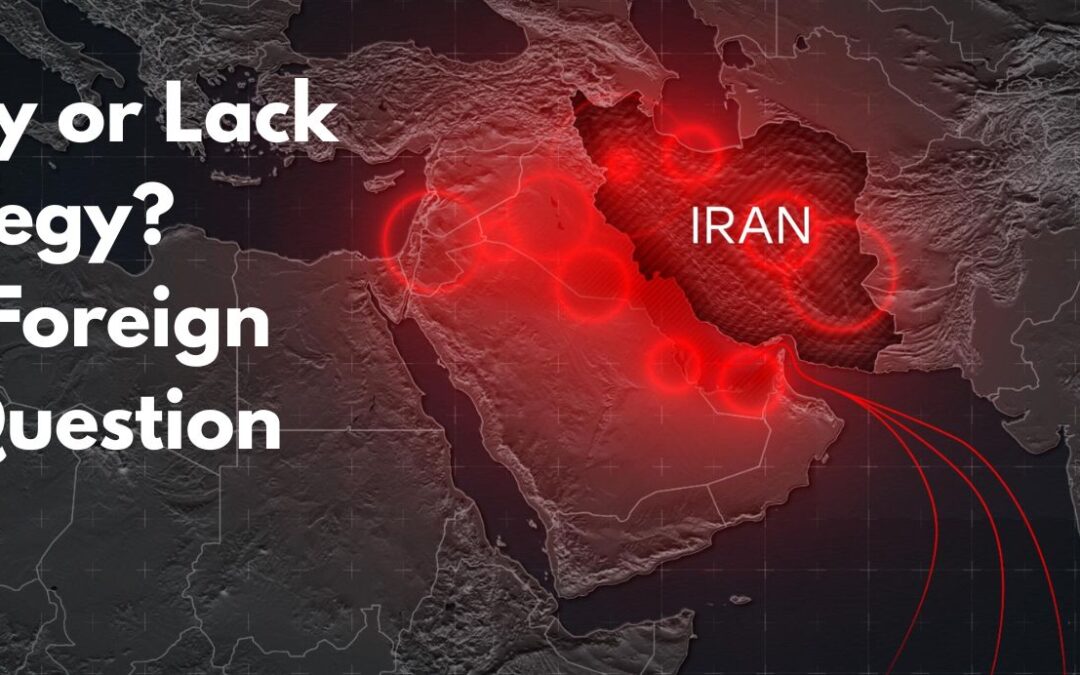

Strategy or Lack of Strategy?
The U.S. Foreign Policy Question
Sept. 7, 2026
Host: Hon. Sam Rohrer
Guest: J.R. McGee
Note: This transcript is taken from a Stand in the Gap Today program aired on 9/07/26. To listen to the podcast, click HERE.
Disclaimer: While reasonable efforts have been made to provide an accurate transcription, the following is a representation of a mechanical transcription and as such, may not be a word for word transcript. Please listen to the audio version for any questions concerning the following dialogue.
Sam Rohrer:
Hello and welcome to this Monday edition of Stand and the Gap Today, and it’s also our monthly focus on national security, international geopolitics, and biblical prophecy. And we do this once a month, generally on the first Monday of the month, which is what today is, with recurring guest J.R. McGee. He’s the X-stream leadership group founder and CEO, and also expertise for many, many, many years in the area of strategic leadership and also functioning and training others as a counter-terrorism specialist. Now, in this opening segment, we’re going to tackle the concept of what I’m going to call the grand blueprint or lack thereof perhaps depending on perspective, and that is that which touches or governs US diplomatic posture policy. Proponents argue, and there’s a whole wide range, but some proponents would argue that the apparent turmoil that we’re seeing emanating out of Washington as an example of policy here surrounding trade and defense alliances and international treaties is a calculated shock doctrine, in other words, designed to actually make big, bold claims and to disrupt entrenched globalist bureaucracies and extract maximum bilateral concessions for America.
And on the other hand, there are critics who counter this by saying, well, disruption is not strategic at all, but rather what we’re seeing is an erratic result of more impulsive transactional type leadership that sacrifices long-term institutional stability for more short-term political wins. Now, one observation upon which I think all can agree is that the current world order, the global picture, we speak about that often here, and JR and I do when we get together, the international and regional alliances as we have known them since World War II are rapidly changing. For instance, Herbert Walker, Bush, Bush I, before Congress made a bold declaration, as most of you can remember, where he talked about the emerging new world order that he desired. But frankly, every US president has spoken of one degree or another about an existing world order, a changing world order, and one degree or another have weighed in with their idea of what it should be for the future.
Nations such as Russia and China and the European Union, as an example, they’ve also expressed their desire over the years to create or shape in their image some new world order different than that which currently dominates the world as represented by the Western world versus the Eastern world and the Western world now and the world effectively ruled by the economic power of the US dollar and the scope of the US military. Now, in our day, Donald Trump came to power promising a new golden age, a new way of doing things, returning of America to the America of old where products were made here and where our nation was respected for who we are and were. But without dispute, the world today is far more chaotic than ever. Clear goals, debated policies and diplomacy as we used to see, say like under the days when Ronald Reagan existed with Tip O’Neill, as an example, that’s been replaced with more partisan transactional relationships with statements and policies made unilaterally oftentimes and sometimes subject almost immediate retraction and change within the next hour.
And so the need to provide some focus in today’s conversation as we look at this, I’ve entitled this Strategy or Lack of Strategy, the US Foreign Policy Question. So we’re going to take a look at that. And with that, JR, welcome to the program. Kind of a big issue in some respects and we’ll not be able to make it exhaustive, but anyway, let’s take a shot at it. Thanks for being here.
J.R. McGee:
It’s my pleasure, Sam, and this is a critical issue facing us today and I’m anxious to get into it.
Sam Rohrer:
Well, let’s get into it because now from a military strategy perspective, that’s where you’re coming from in particular, how would you describe the current state? I’m going to say international relationships, policies that are emanating, in particular from Washington, more than we talking about Washington or Beijing or Moscow. We’re talking about Washington here. Are the policies that we are seeing in the frame, the way they’re laid out, are they clear? Are they becoming more clear? Are they confusing? Perhaps becoming more confusing? And does the current approach from your perspective project strength and confidence or is it actually causing questions in an undermining of historical American credibility?
J.R. McGee:
Sam, that’s a great question. And it looks like that the administration’s all over the map and lurching from crisis to crisis. Let me just give you a few examples. The Middle East, absolutely on fire. The Russian-Ukrainian war that was once promised to be solved in less than a week is still going on. NATO is in constant upheaval. The European Union struggling to stay together. Venezuela, Cuba, and Greenland, they’re now very much in play and behind the scenes. They’re connected in ways, directly connected in ways that impact the long-term security of the United States, both economically and militarily. Look at Canada. They’ve decided to pick a fight with the United States over trade policy. That’s blown up and gotten ugly. It would be very easy to look at all of these different things and say, “This is out of control.” But if you look at it behind the scenes and you look at it from a specific perspective, I see a strong strategy.
I see a coherent desire that pulls all these things together in ways that aren’t obvious immediately looking at it from the surface, Sam.
Sam Rohrer:
Okay, JR. And we’ll build that out further. And ladies and gentlemen, we’re going to make and kind of apply the policies we’re seeing in the second segment to Iran because that’s a big issue. A lot of policy involved there. Oil, we’re going to talk about that in the third segment and then we’re going to end up with the fact of how biblical prophecy brings it all together. But JR, just from your perspective, military strategy, it’s one thing keeping the enemy off base. My perspective of being in office for as long as I was, policy is coming from that. I look and say debated policy, carefully stated, put forward so that it becomes a matter of credibility is far different than let’s say policy by tweet as an example that we’re seeing that forever keeps people off base. What about that? What’s your thought on that?
J.R. McGee:
That’s interesting also. This is brand new. Part of it’s technology. We’ve never had tweets and instant messaging before and diplomacy and governmental communications have normally historically plotted along at the speed of snails. Today, things are moving much faster. And I would argue that some of this is incredibly effective, but is it all being handled professionally? Is it all being handled correctly? Absolutely not. I think some of it borders on juvenile, but all of it is designed to send messaging to people faster than we have in the past. And I would say more effectively than we have in the past, but it is absolutely different than it has been in the past.
Sam Rohrer:
Okay. And that’s great, JR. Ladies and gentlemen, stay whether we’re talking about strategy or lack of strategy, the US foreign policy question. We’re talking about how things are being done, primarily policies coming out of Washington, but it will extend beyond that. We’ll be right back. Well, welcome back to Stand in the Gap. J.R. McGee is with me today here on this first Monday of the month, which we do almost every month if we’re able to do that on this first Monday. And our consideration today is one that we can’t fully exhaust at all in the space of one program, but it’s an important one to consider strategy. And our theme is this, strategy or lack of strategy, the US foreign policy question. And in our opening segment, JR and I, we tackled, I would say the overarching blueprint regarding the current governing Washington foreign policy posture.
Some say it’s strategic, others say it’s erratic. And how does that fit together as one looks at as policy versus strategy and that kind of thing. But we’re going to narrow our focus now to what is arguably the most volatile flashpoint, I’m going to say testing this strategy. And that is America’s ongoing approach toward Iran and the broader Middle East. Rapid pivots that we witness routinely in sanctions enforcement, threats of one type, retractions, erratic maximum pressure tactics, inconsistent messages which we know exist regarding deterrence and all of that have left both enemies and long-term regional allies scrambling to recalculate and to determine their relationship with the United States. Proponents contend that this deliberate ambiguity as it relates to Iran in particular keeps Tehran completely off balance, assuring our success over them. And on the other hand, it keeps the regime from solidifying their regional dominance.
But on the other hand, critics would say that, well, there’s a different outcome. Look at what’s happening in the Middle East. Our allies are no longer able to depend upon us. Traditional Sunni allies, deeply unnerved by American unpredictability are being. Well, they’re being driven to build independent security architectures entirely separate from Washington with US military bases in the Middle East, now mostly in tatters, not really usable, making the US presence there more unreliable than at any time in their inception. We’ll talk a bit more about some of that that’s happening. But JR, with that, looking at Iran, because without a doubt, I mean, you and I have talked about this for a long time since February 28, it’s there in the news, but from the perspective of Iran policy and strategy, to what degree from your perspective has the shifting US posture toward Iran, clearly different now than what it was in Obama before, obviously we know that, but to what extent has it successfully disrupted Tehran’s strategic calculus and has it actually made for a weaker Iran or perhaps inadvertently actually acting as a catalyst for forming new alliances like this, the new Mecca joint defense agreement between Saudi Arabia and Turkey and Pakistan?
J.R. McGee:
Sam, like several things in life, both of those can be true at the same time. I think it has absolutely thrown Tehran for a loop because they were used to American presidents ultimately blustering and then folding very quickly and giving them exactly what they want. Trump’s not doing that. Trump is playing this completely differently than anything that they’ve seen in the last 50, 60 years. But at the same time, the way that it’s been occurring has caused countries like Saudi Arabia in particular, Jordan and the UAE to be concerned because they absolutely wanted the United States to go in and deal with Iran quickly, violently and put it down and fix it. When Trump took his foot off the gas and gave them a break and essentially saved the Iranian regime by stopping the bombing, that threw everything into turmoil. Trump seems to be obsessed with peace deals as opposed to fixing problems.
Now Iran is a problem. It’s going to have to be fixed. If it’s not fixed, it’ll continue to metastasize and we’re seeing that. But the strategy that they’re using is twofold. It’s to take away their ability to be aggressive and taking away the money that they’re using to finance terrorism throughout the rest of the world and to support their own government. But those strategies both require time and patience. The one thing that the American people have demonstrated is we have no patience for anything that lasts more than two news cycles. This economic strategy that Bessent is pursuing is absolutely effective. It is dramatically effective, but it takes time for money to dry up. It takes time to shut off all of the different feeder circuits that money can come into the system. Time is the one thing that people want to take away from this.
They’re not willing to allow the strategy to be successful because they want it done, they want it over with, they want it over with now. You can’t take a problem that’s been in existence for 47 years and fix it over a weekend. It’s unrealistic, but it also requires that the administration be very clear and communicate exactly what they’re doing and why, and that’s compounded by the fact that you don’t want to give the enemy insight and information that can be used to defeat your strategy. So it’s a very complicated dance that we’re in. The strategy that they’re using is effective. The weakness is it requires time and time’s the one thing we don’t have.
Sam Rohrer:
Okay. Let me come back with you on that, JR, because what you’re discussing there, a policy aspect is effectively sanctions and what Bessen’s talking about is secondary sanctions, trying to limit other countries. Well, immediately after he stated that, China came back and told Bessent and the United States to pound sand, that we’re not going to do it, so don’t threaten us. And you and I have talked in this program before that sanctions have never worked. So why are you thinking now that that approach. Are you saying that you think it will work now? And if so, why?
J.R. McGee:
No, it’s not the sanctions that work. It’s the elimination of the military capability and the elimination of the money to defend that military. The sanctions in and of themselves don’t work, but money is what drives militaries. When you cut off the funding, you cut off the ability for them to become aggressive. I don’t think it’s the sanctions that’s working, but it’s shutting off their economy, turning off the oil spigots where they get their money. That’s not necessarily sanctions as much as it is an economic weapon. We’ve used sanctions in a way that had been completely non-effective, but for the first time in my lifetime, we have found a way to turn off an enemy’s ability to fund its direction and its activities in a way that’s really beginning to hurt. Like I just said though, that takes time and time is. I would give anything if people were willing to see something through all the way to the end, but we’ve become such a culture for immediate gratification.
I don’t think that’s possible anymore, Sam.
Sam Rohrer:
And that raises a real challenge. I agree with you as well on that, Jayar, that we’ve moved to if I don’t get something in 30 seconds, I’m not going to read anything. It’s the same kind of a mindset. But in this case, policy with Iran, we go after Iran February 28th, Iran shuts poor moves and stops oil. Well, I would say from a strategic perspective, why did that happen? Because Iran has made it clear, we’re going to outweigh you because you depend America on oil. We depend on oil, yes, their revenue, but we depend on oil for fertilizer. I mean, our diesel prices are going through the roof, crude is going up. So strategically, which strategy is working?
J.R. McGee:
In war, it’s inherently messy. War is always chaotic. I don’t care how good your plans are, the enemy gets a vote and they get to react. You can’t always assume or predict exactly what an enemy’s going to do in reaction to your actions. That is why successful militaries really focus on flexibility and rapid response, rapid reaction and change because everything that happens is happening in a way that it’s real time. I hate to use this example, but in a bar fight, you didn’t walk into the bar planning to get in a fight, but when it happens, it happens very quickly and it doesn’t matter how much you’ve trained or how much you’ve prepared, it’s never going to go the way you absolutely thought it was going to go. I don’t care who you are, I don’t care how good you are, it’s going to be slightly different than you thought.
The best that you can do is be able to react faster than the other person and react more intelligently than the other person and/or have deeper resources and deeper access to capability than the other opponent. I think Iran has always been able to outlast America and they’ve realized that America’s greatest weakness is we don’t follow through and we don’t hold people accountable
And they think that that’s going to be the success here. I think Trump is changing that equation and they’re not yet quite ready to admit that, but I don’t think Trump’s going to fold like all previous American presidents.
Sam Rohrer:
Okay. Hold that JR out of time. Ladies and gentlemen, stay with us because as we talk about policy, JR McGee, my guest today and myself talk about this matter of policy. In the next segment, we’re going to connect what we’re talking about and talk about oil overall because it is the focus. Well, as we continue our discussion here talking about strategy or lack of strategy as regards to say US foreign policy, we consider a little bit from an overall perspective in the first segment. JR McGee is my guest again today. And then the second segment we looked at as it applies to Iran, and again, weren’t able to exhaust it by any means, but very clearly Iran is in the news, policy at any one given point in time, most people wouldn’t know exactly what it is because things change from day to day. And so we were talking in terms of that, but ended up talking about oil because oil seems to be at the heart, certainly a major focus of what’s taking place between our policies here and Iran, and Iran is using that commodity called oil against the West, against the United States.
There’s actually a lot of, well, tactical things that are happening back and forth in regard to that. So I want to go there specifically because when you come back home here, JR, before Iran came into the picture, oil was already a discussion here and I want to ask for your comment. So from a strategic leadership and I want to say national security perspective, one would say that oil policies have been weaponized. Everybody needs oil. China needs oil. We need oil. We sell oil. Russia survives on oil. The world runs on oil and oil policy. So when tariffs are applied, when we put pressure on various countries because of oil, or now Iran is putting pressure on the world, including us because of the Straits of War moves, at the end of the day, it’s a question of, all right, well, oil policy and what we’re seeing out of Washington, is that stabilizing?
Is that strengthening our position or is that actually weakening it and actually driving our former partners away from us? What do you think?
J.R. McGee:
Through the history of the world, trade and items that are critical for trade have driven conflict. In fact, oil, this is not the first time that war has been created over oil. A lot of people don’t realize it, but World War II with Japan was triggered by an oil embargo. The United States cut off oil to the country of Japan before World War II, and that led to Japan attacking Pearl Harbor over the strategic availability of oil. This is nothing new, but the fact that people are beginning to understand how critical it is for economies and the fact that it’s affecting people’s pocketbook, that’s a little bit new. But you’ve got to realize that there’s all kinds of things going on right now. Canada, there’s this trade issue with Canada and it’s over the perceived fairness of trade. Oil is also an issue perceived as fairness.
Those who have it, it has value. Those people who need it, they’re willing to provide value. There’s so many things about how oil drives the world’s economy right now. It is the quintessential determinant value for markets everywhere. Everything depends on oil and whether or not you can get it, whether or not you have it or whether or not you have it in reserve. Countries that do are always going to have leverage over those that don’t.
Ironically right now, the one thing Iran has in their favor is access and control of a strip of water through which 20% of the world’s oil flows. Now, some people would say 20%, that’s not that big a deal, but it’s a fungible issue. 20% impact there has to. When that’s missing, it’s got to be replaced from someplace else. And then you’ve got the war in Russia. Ukraine’s been attacking the refineries and oil facilities in Russia and taking a lot of that offline. That has had to be replaced. The Chinese, they get most of their oil from the Middle East and Iran in particular, that’s got to be replaced. So when you choke down that much oil in one location, you directly impact the supply of oil in all these other locations and it becomes more valuable because it becomes scarcer. We can talk about socialism all you want, but the world runs on capitalism.
When you have something of value, you have something that people want, people will trade for it. It’s that simple. You can’t just wish you had it and people give it to you. You’ve got to either trade for it or take it. The world works peacefully when we trade for it. The world descends into chaos and more when people want to take it, Sam. I
Sam Rohrer:
Mean, I think people listening would say, “Yeah, obviously that makes sense.” And we can see that because as a matter of strategy, Iran has said China looks as well, and they look and they say, “Wow, wow, diesel prices in America going up, up, up.” The president has been, in order to try to stabilize some prices, has been depleting US strategic oil reserve, which is nearly at the bottom now. And you said now there’s a trade war happening with Canada, which is a really tough thing from my perspective because they are our friends and it’s being driven into almost an enemy capacity. So with all of that happening, it’s not just America and Iran, it’s actually the world. How do you see non-Western powers like Russia and China, even though Russia has taken the refineries being hit because of Ukraine, how do you think Russia and China are capitalizing on this energy uncertainty as a matter of policy?
And do they, in your perspective, perceive US policy to be consistent, predictable, or erratic, an opportunity for them or a threat to them?
J.R. McGee:
I think they see it as a threat, Sam, and I think. Let’s take a look at what just happened in Venezuela. A lot of people think that we just arbitrarily took over Venezuela. Venezuela was a threat. China and Russia and Cuba were using Venezuela as a base to build the capability to launch attacks against the United States. People don’t realize just how many Iranians and Middle East terrorists had moved into Venezuela as a safe haven. Venezuela has enormous oil reserves. They’re one of the largest holders of oil reserves, in fact, more than Saudi Arabia. So the United States went in and took Maduro, resolved a lot of the conflict and the chaos in that country, and through individual private companies are beginning to invest in rebuilding the oil infrastructure in Venezuela that was allowed to dissolve and rust and corrode away. Venezuela, even though they’ve got these massive oil reserves, had allowed their entire oil industry to degenerate into something that would not work at all.
So in exchange for America coming in and revitalizing these oil fields, we’ve signed a trade deal with Venezuela for 65 billion barrels of oil and it’s heavy crude. Now, US crude oil is light, it’s sweet, and that’s good, but it doesn’t allow us to refine for all of the products that America needs. We have to blend that with heavy crude. That heavy crude has come from Canada and most of Canada’s economy is based on those heavy tar sands. Those are expensive and hard to extract. Venezuela’s got the same oil even better and in much greater volume, and now we can get it cheaper than what we can get it from Canada. So Canada ironically chose to pursue this trade negotiations at the worst possible time because of the alignment with Venezuela now. We don’t really need the Canadian oil like we thought we did. So Canada lost a lot of its leverage and they’ve treated American farmers and American loggers and American dairy workers terribly.
The Canadian tariffs on the US products have been huge for years. Trump was simply trying to level that playing field. Whenever you make change, Sam, if you make it incrementally, it’s smooth and easy. When you make change fast, it is always painful, it’s ugly, and it’s chaotic. And that’s what we’re seeing is fast change because incremental change simply wasn’t getting things done.
Sam Rohrer:
JR, we don’t have the time to actually go too much further, but in my research, I’m just looking at official numbers here right now, the problem with Venezuela is they have oil, but it requires an immediate $50 billion approximately in order to actually get it to the point where we can access that oil, $180 billion over five years in order to repair rusted out equipment, and that’s why the oil companies are refusing to invest because Venezuela has historically known for taking over anything. So the Venezuelan oil may be in a long time and a few But it’s not now, so we need Canada now. So ladies and gentlemen, can you see, these are the kind of things that are a part of policy. So when statements are made, policies are done, there’s a long-term aspect, but can you get there? All of those are involved, which tends to make, well, complicated.
But in the end, it’s going to work according how to how God intended. We’ll be right back.
Well, as we go into our final segment, we always, at least when JR and I are together on the program and looking at world events, globally impacting events, anytime you talk about nations, anytime you talk about the Middle East, and certainly when you talk about Israel, which has not been the focus directly of our program today, but it certainly factors into policies that are happening relative to Iran. And as we’ve mentioned, because of involvement with Iran and us and them and Israel, there is now forming a new alignment of nations. One of those that I talked about on this program last week with special guest Michael Rubin was what is referred to as the Mecca joint defense agreement, which because of policy implications that are impacting the Middle East nations and oil is a definite part of it and US military strength and ability to protect all of those factors are wrapped up into it, this new alliance of nations are forming.
And it causes anyone who looks at it, I look at it this way, I know JR, you do too, is saying, “Well, we can see certain things and we can come up with our own opinion as to why certain things are happening.” And most of the world right now is confused. The leaders of the world think what they’re doing is going to work things out for their good. The Chinese think that they’re going to get their way. The Russians think they’re going to get their way. European leaders think they’re going to get their way. American leaders think they’re going to get their way. But in the end, God’s going to get his way, isn’t it? And that’s where I want to go with this in the last segment because as traditional allies step away from American security umbrella, which that is happening, we see that.
And autonomous alliances like this Mecca joint defense agreement I just talked about are forming and treaties have been established between Iran and Russia and Iran and China. Things are changing and alignment of nations that only make sense when we look at it from the biblical perspective seems to explain that. Give your thoughts as you look at it from a strategic perspective. And yeah, policies, manmade policies, they do make a difference, but in the end, God directs the steps of kings.
J.R. McGee:
This new alliance that you just spoke of between Pakistan, Saudi Arabia and Turkey, it is amazing. And it’s based on Pakistan’s possession of nuclear weapons. They’ve all seen how important it is to be protected by a nuclear umbrella. And as you pointed out earlier, America’s actions have shown that we’re not entirely trustworthy. We tend to leave like we did in Afghanistan, like we did in Iraq. So they’re looking at ways, how can we defend ourselves and how can we be certain that the agreements that we make will be held? And this whole thing boils down to the fact that I’m not here to defend Trump or the Trump administration. What I’m trying to do is make sure that Christians and normal Americans can understand some of the things that are going on behind the scenes. So this kind of makes a little bit more sense.
As I look at all these things that are happening, all these alignments that are changing, it’s moving to exactly what the Bible tells us is going to happen. It’s astonishing how accurate the prophecy was, even though the prophecies were written 3000 years ago. Now, is all this being handled perfectly? Absolutely not. There’s no politician that’s perfect. There’s nobody that’s perfect. Jesus Christ is the only perfect person who’s ever lived. And ultimately it’s him. It’s Jesus who’s bringing all these pieces and all the players into the correct alignment, the right alliances and the proper structure. All of this, Sam, is going to work out to put into place the fulfillment of the prophecy and the biblical teachings that we’ve been told to watch for. We’ve been told we don’t know the day, but we should be able to determine the seasons and the seasons are becoming crystal clear.
I think this Mecca alignment is going to rapidly grow. It looks like Bangladesh is considering it, Oman’s considering it, Iran’s considering it. I think if you look at Ezekiel chapters 38 and 39, those tell you exactly the countries that are going to become involved in this particular alignment, to include Russia, just like the Bible tells us is going to happen. Sam, the one thing that I know is it doesn’t matter what politicians say. It doesn’t matter what other people say. It only matters what does the Bible say and can I understand what the Bible says and then put everything else that I’m seeing within that context? That’s the only way I can make sense of these strategies. It’s the only way I can make sense of what’s going on behind the scenes. But when you do, it is incredible how clear the picture becomes.
Sam Rohrer:
And JR, there’s so many practical applications of what we’re talking about. I have said before, and I know you believe this as well, that when we approach God’s word, it’s not necessary that we are able to fully explain everything that we read, but we do have an obligation to believe what is stated in God’s word. And one of those things is the matter of prophecy as we’re talking today. Most of the time prophecy in the scripture is not really fully understood until actually it occurs. And that’s why Jesus told the disciples many times was, “I’m just telling you right now guys, today prophecy is being fulfilled in your eyes. I mean right now.” So there’s an aspect of that, that we approach God’s word and prophecy and what’s happening. We don’t have to explain everything that we see in policy that’s enacting, do we?
J.R. McGee:
You can look at all kinds of things. Let’s take a look at Israel because Israel is central to those prophecies and Israel is continuing to fight for her very existence and this new Peace Board, people need to pay very close attention to this new Middle Eastern peace board. I think that’s going to become a key piece and a major player in all these things that are going to happen. But the one thing that I know, regardless of what the politicians say is Israel is going to become more isolated, more alone on the world stage exactly the way the Bible tells us it’s going to happen. And I also know that the United States is going to pay a price and then continue to pay a heavier price for what we’ve allowed to happen. Sam, I look at modern news media today and the things that are happening and I struggle.
I struggle as a human being, much less a Christian, but just as a human being to understand how we can be okay with abortion on demand right up until the delivery of the birth of a child. How can we be okay with the sexual mutilation of young children in the name of social awareness and the abandonment of our standards and our accountability in our schools and our businesses and the breakdowns of customs just in the name of progress. It’s not progress. We’re moving forward at the speed of stink. And these things are going to have severe negative impacts in our culture and our society. God has told us that. Sam, I think we need to pray and pray hard. I don’t believe any of us can change the world simply because we don’t like it, but what we can do, we can influence those people around us.
We can do it one at a time. Each of us reaching one other person, talking with one other person, communicating with one other person, sharing the gospel with one other person. In fact, the only way this world has ever been changed is through one person at a time. Turns out evangelism works just like Jesus said it was going to, Sam.
Sam Rohrer:
Amen, amen. And with that, thank you JR. Ladies and gentlemen, thank you for being with us today and what a thing to remember for all of us. Fear God, keep his commandments. We can’t change the world, but we can make a difference in our choices and how we impact those around us for the cause of Christ.

Recent Comments