
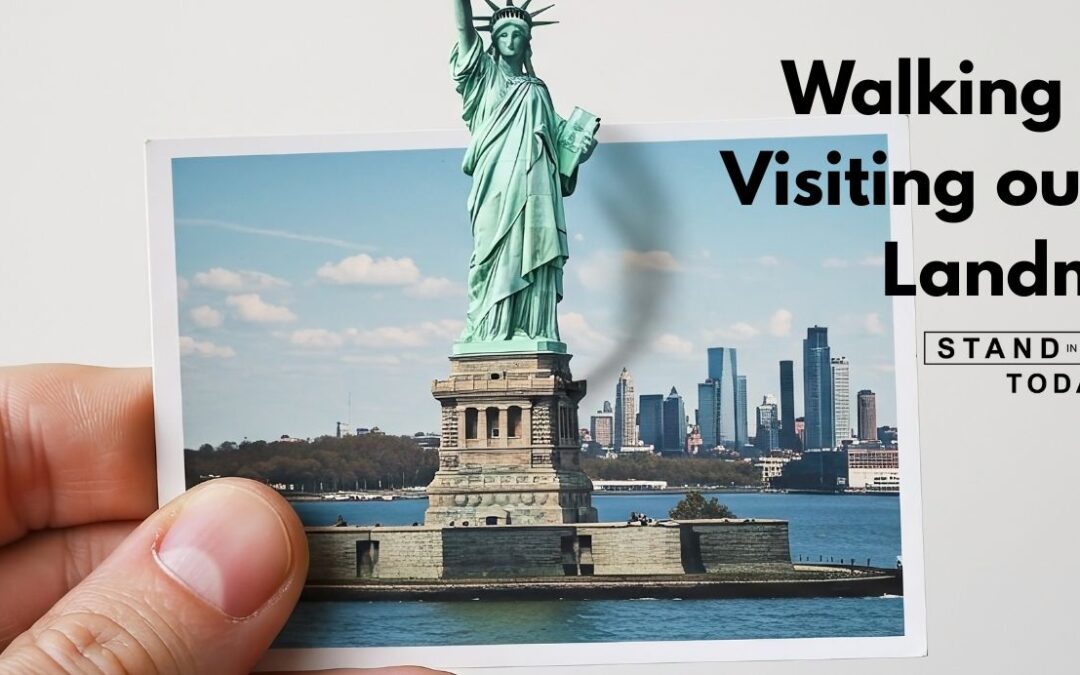

Walking History: Visiting Our Nation’s Landmarks
June 16, 2026
Host: Dr. Jamie Mitchell
Guest: Bill Troppman
Note: This transcript is taken from a Stand in the Gap Today program aired on 6/16/26. To listen to the podcast, click HERE.
Disclaimer: While reasonable efforts have been made to provide an accurate transcription, the following is a representation of a mechanical transcription and as such, may not be a word for word transcript. Please listen to the audio version for any questions concerning the following dialogue.
Jamie Mitchell:
Good afternoon and welcome again to Stand in the Gap today. I’m your host, Jamie Mitchell, and today I want to help you make this year’s vacation more meaningful. It’s summertime and I know many people are planning trips with their family. Maybe you’re thinking about a day trip to get the kids out of the house, or maybe with the 250th anniversary of our nation, you may want to go see a historical site. I love history. I love watching documentary about people and places in our nation’s past. But one of the things I know is how much more I learned from actually visiting a historical landmark. I especially love to visit those little known places to discover how they played a massive role in shaping the United States. And so today on Stand of the Gap, I’m calling this program Walking History. And I want to consider and help you consider some places that you and your family could actually visit and why those places are historically significant.
To help take us on this tour, it’s only fitting to have a US Parks Department guide to help us. Bill Troppman is now retired but has been involved with teaching and helping people experience the national parks. Bill is a committed follower of Christ. I’ve known him for decades. He was a Christian school teacher where my wife went to school and that doesn’t mean that Bill is old. Bill, we are old, but welcome to Stand in the Gap.
Bill Troppman:
It’s an honor to be with you, Jamie. I’m feeling my age, but I’ll tell you, we’re doing fine here.
Jamie Mitchell:
Bill, I can’t wait for you to start sharing about actual locations to our audience and giving them some amazing insights. But first I want you to share where did your love for history come from and how did you become a guide in the parks department after teaching in the Christian school for such a long time?
Bill Troppman:
Well, short answer, which is difficult for me to do, but that’s what I’ll do right now. Oh, seriously. As a boy, one of my early memories when our family went down to historic Williamsburg, this is way back years and years ago. And my early memories were standing by Raleigh Tavern and then there were baking bread in the back and some reenactors dressed as Washington soldiers walked by. I was hooked. And so then my dad would take me to places like in Western Pennsylvania, some historic sites. I grew up in the Pittsburgh area, but that triggered it. Then my first trip to Gettysburg when I was only about 11 or 12 years old, that really got the ball writing rolling, so to speak. And I made numerous trips there. And it was good for me just academically because I was doing a lot of reading. I had struggled as a student early on, but when I started reading and just had such a desire to learn all these great stories from the past, that got it going.
I did work at a Christian school here in the Delaware Valley outside Philadelphia for nine years called Christian Academy. I was teaching history and Bible and then I worked for 30 years, 31 years with the National Park Service as a park ranger. That’s the interpretive division. It gives me opportunity then to continue with history, but focusing, especially on the areas around the American Revolution and our constitutional period.
Jamie Mitchell:
Bill, I didn’t know that. I didn’t know that about how that first trip you’re giving great credence to this program today in that going to actual locations really impacts us. But Bill, one other introductory thought, because I want people to know you and know your heart, there are numerous stories woven through our history regarding our faith in the Bible and particularly God’s providence over America. As you’ve been a guide all these years, how has discovering these historical sites and landmarks and learning the stories behind them bolstered your faith as a Christ follower in Christ, in God’s work and in his word?
Bill Troppman:
I had one of my college professors, my Old Testament teacher and he was also Old Testament and ancient history. He helped me a lot to … He would give us quotes from some of the founding fathers of, “Righteousness exalts a nation,” John Adams said, “But sin is a reproach to any people. ” Quotes like that and quotes that when the constitutional convention had ended in 1787 and old 81 year old Franklin comes out and the wife of the mayor of Philadelphia said, “Well, Dr. Franklin, do we have our constitution? Do we have our republic?” And Franklin said, “Yes, madam, if you can keep it, it’s up to us now.” And I’m thinking, “Whoa, what a responsibility. If you can keep it, it’s up to us.” Washington said his first inaugural other things. And answer your question, ladies, reading the actual letters of some of these, not just looking at the regular history books, but reading the letters of these people.
When Washington, his first inaugural says, “This nation cannot survive if we are not a moral people. ” And so those are the kind of things that I thought, “I need to read more, see what they’re really saying.” And that got me going. Well,
Jamie Mitchell:
Bill, I know when you’ve spoken, because years ago I remember speaking at our church and listening to you, you love to weave in the stories of faith and the Christian testimony to history and especially pastors role in things like the revolution and our history, we got about a minute left. Pastors did play a big role in our history, didn’t they, Bill?
Bill Troppman:
Absolutely. Where do I even begin? But Samuel Davies, not well known, a Presbyterian minister during the Great Awakening in those wonderful years before the revolution, Samuel Davies was a preacher in Virginia. And as a little boy, Patrick Henry’s mother took him to hear Samuel Davies and Patrick Henry’s life was touched by this and Henry was a Christian, but you read about Samuel Davies. And I’ll refer to him again later in the length of Washington when Washington was a young man.
Jamie Mitchell:
Well, it’s important that as Christians, we again hear and understand how much God played in the role of our founding and our history and the people who shaped this country and also because we are the American Pastors Network, how influential ministers of the gospel were in encouraging and supporting the founding of this nation. And that’s what we want to do today. Friends, as you can see, you can’t separate God’s presence and power from the US history as we see every person and every place. Now, when we return, Bill’s going to take us on a tour. We’re going to start to investigate and consider and look at different locations in New England, in Pennsylvania, down south, all around, and begin to find out some of the stories so that you can go yourself and walk history. That’s our goal today, understanding great historical landmarks and why you should go and see them for yourself.
It’s going to be a fascinating stand in the gap today. Do not go anywhere. Well, welcome back. I’m so glad you can join us today. Bill Troppman, retired parks guide historian Bible teacher is here to enlighten us on some historical sites that you should visit, especially this summer and in light of the 250th anniversary of our independence. Bill, New England’s a beautiful, lovely place to visit Boston, Cape Cod, and of course the vacation land of Maine. If our friends listening today were to head up to New England, you would probably encourage them to go to Newburyport, Massachusetts. Why is that significant? What happened there and why should they go?
Bill Troppman:
I’m so glad you mentioned Newburyport because most people will be quizzically saying, “What in the world? Where’s Newberry Port in Massachusetts?” It’s north of Boston and it’s a jewel. There’s a Presbyterian church there that dates back to the 1740s and on reason to go there, visit that church, you find the burial place of a Reverend George Witfield. Now some of the listeners you may have heard of the Great Awakening and the Great Revivals in the colonies beginning in the 1730s up through the 50s and the great evangelist George Whitfield, so we explained to some people, he was like the Billy Graham of his day. He went up and down the colonies in very many meetings and people came out by the tens of thousands. It’s estimated that he spoke to over a million people over this period of time when there were no other special communications, no microphones and under this.
What makes it exciting why people really want to go, you’ll see the burial place of George Whitfield. If you have an opportunity, see the movie A Great Awakening. Some of you may have seen it already. It came out around Easter time and the whole film, this movie is excellently done about the relationship of evangelist George Whitfield and Dr. Benjamin Franklin. Franklin, who had walked away from his faith, embraced science and the enlightenment, but in later years there was a shift. He met George Whitfield and if you have an opportunity, folks who could go online and trust that if you say the letters of George Whitfield and Benjamin Franklin, boy, will it increase your faith and find that Whitfield had a lot to do with these teachings about the rights of man with a biblical perspective.
Jamie Mitchell:
Bill, up in New England as well, there are a couple other sites that people could go and see. Plymouth Rock is there. Is there anything else in the New England area that comes to your mind that would be just a great place for people to walk and gain new perspective of history?
Bill Troppman:
Absolutely. And you mentioned Plymouth, Massachusetts. I had the privilege of going back there last year and John Winthrop and early Boston city on a hill talking about wanting God’s leading, but especially Plymouth. There are a number of these 18th, 17th century buildings. We talk about the many great godly leaders that were there. There’s some wonderful buildings there. Also, you may want to travel over to the other end of the state to up Connecticut to Yale and you may say, “Well, Bill, why would you send us over as a place to go to Yale?” Because you’ll find out about Timothy Dwight, D-W-I-G-H-T, Timothy Dwight, grandson of the great awakener, Jonathan Edwards. Timothy Dwight went on to become president of Yale and he was the leader of the second great awakening, all these amazing, amazing revivals from 1795 up through the 1830s and he sent countless missionaries where students that graduated from Yale going into the western frontier, meaning upstate New York and Ohio with the gospel.
It had an incredible influence. Timothy Dwight chaplain who’s at Valley Forge and later president of Yale, anything about him is going to encourage your faith. Oh, and Washington said far more noble than the character of a patriot is the noble character of a Christian. Washington was asked, “Who’s the most important soldier in the army?” He said, “It’s the
Jamie Mitchell:
Chaplain.” Wow. All right, Bill, let’s keep heading south down the coast to Maryland and especially Annapolis. Obviously, they could visit the US Naval Academy. They’d get some really great seafood, but you’ve recommended to me that they go over to the old state house. What role did that play in our nation’s history?
Bill Troppman:
Jamie, when you mentioned Annapolis and certainly there’s a lot of really neat stuff there about the academy, the burial place of John Paul Jones, but I’ll tell you, the old state house is a real gym, a real gem. You know the old state houses of the original 13 state houses for government, the only one still standing is Annapolis, the old state house there. Well, okay, what makes that so important? What many historians say is one of the top three or four moments in Washington’s life and we can come to this later too, is when George Washington at the end of the revolution, he retires, he retires from the army. Many people thought he’d want to be a dictator or something like that. He hands his military commission after eight years back to the Congress of the United States and he promised then he told Martha he’d be home by Christmas Eve, he made it by two hours, but there’s that walking away from all this power.
There was an American artist in London at the time of the end of the American Revolution, an artist, the King of England. After the surrender, Britain has given up 13 colonies and the king said to this artist in London, “Well, Mr. West,” that was his name, Benjamin West, the artist. “Well, Mr. West, what will your General Washington do now that the war is over? “And Wes thought for a moment and then he answered,” Well, your majesty, knowing Washington as I do, he’ll go back to his plow. He’ll go back to his farm. “And King George III said,” If he does that, he’ll be the greatest man in the world.
Jamie Mitchell:
“You know, Bill, and we’ve chosen today, because as you and I have talked about this program, we’ve chosen some of these places that are not the historical places that you would think of, Independence Hall or even Williamsburg and Yorktown and some of these places, but it’s in these small secluded places in history where you get these rich stories about how the revolution unfolded, how our history unfolded. But one for sure, and Chris and I just went there a couple years ago, was Mount Vernon and you’re talking about Washington returning to Mount Vernon. That is quite a place to go and the stories that come out of Mount Vernon is just amazing. Do you have any thoughts about Washington’s home there at Mount Vernon and all the significance behind that place?
Bill Troppman:
Yes. Washington loved Mount Vernon. In the dark days of the revolution, excuse me, excuse me. In the dark days of the revolution, Washington would think back to his home and he would write back to those who were running the farms and so on and that just gave him such comfort. And this ties in with Valley Forge. Let me give you another quote. What Washington said to the brigade chaplains at Valley Forge, “Be certain to hold divine services every Sabbath for we can up but help see the hand of superintendent divine providence on these proceedings for far more noble than the character of a Christian of a patriot is that of a Christian.” And he wrote letters, a number of letters like that from home, Mount Vernon, when he had a chance to go back there and to reflect on freedom. Washington was a vestrement. A lot of people don’t realize from home, that would be like a deacon in the Anglican or Episcopalian tradition.
For over 20 years, Washington was a vestreman in the church and he took that very seriously. You couldn’t be a vestreman in the Anglican church unless you held to the cardinal doctors of the historic Christian faith and he was also a church warden for 10 years and all of that circling around his beloved Mount
Jamie Mitchell:
Vernon. When we went and visited Mount Vernon, we were sad to learn that it had fallen into great disrepair and decay and people came along and reclaimed it and put it all back together. So as you walk among that building, you walk on his property, you see where he farmed, you even see the places where his servants lived, it really helps bring out the man Washington. And I guess Bill, that’s what we’re trying to do with any of these locations, you really begin to see the character of the people who are in the story, don’t you?
Bill Troppman:
You do. You absolutely do. Some of the very famous people at that time would visit Mount Vernon and spend time with Washington. Noah Webster … Oh, terribly sorry. Noah Webster wrote that first dictionary and he was a fine Christian man and he enjoyed visiting with Washington. You had of course other leaders of the church that would come to visit. We have a number of cases where Washington would be talking about prayer and quietly. You read the journals of Johan Mullenberg. I’m sorry, Henry Muellenberg, who was the father of the Lutheran Church in America and Muhlenberg writes in his journals how he liked to sit with Washington and discuss scripture when he thought he were going to be talking about something else. And the two of them went on for a number of hours there at Mount Vernon.
Jamie Mitchell:
Amen. Well, when we return, Bill, I want you to share some places in Pennsylvania that will help bring history alive to our minds. We’ve got a lot of listeners in the Pennsylvania, New Jersey area, but friends, I hope you’re catching this. Go to New England, go to Maryland, go to Mount Vernon, see these places and see history come alive. Stay with us. We’ll be back in a moment. My guest today is Bill Troppman, who for decades shared his insights on history in the US Park Service. Today, he’s giving us some highlights on some places that we should visit to learn about history. Bill, a great portion of our audience is in the mid-Atlantic area. So let’s get to Pennsylvania and some possibilities of places to visit. First, Uniontown, PA and Fort Ligonier. What happened there and why would I want to go and visit?
Bill Troppman:
Oh, what a great place. It’s one of those jewels, Fort Ligonier. It is in Southwestern Pennsylvania, up in the mountains. And we might be scratching your head. Well, what in the world’s a Ligonier? George Washington, many of our listeners will know. He served as an officer along with the British Army. We were British colonies. And as a young man in his early to mid 20s, Washington served as a, we might say, a militia officer and he joined with a British army that marched over the mountains from, I should say, west of Baltimore over to over the mountains to Cumberland, Maryland to capture a French fort at the forks of the Ohio. We call it Pittsburgh, but it was French Duquesne at that time. Okay, here’s how it fits with Washington. Washington is with an officer with the British Army and a French Indian force ambushes that British army and it is decimated.
It is a terrible moment. Hundreds of men, many casualties, half the British force was killed, maybe even higher percentage. All of the officers in General Braddock, that British commander, all of the officers were killed and they were targeted by the native forces. All of them were killed except for George Washington. He had four bullet holes go through his regimental coat. His hat was shot out. He had two horses shot out from under him and he helped with the retreat to get as many troops off the field as possible. And after that defeat, it’s two or three years before they have another British army to go over and capture 42K, which they were able to do. Again, Washington’s with this British force and they built Fort Ligonier, which is all about, I’d say in the Uniontown area, that’s about an hour and a half southeast of Pittsburgh.
But at Fort Ligonier, Washington serves as a Colonel and there was a skirmish, a fight again with British, with the French and Indian troops and there was a friendly fire incident. Musk gets out in the woods in November. They were firing at each other in Washington seeing a number of those men falling. He pulls his sword on horseback. He goes between the lines with his sword raising their muskets, bullets flying everywhere and he wasn’t hit. The people couldn’t believe it. So Samuel Davies, who we mentioned before, who was a minister in Virginia, he read about Washington and what had happened and how he was almost killed with General Braddock and so on. And he says, “Divine providence has plans for this men,” or words to that effect, and we will follow his career closely. The divine providence has this man marked for great things.
Jamie Mitchell:
Wow. Well, Bill, talking about this General Braddock, you shared a little bit about this with me. Who is he? And I think I may be wrong, but isn’t North Braddock Pennsylvania the home of Senator Fetterman? But what is up with General Braddock and what happened out there?
Bill Troppman:
Well, of course, during the so- called French and Indian War, we’re the allies of the mother country of Britain and it’s fighting over French Canada. There’s fighting all the way down to Georgia. There was fighting. I mean, this is a long war. We all remember the revolution, but that six, seven year French and Indian war, that’s the setting for this. Braddock is just one of the many British generals that comes over here during the French and Indian war. He was a veteran soldier. He was of the old streamguards of the British army. Washington served as a military aid for him because Washington had surveyed out on the frontier. Braddock was a fine officer, but he got arrogant. He got cocky, we might say. “Oh, we can handle these Native Americans. They can’t do anything. “Washington warned him,” Please do not use European battle tactics with this army.
“Again, and then Washington didn’t know that he was going to barely survive this. As the army is retreating, Washington conducted the burial service using holy scripture over his … And then the wagons went over the grave so that the Braddock’s grave couldn’t be desecrated by the enemy forces. So he was an important officer and Braddock’s death led to all this frontier fighting in the Pennsylvania frontier and down into Virginia. So this was significant stuff. British- He was a British-Fetterman. I forgot to mention about Fetterman. The museum, there’s a Braddock Museum at the site of the battle there in that area of Braddock, Pennsylvania. And it’s when the Friendly Fire episode and so on, it gives a real good account of that. I’m sorry, go ahead.
Jamie Mitchell:
So Braddock was a British general who after our independence came over here and helped us. Is that right?
Bill Troppman:
No, beforehand. Oh, beforehand. That expedition over the mountains to capture French Fort Duquesne and was when Washington’s only 24 years old. This is 1756, not 1776. This is before the revolution when Washington was glad to be part of the British Empire, he wanted to be a British officer and the Lord blocked that. That’s another whole series of stories. And then we have a breakdown of communications with the king and the crown, and of course that leads to Lexington and Concord in 1775.
Jamie Mitchell:
Wow. So Bill, take us up to Allentown, Pennsylvania, that whole area. You go up there, you’ll see a sign for Muellenberg College. That name Muellenberg is important in our history. Who were the Muellenbergs and how did they play a part in our great history?
Bill Troppman:
This is a perfect case of where you lead the … We have these top tiered living, top tiered patriots and founding fathers, as we say, but it’s those people that tear right below them. They’re important, but you just don’t hear about them much. And John Peter Muellenberg is definitely one of these people and his famous father, Heinrich Muellenberg, the father of the Lutheran Church in North America. Washington knew Heinrich Muellenberg. Now, John Peter Muellenberg, the son, this takes us to Valley Forge. He was a chaplain in Washington’s army, but he’s also a general officer. He was called the fighting Parson. He had a Bible in one hand and a sword in the other. Now, they frown on that today with the army. They don’t allow chaplains to be armed, but he was. So Muellenberg College, right up there in Allentown, and you see the statue up there of John Muellenberg.
We have reference to him at Valley Forge. He later, the Chaplain Muellenberg, he goes on to serve in the Congress of the United States. He and his brother are senators in the United States Congress. In fact, Friedrich Augustus Muellenberg, his brother, was the first speaker of the house in the United States Congress. They were a very prominent American family and they were godly men.
Jamie Mitchell:
Bill, you spent a lot of your career at Valley Forge. Again, we don’t have the time involved for you to discuss everything, but what is your favorite place at Valley Forge that you love taking people to and love telling a story? Give us a little insight in these last two or three minutes.
Bill Troppman:
Well, in the eight year war of the revolution. I mean, just some of these key facts about Valley Forge that many are not acquainted with. The revolution drags on for eight years in fighting for our independence, eight years. Well, thus there were eight winter encampments. And I don’t put visitors on the spot to ask them to list the location of the seven other winter encampments. That wouldn’t make sense, but Valley Forge, highest death total of the eight winter encampments of the war. More men, enlisted men died there than in any of the other winter encampments, more than any battle. And you know when Washington wrote to the chaplains there at Valley Forge, I bleakly made reference to this earlier. Washington said, “Be certain to hold divine services every Sabbath. We cannot but help see the hand of super attending divine providence on these proceedings.” Washington saying that God’s hand is involved divine sovereignty and all that suffering at Valley Forge, he said so for far more noble than the character of a patriot is a noble character of a Christian.
Washington, I think my favorites there in our short time together, Washington had some of his favorite preachers, some of the chaplains who he enjoyed John Geno.
John Geno was a French Shuganot family in New York. It was Genove. John Gano was a Baptist, an early Baptist in New York. Washington Market, he enjoyed hearing him preach and there were others. I made reference to Timothy Dwight and I think those were my favorites in certain areas where they would have set up meetings Out in the open with the weather permitted were the sermons that they preach.
Jamie Mitchell:
Well, there you have it, friends. If you’re in the Pennsylvania area, go to Uniontown to Fort Ligonier, go to North Braddock, Muhlenberg College and then throw in Gettysburg, Philadelphia, Valley Forge. You’ll need a whole week to visit these historical sites. But remember that in each of those places there are significant stories and significant pieces of history and many unknown people who helped shape our nation. I can tell you from my personal experiences as even Bill mentioned, what started him and the road to loving history is to go to these places, see the actual place where history happened and it will touch your life. When we finish up, I want Bill to talk a little bit about North Carolina, South Carolina, and then finish up with another story about Washington. We’re walking history from some great places in our country. Don’t go anywhere. Thanks for staying with us.
We’ve been walking history and talking about historical sites to visit and why they are important. Bill Tropman. We’re going to need to take every minute as we close, but I want to take a quick trip down to the Carolinas. There are three battlefields there, Kings Mountain, Cowpens Battlefield, and the Guilford Courthouse. Why would you encourage people to see those three places if they were down in the Carolinas?
Bill Troppman:
Well, because all three of those battles right there in the Carolinas restored hope, restored much needed hope during the American Revolution. After the war, when they asked George Washington, what was the darkest moment? What was the hardest part of that eight year war? He didn’t say Valley Fords. I mean, it was very dark, but the worst, the dark year George Washington said was 1780. That was right after Valley Forge year after. There was some disasters on the battlefield. Financially, things were awful. Washington despaired thinking that the British were going to take things over right there, 1780. Then comes these three quick victories, battlefield victories with the army in the south there, with Washington’s troops down there under Nathaniel Green and Dan Morgan in Kings Mountain, South Carolina. And that was in October of 1780. Then Cowpen’s battlefield, just only about a half a mile, about 40 minutes away from there, the Cowpens Battlefield, and that’s in late January of 81.
Then the Battle of Guilford Courthouse down in that area. Those three quick victories against another British army, that set the stage. If it hadn’t been for that crease and morale, those three victories set the stage for the Battle of Yorktown when the British pulled out of that North Carolina area, moved up to the Virginia and it leads to the surrender of the British army. If it hadn’t been for those three quick victories and they’re fascinating what was then the frontier, they’re fascinating sites anyway, but not that well known, but highly significant.
Jamie Mitchell:
Bill, as we have been talking about these places, one of the things that keeps coming to my mind is how close we were to losing the revolutionary war and losing our freedom that they were fighting for. I mean, there were moments within our history where things could not have gone well and everything would have been lost. Yet in some of these places we see how the battle turns or things change. I guess that’s a big story behind a lot of these places, isn’t it?
Bill Troppman:
It is. It is. I think of Washington writing to his brother after Yorktown when he’s saying that whoever does not see the hand of divine providence in that victory is blind, absolutely blind. And he also talked about, he mentioned the hand of God there and his brother said to Washington, “Well, it sounds like you want to be a minister.” And this was in July of 1778 and Washington said, “Well, I’ve thought about that from time to time.” Now, how many of us know that Washington’s brother said, “You sound like a minister.” But seriously on this, that time when Washington was a young man way back in 1755 under General Edward Bradock and those bullets go through his coat, the great Indian chief out there, Tanatorisen, I think was his name, Washington was out on a surveying mission. This is before the revolution and this old Indian chief, they know his name, this is well attested to by witnesses around the campfire said, “You were with Braddock’s army back in 1755.
I remember. I ordered my braves to drop you. ” In other words, to kill him, shoot him off the horse and was unable to do so. The great spirit is with you.
That’s not well known. And when Washington’s very, very close call in the American Revolution at the Battle of Princeton, Princeton, Trenton, in that whole area over there in New Jersey, one of the turning points of the war, early 1777, at the Battle of Princeton, the Army was breaking about the run. Washington rides right up to the front line drawn saber and he goes between the British lines to rally his troops. The British fired a volley. I mean, this is battalion strength. They fired 40 or 50 rounds up close we would say like maybe 40, 50 yards. Washington’s AIDS covered their faces with their cloaks. They didn’t want to see their chief be shot down. The smoke cleared and there’s Washington. This didn’t escape conversation. People were saying, “This is amazing. It’s a miracle that he was not
Jamie Mitchell:
Hit.” Well, talk about Washington. Let’s say the best for last. Newburgh, New York. I’ve been there. Something occurred with Washington there and it even has a tie to a famous city in Ohio. Bill, what happened in Newburg?
Bill Troppman:
Newburgh, New York. It’s another case where … Now this is when the war was winding down up there in Newburgh, New York. Remember we mentioned earlier that Benjamin West, the artist over in London and after that, about this time, the king said, “What will your general Washington do now that the war is over?” And when West said he’ll go back to his farm and the king did say he’ll be the greatest man in the world. This is part of that story. Up in Newburgh, New York on the Hudson River, not far from West Point, Washington’s with his offers, his officers. Things were so bad toward the end there, finances, men hadn’t been paid for a year and a half. A number of officers said, “We’ll have Washington to lead us. We’re going to march on Congress. We’re going to force them to answer to us.” Washington went into their secret meeting.
He personally, he wasn’t invited, but he showed up and he pleaded with them. “Do not do this. Remember why we’ve been fighting and I’ve been with you every turn. “They said,” No, you’re with us or you’re against us. “And in that moment, and it’s right there in Newburgh, New York is another one of those great moments in his life when Washington, he’s patting his coat thinking,” In fact, I have here a letter that I want to read to you that I was going to write to Congress asking again for help. “And as he’s reaching around to get out the letter, he opens it up. He puts spectacles on eyeglasses and most of the enlisted and they’ve never seen why. Washington had to wear glasses to conduct his business. And he said,” Gentlemen, you must excuse me. I’ve grown not only gray but almost blind in the service of my country.
“And that did it. It stopped that rebellion, that mutiny. There weren’t a lot of dry eyes there because they’re looking at Washington. He had suffered with them throughout those eight years. And he said,” I’ve grown not only gray, but almost blind in the service of my country. “And he then went back, as I mentioned, to Annapolis, Maryland that Congress where Washington hands all his power, his commission back to the Congress of the United States and Cincinnatus went back home. The founding fathers liked the old story of the ancient Roman before the Roman Empire. It was a Republic, the Roman Republic. And there was a famous Roman general, we don’t know if it’s mythological or true, but the story’s powerful. And this guy’s name was Quenches Cincinnatus. He’d been a Roman general, he’d been a Roman senator. So he had been a military man, Roman legions and all that.
He was also a civilian, or I should say he was in the Roman Senate. The city of Rome was threatened by an enemy army and the Senate gave Cincinnatus absolute power. He receives that power. Cincinnatus defeats the force threatening Rome and he comes back and he resigns his commission. He goes back to his plow. You see, Cincinnatus was a farmer. Who does this sound like? Cincinnati was a farmer. What’s Washington’s occupation to farm? Before the revolution, like Cincinnatus, Washington had some military experience and he was in the House of Burgesses, both military and civil service.
Jamie Mitchell:
Wow.
Bill Troppman:
Washington was handed a military commission officially giving him almost absolute power in Washington.
Jamie Mitchell:
We’re going to have to have you back to finish the story of Cincinnati. It has been fantastic. Thank you. Thank you. Thank you. Friends, God bless you. Have a great day.

Recent Comments