
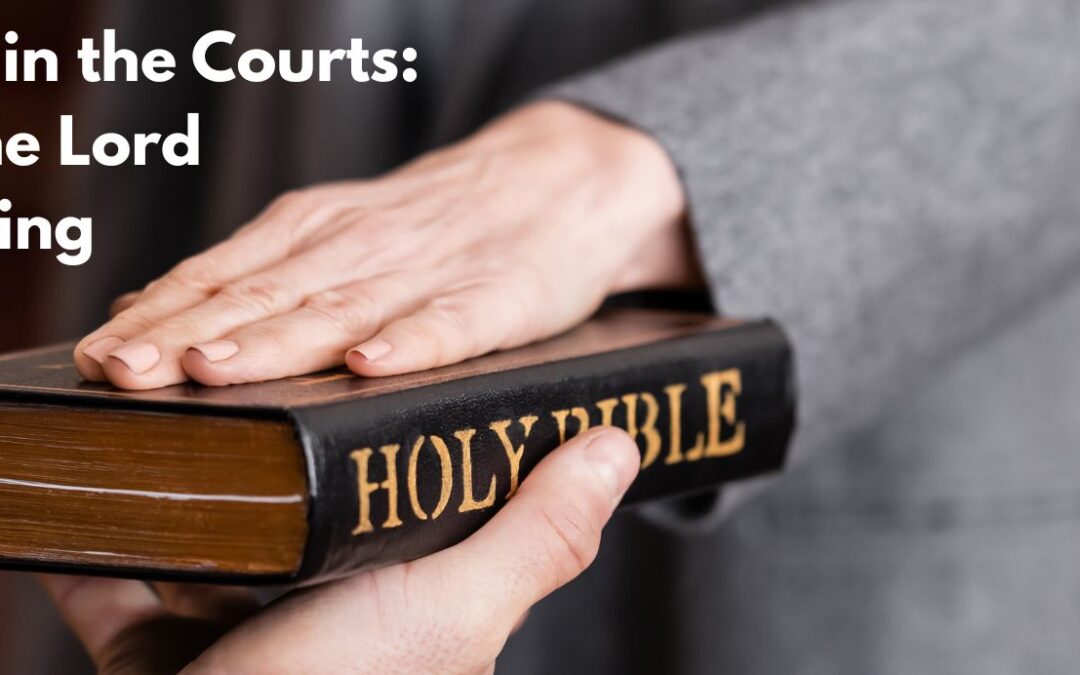

Christians in the Courts:
Trusting the Lord and Knowing the Law
June 23, 2026
Host: Dr. Jamie Mitchell
Guest: Don Ziel
Note: This transcript is taken from a Stand in the Gap Today program aired on 6/23/26. To listen to the podcast, click HERE.
Disclaimer: While reasonable efforts have been made to provide an accurate transcription, the following is a representation of a mechanical transcription and as such, may not be a word for word transcript. Please listen to the audio version for any questions concerning the following dialogue.
Jamie Mitchell:
Welcome again, friends to Stand in the Gap today. I’m your host, Jamie Mitchell, Director of Church Culture at the American Pastors Network. Recently, I was helping a church revise their church constitution. It’s been a while since they looked it over and made sure that they had all their things in the church’s charter and guiding documents to run orderly. But also I found myself constantly saying, how do we avoid legal concerns? I remember doing this 30 years ago with the church and back then I was mostly concerned about how to elect deacons or get the annual budget passed. But things are different now. Almost every step along the way, the church I’m helping was faced with considering what if some legal trouble arises and are we opening ourselves up to any further litigation? Boy, how the world has changed. More and more we must be aware of the potential legal entanglements we could get ourselves into.
Christians and churches are targets for all sorts of lawsuits and attacks through the law. Now, we must trust the Lord in all things. I get that. But we also must be fully aware of the law and be wise regarding legal matters and potential threats. And today on Stand of the Gap, we want to talk about what’s happening in the legal world and within the courts and how it’s affecting the Christian community. Don Ziel is my guest. He’s the senior vice president for the Alliance Defending Freedom. ADF is the world’s largest legal organization committed to protecting religious freedom and free speech, sanctity of life, parents’ rights, God’s design for marriage and family. They were founded in 1994 by a group of prominent Christian leaders. If I named them, you would know them and who saw need to combat the decades long efforts by activists and the government officials to drive the expression of faith out of the public square.
And since then, ADF has remained dedicated to victory winning nearly 80% of their cases, including 18 cases before the Supreme Court. They are proud to have made a difference and we are grateful unto God for them and God has accomplished must with them these last 30 years. And though you may not have been represented personally by ADF, I tell you right now, our Christian interests have been and we’re grateful. So Don, on behalf of the Christian community to ADF, thank you for all you do and thank you so much for joining us and giving us some insights on what’s happening in the legal world.
Don Ziel:
Thanks so much, Jamie. I’m so glad to be here and thanks for the kind words. Really appreciate the opportunity to speak with you today.
Jamie Mitchell:
Well, Don, many of our listeners may not be familiar with ADF, how it started and what was behind its founding and what exactly you guys do. Can you give us a quick splash on and share what ADF is all about?
Don Ziel:
Yeah, I’m happy to. So Alliance Defending Freedom is a Christian legal ministry that exists and this is our mission statement. We exist to keep the door open for the gospel by advancing every person’s God given right to live and speak the truth. So what that looks like is we contend for truth in law and policy and the public square and then we equip a broad alliance to do the same, both in the law and in the church. So as you mentioned, ADF was founded in 1994 by over 30 prominent Christian leaders and some of those names include James Dobson, Bill Bright, D James Kennedy, Marlon Maddox, Larry Burkett. And the purpose of this was to consolidate a strategy to protect God given freedoms in the court and to recruit and train attorneys dedicated to the mission. So ADF started as a funding and a training organization, but over the years the organization began taking on the work of litigation and the work of legal support and now we’ve grown to well over a hundred attorneys.
And as you mentioned, we’ve won nearly 80% of our cases, including 18 cases at the US Supreme Court. It’s been also a really busy year this year as we’ve had four cases before the court in this last term. We’re not a political organization or a legal ministry grounded in a historic Christian tradition working in five areas to ensure that life is safeguarded, that religious freedom prevails, that all can speak freely, that parental rights are guaranteed and that marriage and family are protected. So that’s ADF in a nutshell.
Jamie Mitchell:
Don ADF, as I understand it, it’s really driven by need. Where there’s a need, you guys show up, but the amount of potential cases and the intensity of the need since 1994 has drastically changed. I heard my opening about even helping a church figure out their constitution. They’re greatly concerned about legal issues. Why do you think that has happened? What has happened to our culture, especially towards the Christian community?
Don Ziel:
Yeah, I think it’s a great question, but first, and as you mentioned in the beginning that we trust God first and we have to heed the words of the author of Ecclesiastes that there’s nothing new under the Sun conflict and struggle with sin and wrestling for truth is not new to our culture, but it’s also important that we understand context and we understand the context we’ve been. And there have been significant changes in our culture since 1994 on how our culture sees the law, how the law is crafted and how the culture sees religious organizations and religious liberty. So religious liberty and freedom of conscience are no longer universally viewed as favorable governing principles. There are many who view these concepts as being at odds with societal progress. Just a few examples. In 2016, the Office of Civil Rights, the US Office of Civil Rights concluded a report on the state of religious liberty with these words.
They said the phrases religious liberty and religious freedom will stand for nothing but hypocrisy as they remain code words for discrimination and intolerance. And Justice Alito in a 2022 speech said this, he said it’s hard to convince people that religious liberty is worth defending if they don’t think religion is a good thing that deserves protection. So I think the most prominent way that we’ve seen this change or where the tension currently plays out in the law is this conflict between religious protections, which have historically been viewed as good and flowing from natural law, flowing from good governance with these non-discrimination protection. So for many lawmakers preserving the right of a church to hire pastors according to their faith or a missions organization to require its employees to share biblical convictions on gender or sexuality is just an antiquated obstacle to the eradication of what they see as intolerable discrimination.
So non-discrimination laws can be good in and of themselves, but there’s certainly this conflict between religious protection and non-discrimination provisions where a lot of the conflict in the law comes today.
Jamie Mitchell:
Well, we want to get into the law. We got to get into culture and what’s happening and friends, I hope you catch this. The world has changed. Christians and people of faith are not cherished or valued in society as we once were. And there are those who see us as the enemy and us is standing in the way of what they want to accomplish. Now, when we return, you’re going to hear about one of those organizations that in some ways has declared war on Christians, people of faith and I think it will surprise you. It’s been in the news and ADF has been right there defending our rights and our liberties. Do not go anywhere as we’re talking about the law and Christians today on Standing Together Welcome back. My guest today, Don Ziel from Alliance Defending Freedom, one of the premier legal groups in our country.
They are literally the point of the spear regarding legal issues facing believers today. And today we’re looking at threats upon Christians and our need for legal help. Don, I want to get to some of the threats that Christians and churches and Christian organizations are facing, but I first want you to weigh in on a major news item that ADF has been involved with and really a main player in and that is the Southern Poverty Law Centered. Just a few weeks ago, there were some congressional hearings that was the focal point there prominently sitting at the dais was one of your key people at ADF, but help our people understand, Don, what is the Southern Poverty Law Center and what were they originally supposed to be doing? And then we’ll talk about what they’re doing today.
Don Ziel:
Yeah. The Southern Poverty Law Center was founded in 1971 and it was founded as a legal advocacy group fighting against segregation in the South and against an incomplete desegregation and despite this noble founding and a lot of good work supporting disenfranchised individuals in its early days and that was the purpose of the organization. The SPLC has sort of expanded its scope since then and become much more of a far left activist organization that really attacks anyone who disagrees with its narrow agenda.
Jamie Mitchell:
I’ll tell you, Don, I’ve been looking and watching them for a while because I know that they have some poor intent. They moved from being defending civil rights and now this political activist group, but now they launched what they call their hate map, meaning they’re identifying organizations and people that they are deeming dangerous. And many of those groups listed are conservative Christian groups like Moms for Liberty and Turning Point and Family Research Council and you guys. And I looked at the map the other day, there you are on there, but that’s not why they’re in big trouble. What has been the recent news that has brought the SPLC to the forefront and some of maybe their unethical practices that are being alleged that they have done and then brought about this congressional hearing
Don Ziel:
Yeah, I’ll come back to the hate map question that you raised, but I’ll start with first sort of the current news and where they’re at. So in April, a federal grand jury indicted the SPLC on several criminal counts including wire fraud and making false statements to federally insured banks. So the indictment alleges that through these actions, these actions of wire fraud and false statements that the SPLC deceived its donors and it actually funded the very sort of hate and violence that it claims to police and then they capitalize that with further fundraising. So those are the allegations in the federal grand jury indictment. You can go and take a look at that and see what else is in there. Aside from these shocking allegations, I’ll tell you a little bit about where this has impacted ADF and back to what you brought up with the SPLC’s hate map.
So ADF was placed on the hate map around 2016. I know that a lot of this has come to light recently, but this has been a problem that we’ve been dealing with for a long time in other organizations as well and it’s unfortunately had a deeply negative impact on our work. Luckily with recent events, I think some of these things have begun to be put in the spotlight. You mentioned the congressional hearing that my colleague was able to testify at and it’s raised more people’s awareness of the SPLC’s credibility problem, but ADF and many other organizations have been battling this arbitrary labeling, which has had a lot of implications over the years. And while SBC has enjoyed the SPLC has enjoyed this reputation as a civil rights leader, this hate map has become a significant problem for a lot of organizations when other people take that as a warning or they take that as the truth about an organization like ADF, which is far from the truth.
Jamie Mitchell:
Don, just think about it. There is not one of us that would ever want to be labeled or put on some organization’s website and said, “Hey, these people are spewing hate. These are hateful people. These people are not to be trusted.” And that’s what happens. They go up there and there’s no real clear understanding about what it is, but the problem is, and then even these recent allegations that they actually were using some of their money to fund some of these hate groups to gin up more hate so that they would stay in business. But Don, as I watched the hearing, it became just abundantly clear that they are losing credibility and there’s also so much hypocrisy. One of the moments, and maybe you can weigh in on this because your colleague was there and he did a fabulous job, was when Chip Roy from Texas, the Congressman, he asked them, “Well, I don’t find any Islamic terrorist organizations on your hate map.” And the point he was making was that for the most part, Islamic hate groups or Muslim hate groups, they have a very, very poor view of the gay community, of the LGBTQ community, the trans community, and they have actually done violence to those types of groups and those types of people, yet they weren’t on the hate map.
And that really is the problem, Don. There’s such hypocrisy with who they have on there and who they don’t have on there and that really is what’s being brought to light now.
Don Ziel:
Yeah. I think the congressional hearing and some of the other things in the news have showed again, this has been going on for quite some time and it’s really based on a narrow conception decided internally by one organization to label all of these other organizations a certain way. And yeah, it really comes from the idea of attacking someone who we disagree with as an organization. We disagree with this organization and so they go on this list and it has pretty significant consequences on the people who are named to that list and I can get into that a little bit.
Jamie Mitchell:
Yeah. I mean FRC, the Family Research Council, they had some guy try to do them harm. Isn’t that one of the things that have come out because of this whole thing?
Don Ziel:
Yeah. I think the important thing to note about this hate map is that in other lists like it, there’s other lists that are created the same way, but they’re created with the purpose of censoring and silencing opposing viewpoints. And in this case, there was a concerted and successful effort to get the SPLC list into the filters of major corporations. So large companies were using this list as a filter to decide whether an organization was worthy, for example, of its nonprofit discount program or a matching grant program. So think about that. If you go to a company that offers employee matching grants, you could select that grant as an employee, but then it could get kicked out of the program because this organization that you want to give to was disqualified because they’re on this hate list. They could even use this to keep from doing business with the quote unquote hate groups on the list.
So this is a different legal problem than government censorship, of course. And in the United States when we have government censorship, it’s answered through appealing to First Amendment principles, but this is a type of shadow censorship or private censorship that has to be addressed in a way that both upholds the marketplace of ideas, free speech, those principles, and the ability for all to speak freely, but also the public needs to be informed about what’s really going on with this arbitrary labeling. And I think we’re seeing the tide turn on that, but this has been happening for many, many years.
Jamie Mitchell:
Don, with a minute left, is there recourse? I mean, is there legal means, can you sue them for defamation? Can you serve them for maybe lost income or anything like that? Is there a way for a Christian organization to go after the SPLC and try to become whole and make some of these things right?
Don Ziel:
Well, I think the number one thing that we’re seeing right now is transparency and this being brought to light in the public and then we’re seeing companies turn based on that pressure. So there are potential legal pathways to pursue that. We talk to a lot of organizations and analyze whether it’s in this case or in other cases where a company has denied them service or something like that, is there a legal pathway? But I really do think one of the best ways is what we’re seeing happen is this unfolding in the public sphere, in the broader conversation and people seeing that we don’t want this, this isn’t fair, this isn’t true and companies are seeing that and changing. Last week, for example, DoorDash became the latest company to agree to instruct their third party gift matching administrator to remove the SPLC hate list from its screening mechanism.
So that public pressure has proved to be the most important, even though there are some legal avenues to pursue.
Jamie Mitchell:
Wow. Well, this case is getting a lot of notoriety, but there are smaller ones. There are many smaller ones where Christians are being silenced, targeted, losing out on precious resources just because of their faith. Now, when we return, I want Don to weigh in on what’s happening on the family and parent front, how they’re being silenced and threatened. We’re talking about legal concerns and the Christian community here on Stand of the Gap today. Well, thank you for staying with us, Don Ziel from Alliance Defending Freedom is my guest and we’re discussing threats upon people, faith and a legal recourse that we may or may not have. Don, I want to shift our focus on family and parent rights. And my guess is a lot of our listening audience have not heard of all the different cases that ADF has been involved with and situations where you have stepped in, but I was wondering if you could give us a little idea of some of the cases, situations you guys have been involved with the past couple of years surrounding this idea of family and parents’ rights.
What kinds of litigations are you dealing with? What kind of victories or even setbacks are you seeing? Give us a little splash of what’s happening in the legal world.
Don Ziel:
Yeah. Let me highlight a few areas where we’re working now related to the rights of parents. Again, there are several areas, but let me highlight too. First, we’re defending the rights of parents to make informed decisions on behalf of their children and oppose efforts by government officials to hide information from parents. So I’ll give you two examples of this. There’s a case going on in Michigan right now called Mead versus Rockford Public School District and the Mead family is in the middle of a fairly long drawn out case right now because a few years ago the school socially transitioned their daughter without their permission and then actively tried to hide it from them in subsequent meetings. So in essence, the school was keeping two records, one using male pronouns and preferred names that they used at school and the other is using their daughter’s given name and female pronouns when they would send that home, send stuff home.
And the means had been actively engaged in seeking help for their daughter who was struggling with depression and was going through counseling both in school and out of school and they became aware of this practice because there was a redaction mistake made by the school on a paper that was sent home.
They had forgot to take off the male pronouns and so the means went and questioned the school and at that time the school admitted that it was following its policy on the privacy of health decisions and confidentiality. So when the means could not get satisfactory action from the school, they removed their daughter and they decided to sue to end the policy for future students and this case is currently ongoing and there was a similar case around the same time that is resolved. It’s in Wisconsin, it’s called TF and BF versus Kettle Moraine School District. And in that case, the court granted the family of victory holding that a school district cannot supplant a parent’s right to control the healthcare and medical decisions for their children. It’s a right that resides with the parents and that can’t be taken away lightly and the district did not have narrowly tailored grounds to remove those in that case.
So example that a lot of people don’t know that that stuff is going on. Is it going on everywhere? Well, no, maybe not, but it’s something to be aware of and to be mindful of where you are. Second, we’re working to ensure that people of faith are allowed into the foster and adoption system so they can give children loving homes without being forced to compromise their beliefs. So there’s a couple cases I would highlight on this issue and it’s an important one. The first one is a woman named Jessica Bates and she’s a mother of five who lives in rural Oregon and she was widowed after her husband died in a car crash in 2017 and she’s raising five children on her own. She heard a radio program, a Christian broadcast about a man who had adopted a child from foster care and she felt called and compelled to do the same.
So she began to explore the opportunity and to get certified. The Oregon Department of Human Services she found out requires that people seeking to adopt must respect, accept, and support the sexual orientation and/or gender identity of any child who could be placed in the applicant’s home. This guidance obligates parents to agree to use a child’s self-selected pronouns, take a child to pride parade or facilitate an adolescent’s access to harmful interventions like puberty blockers or cross sex hormones. Jessica saw this and thought these rules would force her to violate her religious beliefs and she couldn’t sign the documentation she need to become a foster parent, but she felt called to do so. So she sued on something called asking for a preliminary injunction to the rule so she could be certified as a foster parent and she lost. She lost at the trial level and it was determined that the state’s rules were reasonable and did not violate her religious beliefs.
Thankfully at the appellate level, she won this temporary injunction and she can start the fostering process. She can go in and however, the case will go on the case doesn’t end that way because it was just a preliminary injunction case and that case will go on. There are two families in Vermont that I also wanted to raise on this question. The Wati and the Gantt family, they’re both pastors in Vermont. They were both long decorated foster families. In fact, between them, they had fostered dozens of kids and they, between them, they had adopted five kids, three in one family and two in the other out of the foster system. And in 2022 and in 2024 in separate interactions with the state of Vermont, their licenses were revoked because of rules similar to what I described in Oregon had been adopted by Vermont and they said these families could no longer qualify as foster parents because they couldn’t agree to these principles.
Now the good news there is that the lawsuit was filed, pressure was put on and Vermont decided to change this policy in February and part of that change is that the Wati and Gantt families were reinstated as foster parents and something they had done so effectively and so well over the years. So good results in both of those cases, one’s still ongoing, one resulted in policy change, but it also is, it should be a wake up call to us to hear that that stuff’s going on.
Jamie Mitchell:
Don, it’s just amazing to me the outright hatred towards God’s ordained social orders. When God ordained, he ordained the home, he ordained the church and he ordained government. We see that clearly in the scripture and government is compliant with what the world and some of these groups wants to do and so their target has to be the home and it has to be the church and when it comes to the home they have to supplant the parents. The parents can no longer be the God ordained authority in a family’s life and that’s what we’re seeing and what again, ADF is doing to say, “No, no, no, the parents are the authority. They’re the ones God has ordained. They’re the ones who should speak to the rights of children.” And it’s so important, but we see this happening. I guess Don too, a part of this is also what we’re seeing like with girls sports and the forcing of men in girls sports and in locker rooms and those kind of things.
I mean, that’s happening all over the place and is there legal recourse for parents to stop these things even though maybe a school system comes up with some policy? Is there a way for parents to say, “No, that can’t happen on our
Don Ziel:
Watch?” Well, I mentioned that we had that ADF has had the privilege of being counseled on four different cases in the Supreme Court this year. I’m proud to say that the first two have resulted in positive decisions, one eight to one decision in a case involving a counselor in Colorado, one in 90 decision in a case involving a pregnancy center, New Jersey. The two cases that will come out in days within the next couple of weeks for sure are related to this sports issue and those cases are related to a state’s right to pass laws which protect women and keep biological males out of women’s sports for the protection of women. And these cases arise out of the spirit of Title IX, which was passed in order to allow for fair treatment in sports. So those cases are at the Supreme Court. The decisions will come down soon where our state has rights.
There’s a mirror of those cases that are working their way through, which asks the question, does Title IX require states to protect women in these sports contexts? And so there’s a lot of legal work going on in these areas, but yeah, I think for parents in any of these situations that we mentioned, they often feel disempowered when they have a question about what’s going on at school and our encouragement is be aware of your context, your rights. We encourage parents to stay engaged, to specifically understand their rights, to hold officials accountable, their rights to choice in education and healthcare, and their rights to require transparency from these officials. So this is about engagement and I think it’s important Important that parents understand and not sit on the sidelines when they see some of these things happening.
Jamie Mitchell:
Don, you are so right. If these school officials do not see or believe there are parents watching what they are doing, then they’re going to do as much as they can get away with. Daily we hear about parents being told after the fact of decisions being made about their kids. I mean, it’s heartbreaking. Some of these actions have long lasting effect on families and they violate their beliefs and their values and we need to stand up and speak up and when possible, go to court. Now when we return, we just said that one of God’s authorities here on earth, the family is being attacked. Well, there’s another one and that’s the church and even Christian schools and colleges and what they are now facing and they need help legally and ADF and other groups like them are there to stand in the gap for them.
And so stay with us. We’re going to hear some stories about what’s happening in the church in the course when we return. Well, it’s hard to believe we’re at the end of another program. Don Ziel has been my guest. He serves with the Alliance Defending Freedom. Don, how can our listeners find out about ADF and more importantly, why would they need to ask for your help? Give some parameters there of how or why somebody might want to reach out to ADF for help.
Don Ziel:
Sure. Well, our website is adflegal.org and you can certainly go there and you can read some more about some of the stories I’ve even told today. And there’s also some really good resources for parents and students on the rights that they have in their context. And so I commend those all to you. It’s adflegal.org. But there’s also another program that I want to tell you about that we have for any pastors or ministry leaders out there. It’s called the ADF Church and Ministry Alliance. The Church and Ministry Alliance is a membership program for churches and ministry organizations that provides its members with legal education, training, awareness and support, including access to nine lawyers on our team who can help navigate certain legal questions or steer you in the right direction. So the concept of those programs, we recognize that most ministries exist to do the work that God’s called into, not to engage in lawsuits, unless they need to and their name is called on that.
So our goal is to come alongside and do some of that pre-work. So one reason they can reach out to the Church and Ministry Alliance at your church or a ministry organization you’re involved in is to get some of that pre-work done like you were talking about at the beginning. What does our constitution say? Are there legal protections built in to those core documents that reflect who we are, what God has called us to? And so I commend the Church and Ministry Alliance to you as well. But in general, other reasons to reach out to ADF is if you’re seeing some of these things that we talked about today. If you’re seeing an issue where a religious organization is being pushed back because of their religion, because of their sincerely held religious beliefs, you’re seeing a parent not understanding what’s going on in their schools or seeing any of those things we want you to bring to us so we can look at and hopefully give you the help you need with that.
So if you’d like to know more about the church or your church of ministry joining ADF Church and Ministry Alliance, that website is adfurchaliance.org. So adflegal.org and adfurchaliance.org will get you information on both of those things. Well,
Jamie Mitchell:
Good. We’re talking about the church, Don. Why don’t you give us as you did with the family threats, what are you seeing in regards to church, Christian schools? How is ADF defending their rights in some maybe recent cases?
Don Ziel:
Yeah. As we talked about before, nothing is new but our context matters. I really want pastors and ministry leaders and other Christians to be aware that religious liberty protections are currently eroded in two principle ways. We’ve talked a lot about one, through targeted hostility, that’s one and that’s on the rise. And through just indifference. The hostility gets talked about more because it is often more egregious. A government official, a school board member or an administrator specifically crafting policies or rules to keep churches or religious organizations or religious people out. However, the second is as common, if not more, a rule or regulation created at the federal, state or local level that simply does not consider its burden on religious organizations at all. And this is the nature of the context that we’re currently in as we talked about at the beginning. The general public and therefore lawmakers and judges are losing touch on why it’s important to protect religious freedom and conscience for the overall flourishing of our entire society.
So today’s ministry leaders need to be mindful and watchful for both of these issues in order to maintain strong religious liberty protections for generations to come. So with that in mind, two practical areas I always want to point out for churches, Christian schools and ministry organizations are not coincidentally two areas where we’re seeing most conflict in the courts and that is employment practices and the use of facility. So organizations should carefully tie the selection and supervision and conduct requirements of employees to the organization’s foundational Christian identity. Who can work here? What are the expectations of an employee inside this workplace? What are our expectations outside? What conduct can you engage in? Religious organizations have the right to craft that for their employment. And there are lots of cases going on right now always working on what we hope continue to open up the religious autonomy that’s with those hiring rights.
Similarly, organizations should see the stewardship of their physical space as an extension of their religious practice. How will we use this property to carry out our mission? How will we bless the community with what God’s given us in this place? Some ministries are not blessed with space, some are. What’s the stewardship look like in that? So these are important proactive discussions that get a lot harder when they become reactive in a litigation setting.
Jamie Mitchell:
Don, one of the things as a pastor I face, this is now over a decade ago, is that the place where our church was, they all of a sudden woke up one day and said, “Hey, we’re going to start taxing churches.” And historically that never happened to taxing the property, taxing churches, all of that. They were to be tax exempt organizations, but they were low on money and they saw that they could try to begin a PR campaign saying, “Look at all these churches and these nonprofit organizations who are beating us out of tax money.” And I ended up writing an article, an editorial saying, “Why has America historically shown tax relief to Christian organizations, churches, nonprofits because of what they give back to the community?” But what you’re saying is so true, there is a different attitude out there. Don, we got a minute left.
Give me two or three things that a church or a Christian ministry must do if you were talking with them, please make sure of these things to guard yourself. You mentioned already about employment and building usage. Anything else?
Don Ziel:
Yeah. I think one overarching principle is that ministry leaders should be careful not to segment sort of their missional and spiritual identities from their temporal or administrative work or processes, like policies and procedures. Most pastors, most ministry leaders don’t go into that line because they really like policy and procedures and governing documents, but I really encourage them to see that process as part of the stewardship of their ministry. They should flow from the Christian identity organization. It’s all spiritual. And when you do that, you create not only a strong transparency, a strong identity that you can put out there and that’s true of who you are, but you also create stronger legal protection because everything’s going to tie back to your ability. We still have strong religious autonomy protection. So when it comes to any things like the things I talked about, employment practices, facility stewardship, but even policies on like for a Christian school, what we’re going to do in the sports realm, how we’re going to cultivate our witness on what we do with our sports teams.
We should all tie back to what God’s called you to as an organization, which both again, I think makes you a good citizen, but it also provides you strong legal protection.
Jamie Mitchell:
Great. Don, there’s so much more I want to ask you. Let’s plan to have you back in the future and we can talk about more of these things. Friends, we live in a day where there’s many who hate us and hate our faith, hate the voice of the Lord being inserted into culture. They want to erase our right, silence, our voice. We can’t let that happen and we’re thankful for ADF and others who defend us. And to do that, we need courage. And so until tomorrow, as I always say, live and leave with courage. God bless you. Thanks for being with us.

Recent Comments