
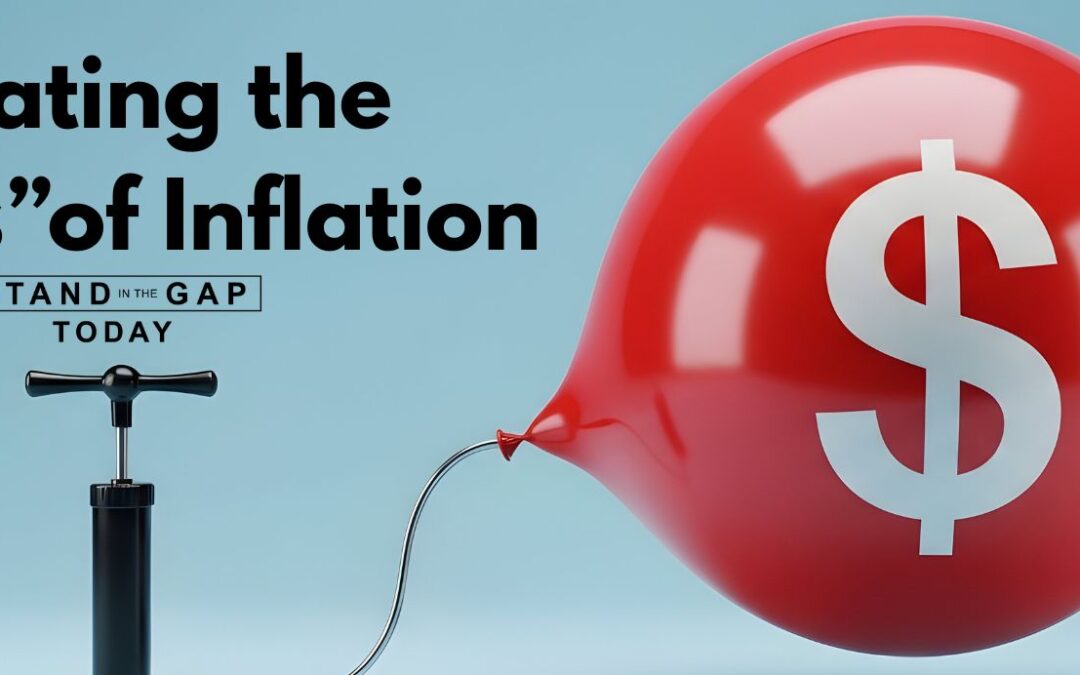

Deflating the Myths of Inflation
August 13, 2026
Host: Hon. Sam Rohrer
Guest: David McAlvany
Note: This transcript is taken from a Stand in the Gap Today program aired on 8/13/26. To listen to the podcast, click HERE.
Disclaimer: While reasonable efforts have been made to provide an accurate transcription, the following is a representation of a mechanical transcription and as such, may not be a word for word transcript. Please listen to the audio version for any questions concerning the following dialogue.
Sam Rohrer:
Hello and welcome to Stand in the Gap Today, and it’s another focus today on economics, finance, and biblical stewardship. We do this about every three weeks or so, but an important topic because it affects us all. But today we’re going to step behind the noise of economic headlines, and certainly there is a lot out there. And we’re going to confront a reality touching every household in America and every person in that household. And that is the destructive reality of inflation. That’s right, inflation. The theme I’ve chosen to frame today’s conversation is this, deflating the myths of inflation. Now, the Bible describes in various ways the destructive effect of what we term inflation. The Bible does not use that word, not at all, but it describes the effect of it. Hagai chapter one and verse six, the prophet there offers, I think, a striking picture of economic decay, very similar today.
He says, “You have sown much and harvested little. And he who earns wages does so to put them into a bag with holes.” In Matthew 6:19, Jesus himself warns against storing up treasures on earth where he said moth and rust destroy and where thieves break in and steal. All speaks about the same type of thing. But systemic currency devaluation is a modern manifestation of an age old issue, the loss of purchasing power through unfaithful stewardship and currency debasement. Now, for the sake of history, the word inflation prior to the 19th century was a strictly medical and/or physical term, and it referred to swelling or blowing air into something. The term first began appearing in American economic writing during the mid-19th century to describe an artificial expansion of paper, money and credit. In 1838, economic commentators used it to describe an inflation of the currency, meaning the money supply was simply being puffed up or swollen beyond its backing in real gold or silver.
And it was not until the mid-20th century, largely during and after World War II, that popular usage shifted from defining inflation as the cause of an expanding money supply to defining it as the symptom, meaning rising prices on goods. Now that being said, I’m glad to welcome back with me today for this focus, David McAlvany. He’s the CEO of the McAlvany Financial Group and he’s author of a book, The Intentional Legacy. And today we’re going to establish our foundation, clarify the true definition of inflation, its true causes, dispel some leading myths. And then all of this will lay out what scripture teaches about honest weights and measures and how as God-fearing people, we can be true to biblical standards and exercise biblical stewardship even in the midst of this perverse day. And with that, David, welcome back to the program.
David McAlvany:
Thank you, Sam. Great to be back with you.
Sam Rohrer:
David, let’s start here. Let’s look at this word inflation. I gave a little bit of a background, but as it’s used today, how has the definition shifted from an expansion of the money supply to merely, which it seems to have anyways, rising prices and why that distinction is so critical?
David McAlvany:
Yeah, there is a connection. There is too much money chasing too few goods. That’s certainly a factor in inflation. So I think you could look first of all at money supply excess as a part of the puzzle when you’re thinking about inflation. To that, I think you can add input costs. If you’re talking about energy, that would be electricity prices, that would be diesel. Those transport costs get added to the cost of goods delivered to a store, which you pay as a consumer. There’s where you see rising prices. We also have disruptions of supply chains. So after decades of outsourcing our productions and manufacturing capacity to enhance margins, that’s outsourcing or offshoring. Now for strategic and national security reasons, we’re gradually shifting manufacturing back to the US. That increases labor costs. You dealing with higher labor costs here in the US. And that comes back to that second point I was mentioning, input costs.
So now you have labor factored in as well. So higher input costs, that drives prices higher for finished manufactured goods. And so you do have kind of this mélange. You have this mix of money supply access, input costs, disruption to supply chains. All of those things factor into both expansion of money supply and rising prices.
Sam Rohrer:
Okay, David, let’s go on to this. Last time we were together, you made a reference to false scales and dishonest again, which scripture clearly condemns. Here in the last little bit of this first segment, link together these principles and others with the word inflation and how modern, I’m going to say modern politicians and some economists have come to justify the actions of modern central banking and how money is printed and expanded. Currency management, we may call that overall, and government fiscal policy, which has to deal with the way we spend money.
David McAlvany:
A friend of mine in England, he ran the London School of Economics Finance Department for 25 years. He also was the longest standing member of the Bank of England for another 25 years. Charles Goodhart. Goodhart’s law says this. When a measure becomes a target, it ceases to be a good measure. So what you’ve had, Sam, is currency managers, fiscal managers basically say, we need to drive GDP growth. And so GDP has become a target. And so to have positive GDP growth, they’ve tried to cobble together economic theories to support inflation as a stimulus for economic growth. Actually, it’s not well supported at all by economic theory, but that hasn’t stopped policymakers from justifying it and moving forward. And we can get to that in a minute because frankly, the biggest winner in inflation is governments. You’ve got the real value of nominal government debt, which declines, and you’ve got the nominal tax base, which increases.
They are the biggest winner for inflation. And we could talk about the biggest losers too. But again, this idea of driving GDP growth, that is frankly, economic theory is often sanitized and it neglects who actually pays the real prices for those ideas. So the cumulative costs that accrue to households and to savers is negative. So I think this is where discussion needs to be had. You have to have average wages keeping up with the increase in inflation for the consumer to not be really put between a rock and a hard place. And it has not. Since the 1970s, wages have not kept up with inflation. And so they’ve got these justifications. Ultimately, I think if you’re talking about the economic managers, the managerial class, they would prefer a little bit of inflation because they assume that they can control a stallion much easier than sort of kicking a dead horse and trying to get it up and moving.
They fear deflation and they’re willing to accept a measure of inflation to avoid it altogether, but it comes at a very high cost.
Sam Rohrer:
Okay. Dave, that’s great. Ladies and gentlemen, stay with us because in the next segment, we’re going to deal with some of those myths. One of them is the fact that some say we ought to have a level of inflation all the time because that’s a good thing. We’ll talk about that. In segment three, we’re going to talk about the winners and the losers when inflation is present. So all of these things we’ve just touched on here are set up for the bounce of the program. Stay with us. We’ll be back in just a moment. If you’re just joining us today, welcome aboard. We’re talking about a theme today. This is in part, part of our economics and finance and biblical stewardship focus, which we do about every three weeks or so. And my guest again today is David McAlvany. He’s the CEO of the McAlvany Financial Group.
Our theme is this. It affects all of us, but we’re going to be giving a lot of information that I think will be of interest no matter whether you’re aware of inflation and what causes it or not. We’re hearing a lot about it. Here’s a theme, deflating the myths of inflation. Now we defined it and gave some history of it and some things about it in the first segment. We’re going to move on now to some of the myths. I want to start here because in Article one of our US Constitution, in that section, it links a primary duty of Congress to do a couple of things. One of them is to coin money. And it directly links it there in that segment within the framework of establishing and maintaining a fixed and just standards of weights and measures for all things. Such I would be in the gasoline tank and a gallon, what’s a gallon and that kind of thing.
It’s all in there together. Weights and measures. A standard that scripture commands weights and measures must remain honest and unchanging. That’s in the word of God. It makes it clear. And our constitution embodies it there in Article one. Now that being said, yet today I’m going to say despite God’s divine order and our constitution’s lawful requirements, political institutional leaders actively defend the deliberate gradual devaluation of our currency. And this deliberate violation of duty, because it is a duty, it’s unconstitutional, it’s word of God, and the embracing of, I’m going to say, deception. It’s not the result of one political party. It’s not the Democrats or it’s not the Republicans. It’s not even reserved to one particular view of economics.
I’m going to say it’s the direct result of the setting aside of truth and fidelity. And here’s an example. Treasury Secretary Scott Bessen just recently outlined this mindset when discussing macroeconomic growth where he stated, “If we can keep inflation around 2% and grow the economy at three or 4%, that’s a winning formula. But it assumes that a constant 2% erosion, 2% inflation is actually healthy. But is it not perhaps a silent tax? So today we’re going to dismantle the three, at least there’s more than these, but there’s three major myths surrounding rising prices. One of them is the mild inflation is harmless and necessary for economic growth. The second one is that inflation is driven by corporate greed or demanding workers or that kind of thing. And the myth three is that the consumer psychology alone, things that basically blame it on the consumer for creating it.
So David, let’s get right into it here with this 2% target. You referred to this in the last segment, and I want to go right there now. Why do policy makers treat currency devaluation as a winning formula, which is what Bessent said. He’s not the only one, but he just most recently said that. And what does that compounding loss actually do to a family’s saving and purchasing power, say, over a generation of 20 to 30 years?
David McAlvany:
Yeah. This is a huge issue. And I think you’re right to frame it as an additional tax. And this was popularized. Inflation targeting was popularized in 1992 by the Central Bank of New Zealand and then became basically economic orthodoxy. The whole community globally of central bankers adopted this. And inflation does not drive nominal growth, but nevertheless, they like it because it does protect against significant. They believe it protects against significant deflationary events. And we mentioned that in the last segment. The cost for that security, if you will, is very high to a household. Over a 30 year period at that 2% target, $100,000 saved today only maintains $55,000 worth of purchasing power tomorrow. Another way of looking at that is if you wanted $100,000 of purchasing power tomorrow, 30 years from now, let’s say you’re 25, 35 years old, maybe you’re thinking about retiring at 65.
Instead of $100,000, you’ve got to have $181,000 today so that in 30 years you can buy $100,000. And of course, we’re talking about. And of course you’ve got negative compounding over time. If you stretch that to 50 years, your $100,000 only has $37,000 worth of purchasing power. The issue is we haven’t been at that 2% target for some time. We’re now 64 months above target. And so that negative compounding, the negative impact for someone who’s retired or living on a fixed income is that much greater.
And so I think the households, really middle class, lower class households are the ones that pay the biggest price here.
Sam Rohrer:
All right. So in essence, if nothing else, it’s a slow leak. But in any event, if you don’t stop it, the tank’s going to empty, which is exactly kind of what you’re saying. We’ll build more on that, ladies and gentlemen. Stay with us. Dave, there’s a myth, number two, that it’s actually kind of happening. We’re hearing it in the media today. And that’s the fact that they say inflation is due to greedy corporations who just blatantly raise prices to increase bottom line profits. Now, whereas that could happen, that is a line that’s out there. And it’s actually being tied into these democratic socialists who are spinning this a little bit. Now, nonetheless, how would you deflate this common myth? Is it the corporations that are causing inflation?
David McAlvany:
It is an easy scapegoat for politicians to point the finger at corporations instead of take ownership of their policy choices. And inflation is very much a policy choice. So I mean, a corporation is producing products that get sold to the general public. When prices go up, it’s often a reflection of their input costs going higher and that being passed on to consumers. That’s not really an expression of corporate greed. That’s an expression of corporate existential threat. They’re trying to defend or manage their margins so that they can have a business and not have mass layoffs as a consequence of losing their business. So oftentimes if the price of oil goes up, you’ll see politicians, they’ll say the same thing. Look at big oil. They’re just pillaging the general public. And the reality is big oil invests in massive projects, billions and billions of dollars with no immediate payoff.
And occasionally the price of oil goes higher and they begin to recoup some of those costs that they’ve put in for years, if not decades. And so these windfalls, governments would love to say, “It’s not my fault that inflation is going higher.
Sam Rohrer:
Look
David McAlvany:
At big oil. Look at corporate greed.” It’s far from that.
Sam Rohrer:
Okay. Let me follow up with this as well, because in a setting as we’ve been blessed to be, where there is competition, that also helps to keep prices in line. But one of the problems with monopolies, which laws have been put in place, is that if you had one entity owned everything, they could in fact raise prices illegitimately. And under a circumstance like that, that could contribute, could it not?
David McAlvany:
Absolutely. If you have monopoly tendencies, that is absolutely the case. Competition is one of the things that keeps honesty, integrity in the market because consumers have choice and consumers will find the lower price with someone who’s competing for that business. So you’re right. Monopoly is held in check by the free markets to a large degree as long as consumers have choice.
Sam Rohrer:
Okay. Now here’s this myth three. Let’s try and deal with that one here. It’s a common one. It’s under a Kinesian economic philosophy. Oftentimes will blame inflation on the consumer by saying that when private business or consumers get driven by fear or an excitement and they go out and they spend money faster than they normally, or they save and they don’t spend because they fear something, that that’s the cause of inflation. What about the truth on that one?
David McAlvany:
Well, I think that’s a characteristic of super or hyperinflation. There is a positive feedback loop. The concept here in economics is called velocity of money. And so if you think of money as it’s supposed to be, you’re talking about as a measure, an honest weight and measure. The dollar used to be 1.5 grams of gold. So if you look at one ounce of gold, it equaled $20.67. And that was when we were on the gold standard. So if you have stable money, you can think of stable money as like a cold potato. When you have less stable money, people treat it like a hot and hotter potato. And the hot potato, you want to get rid of it as fast as you can. And that again is the characteristic of a super inflation. As inflation begins to reach a certain threshold where people are concerned, they have their own sort of existential threat.
The value of money is dropping considerably. We’ve seen that in recent years in places like Argentina, even Brazil where you’ve got double digit inflation. You want to get rid of that currency as fast as you can because it’s not going to buy as much a week from now, a month from now, a year from now. And so it does take on sort of those hot potato tendencies. That is a positive feedback loop. Velocity increases. And again, the consumer is spending faster and faster to buy as many real things, whether that’s a bag of potato chips or just something of substance to get out of the currency. And so that can exacerbate inflation.
Sam Rohrer:
All right. David, you’re doing a great job of providing quick answers to complex questions, all of which we could take and spend a lot further time on. But ladies and gentlemen, stay with us. Hopefully this is helpful because we’re going to move further to the next aspect of the fact that inflation does exist. We have those in government who say that a little bit of inflation is good. We’ve described it as a slow leak though. Over time, it will destroy everything you have in savings. So it’s not a good thing. All right. Now we’re not going to go back and say, right, well then why in the world does it happen? Somebody’s got to win. There are a lot of losers. We’ll talk about winners and losers in this next section.
Today we’re talking about inflation and our theme is deflating the myths of inflation. And my special guest is David McAlvaney, CEO of the McAlvany Financial Group. They have a website at mcalvany.com. And if you go back/stand in the gap, there will be some things there that may be of help to you. Inflation as a symptom of currency devaluation, we’ve been talking about that. It does not impact everyone equally. That’s why I said before the break. If it was bad for everybody, it wouldn’t be happening most likely. But even in the worst of times, they’re oftentimes winners. Even in a matter of war, people always profit in war. Some people do. But economically and historically, inflation like that creates distinct winners and there are clear losers. Through what economists call the cantilan effect, those who receive newly created money first, central institutions, banks and government contractors in particular, they will, I’m going to call it that way, they’re on the inside track.
If they get that inside track and they get that money first, and then they spend it, that current prices before it dilutes itself in the broader economy, they can be a winner. Now, meanwhile, everyday citizens who receive that money last, we face higher prices. For instance, the grocery store and the gas pump, much of what everyone is experiencing today. Heavily indebted institutions and governments, they do benefit by paying back long-term debt with cheaper dollars. While traditional savers, many of you listening to this program would be in that category. We are traditional savers. We save our money. We don’t spend every dollar that we make right away. Retirees on fixed incomes would be in that category. Wage earners all see their purchasing power quietly eroded. And at times it begins to speed up, perhaps like today. But today we look at those who are truly gain and who bear the burden and how inflation shifts a culture from long-term thrift, one of the impacts of this, to short-term speculation.
And I’m going to submit here, my own personal view, that when you look to those in both political parties or banking leaders as institutional banking leaders who make the decisions regarding whether or not you deficit spend or you print more money or you spend more than you have, all of that they together have made where we see today a rather normal practice. And then you’re looking at the very people who view themselves to be among the winners. Those who do that, who make those policies have figured out some way where they think they’ll win by doing it. Now here’s something of interest. A point in fact, Donald Trump, he’s our president now. We know that. But before he was the president, he was a businessman. When he was a businessman and even after that, but he has personally made millions and he’s bragged about that as we know many, many times.
And he’s talked about knowing how to profit off of debt and by borrowing. Right now, for instance, on CNN in 2016, Donald Trump, the businessman, said this, “I’m the king of debt. I’m great with debt. Nobody knows that better than me. I’ve made a fortune by using debt.” Then in his capacity as president, he said just two months ago on June the 10th in the White House regarding at that point, the latest CPI Consumer Price Index report, he said, “You know what I really love? I love inflation.” That’s right. “You know what I really love? I love the inflation.” All right. Now, David, you know, and we say in this program a lot, and I have Dr. George Barne on regularly. And as a result of his research, he’s made it very, very clear that people do what they believe. And what I cited there is to tie into that because that’s true regarding every person, whether it be the president or a member of Congress or anyone else.
Now here’s the question. That being said, can you walk us through the mechanics of who actually benefits most by the eroding power of inflation and why fixed income retirees and savers end up paying the heaviest price? You alluded to it in the last segment, but build that out, please.
David McAlvany:
Sam, I love your reference to the Cantillon effect. This goes back to Richard Cantillon, who was a banker and businessman during the French hyperinflation. And so the French hyperinflation led to the French revolution where people could not pay their bills and they were desperate to feed their families and something had to change politically in response to very desperate situations at the household level. Cantillon effect, if you imagine honey being poured onto a plate, it hits one place and then it gradually spreads across the plate, but it’s very gradual. So when money supply increases, it enriches the wealthy. And this Cantillon effect describes how it further impoverishes the poor. And so we mentioned it a little earlier where for governments, they actually are the biggest beneficiary. The second beneficiary would be leveraged business owners. And the third biggest beneficiary would be wealthy households with assets. But if you look at who’s paying the price, it is people who are living on a fixed income, people who are retired.
They don’t have an ability to increase their income even though the costs of goods and services is going higher as a result of inflation. So government wins the biggest because again, if you look at the nominal debt, today coming up on $40 trillion, you’ve got an increasing nominal tax base with inflation. And the value of each of those dollars is being eroded. You’ve got more money to pay off that set amount of debt and it’s to the benefit of government. So it allows them to deficit spend and pay back those obligations with cheaper and cheaper currency. They’re the biggest winner. Leverage business owners. If you borrow to build out a business and you’re selling goods and services, the cost of those goods and services goes higher, but your debt is fixed. And so the leveraged business owners is the second biggest winner in inflation. In wealthy households who have lots of assets, those assets also tend to appreciate, they tend to be remarked to higher values with inflation.
So when you look at sort of you move through the middle class, fixed income retirees, renters, very low income, the working poor, they don’t have the assets that inflate. If you’re a renter, you could have the cost of your housing go up considerably. It doesn’t mean your income is increasing in a commensurate fashion. So you’re kind of pushed to the wall. You’re the one who’s ultimately going to feel the squeeze of inflation. And it exacerbates social tensions by creating this huge divide between the rich and the poor. It exaggerates it. What some economists have measured in terms of the genie coefficient. That is this great divide between the rich and the poor. And you see it at different inflection points through history. That became intolerable during the French Revolution. So I’m glad you mentioned the Cantillon effect
Sam Rohrer:
Because
David McAlvany:
There is a disproportionate positive effect for the wealthy, disproportionate negative effect to those living on a fixed income or the poor.
Sam Rohrer:
Okay. Let’s think about this. Every policy, when I was in office making laws, I did think as a believer, I thought, how will this law either encourage biblical principles which God says should be followed because he will bless, or encourage people to do the exact opposite? And when it comes to policies of spending, what we don’t have, debt, or the things we’re just talking about, there’s a cause and effect. And here’s what I want to ask you right here. How does an inflationary environment, like we’re talking about, subtly push a culture away from traditional stewardship and saving as an example, instead forcing people into high risk financial speculation where they feel like they’ve got to spend everything they have or risk whatever they have in order just to stay ahead?
David McAlvany:
The more inflation increases, the more people become currency speculators or gamblers. And I see that when I talk to young people today, they don’t want to save. They feel like it is just not worth it. If they save an extra $50 a month, is it really going to make a difference? And frankly, it’s not in this environment where inflation is an issue. And so what I see is they’ll go onto a Robinhood account and they will choose the most speculative investment in hopes that they can hit a home run because only hitting home runs is a way that they can gain some financial security. They’re living with financial insecurity and they’re forced to become gamblers in order to sort of rectify that situation. So where I saw currency speculation, back in 2014, Pain was the last time I was in Argentina. And you’d go into a store, first thing that they would want is they would want you to pay in dollars, not in Argentine pesos.
And it was just an interesting dynamic because everybody wanted to be in the currency exchange business and their business fronts were basically an excuse to be in currency exchange. They had to get out of the peso as fast as possible. Selling goods and services was an excuse for exchanging to a superior currency. It wasn’t really selling goods and services. They were pushed to the wall as well and were basically currency speculators as a result of the massive inflation in Argentina. So again, I think one of the things that you’re hitting on is that there is a cultural erosion as a consequence of inflation. It’s not merely an impact on finances, but because of finances, you begin to see sort of this rending, this tearing of the social fabric. It is a devaluation of cultural ideals. People begin to think differently about the future and focus only on survival in the present.
And that I think is where the most negative effects come from, is you’re devaluing culture and society at the same time you’re devaluing currency.
Sam Rohrer:
And with that, ladies and gentlemen, stay with us. We’re going to conclude by going back to biblical principles, faithful stewardship. Well, as we now move into our final segment, stay with us. We’re just about done, but we’re going to share some very critical principles in this segment and some additional statistics that I think you will find very interesting because it does affect this topic we’re discussing today, inflation. It has already affected every one of us. The thing about inflation, even like that number we talked about, that 2%, which most in governments say we need to have a 2% inflation rate. That’s okay. That’s a good thing. My guest, David McAlvany made clear. Yeah. Good? Well, is it good to have a leak? Inflation’s very much like a leak. You can just have a great burst and everything collapses. Or you can leak a little bit at a time.
Give it enough time. You don’t have anything left. We’re going to conclude on that. We’ve defined here now today the true nature of inflation. We’ve confronted, debunked three major myths. There are others, but the three major ones. We’ve examined who suffers under currency devaluation, which is a major driver of inflation. And I’m going to say the eroder of wealth. But now we turn to the vital question is that how do we live and manage our resources faithfully? It’s God fearing people. How do we live and manage our resources faithfully in an economic system that’s driven by the concept that debasement, a little bit of inflation, if not a little bit more, is good as long as you stay ahead with something else? Well, I’ve already defined it. From God’s word, that approach is both immoral in violation of God’s word. And it’s frankly unlawful in violation of our own constitution, the requirement of Congress to have sound and predictable weights and measures and applies to coinage of money.
That’s on Article one. Now, in one Thessalonians 6:17, the Apostle Paul there instructs us not to set our hopes on the uncertainty of riches, but on God who richly provides us with everything to enjoy. So that’s one thing as believers we need to keep in mind. Now here’s some facts. Listen to these. They’re staggering. Our national debt we now know sits at about $40 trillion and it’s growing faster in the last two years than it ever has. All right? That’s a fact. And when combined with promises made by government, often termed unfunded liabilities, things like social security and Medicaid, things for which people have been promised into the future, that is debt. That number rises to $118 trillion. But that’s not the only debt that’s around. When you combine that with consumer debt of all types, it could be mortgages, it could be credit card, it could be consumer debt of all types.
That number rises to the impossible to repay number and that level of $161 trillion. We are a debtor nation. Now, combined with central bank policies, printing money and so forth, paper currencies that fluctuate constantly, all of that just further erodes the value of what we think we have. Now, how can you measure that? Well, one sure way of measuring it and determining and proving that the bag in fact is full of holes, as Hosea mentioned, that verse I quote at the beginning, “When considered in objective terms,” I just did a little bit of research on this. For example, a person born in the year 2000, make him 26 years old now. The value of a US dollar now compared to what it was then has depreciated by 48.5%. It’s only worth 51 cents today. If you were born in 1960, meaning you’re about 65, 66 years ago, you’re that old now, the dollar value then has eroded 91.2% and is worth only eight cents today.
But despite the flagrant embracing of infidelity in policy and immorality in duty, God’s principles of sound stewardship, tangible value, honest labor, intergenerational planning remains unchanged. So today we just close with some practical wisdom for families seeking to build a lasting legacy amidst economic uncertainty. Now I had to say that after because that lays the foundation. David, as national systems face increasingly fiscal pressure, how can local families and churches and small businesses stay true to God’s principles and as faithful servants handle what they have been given by God, even in the midst of a society that’s seeking to basically steal everything that we have?
David McAlvany:
Well, your questions are always great, Sam. I think just to add one more point to your earlier statistics, since the creation of the Federal Reserve in 1913, with one of their primary mandates being currency stability, purchasing power, management and maintenance, I think you could give them an F minus as a school scorecard. 98% is the loss of purchasing power since 1913. So I think a steward has to look at the world that we live in and recognize that it’s a failing system. It’s a rigged game and it’s not new. Every time we’ve experimented with money, it has ended in the same disaster. We’ve been talking a little bit about the French system. The French in that period, 1789 to 1790. They did not allow their citizens to own gold. It was made illegal. There was no exit from that rigged and failed system. It’s not the case today here in the United States.
You can own gold. In fact, my father helped get gold legalized working with Senator Jesse Helms back in the ’70s. January 1st, 1975 was the first time since gold became illegal, 1933. And now of course we have that privilege. I think the steward has to look at what gold is and the role that it has played in the systems of money through four or 5,000 years of recorded history. Historically, gold is a reliable form of currency. You’ve got stable purchasing power through time. In any fiat regime, and by fiat, I mean a paper currency regime where the currency has nothing real backing it. Gold becomes a form of savings insurance. And why is this important? Because if you don’t take inflation seriously, you are actually talking. We talked about the social devaluation. It is actually an attack on the individual. It is a devaluation of the individual.
Labor is, and if you want to look at savings as a form of labor bottled up and held in reserve for the future, savings, thrift, a future oriented legacy-minded family looks at these reserves and resources as a way to either impact the kingdom, provide for family, et cetera, et cetera. You’re at odds with a system that is destroying your bottled labor. It is devaluing you as the individual saver. And I think gold continues to be a reliable way to store reserves, whether it’s for future use in retirement or as a legacy-minded asset. So I think that is one way that stewards can look at managing an unstable currency environment.
Sam Rohrer:
Okay. We have just a short time left. Your book, The Intentional Legacy, does it speak to any of this? And if so, where can somebody find that?
David McAlvany:
Yeah. The Intentional Legacy is my attempt to say, please look comprehensively at the balance sheet that you’re managing. You have assets. Some of those are tangible assets. It could be homes, it could be stocks, it could be metals, it could be real estate, but look more comprehensively at the rest of what’s on your balance sheet. The intangibles. How are you training your kids and your grandkids in a culture of love and forgiveness? How are you setting them up for success in life with the skills that they need to do life well together? It’s much more of a look at intangibles than it is a look at tangible wealth because we’ve been in business for 55 years. We’ve worked with tens of thousands of families helping them secure their wealth. But what I see a lot of times is that folks forget the intangibles and just how important those are to manage.
You don’t get a statement.
Sam Rohrer:
Okay. And with that, David, we got to jump off. We’re out of time. Thanks so much. His book, The Intentional Legacy. Folks, I’m sure you can go online and find that intentional legacy. Thanks for being with us today. Hopefully this program has been helpful to you, not just in the moment, but in the days ahead.

Recent Comments