
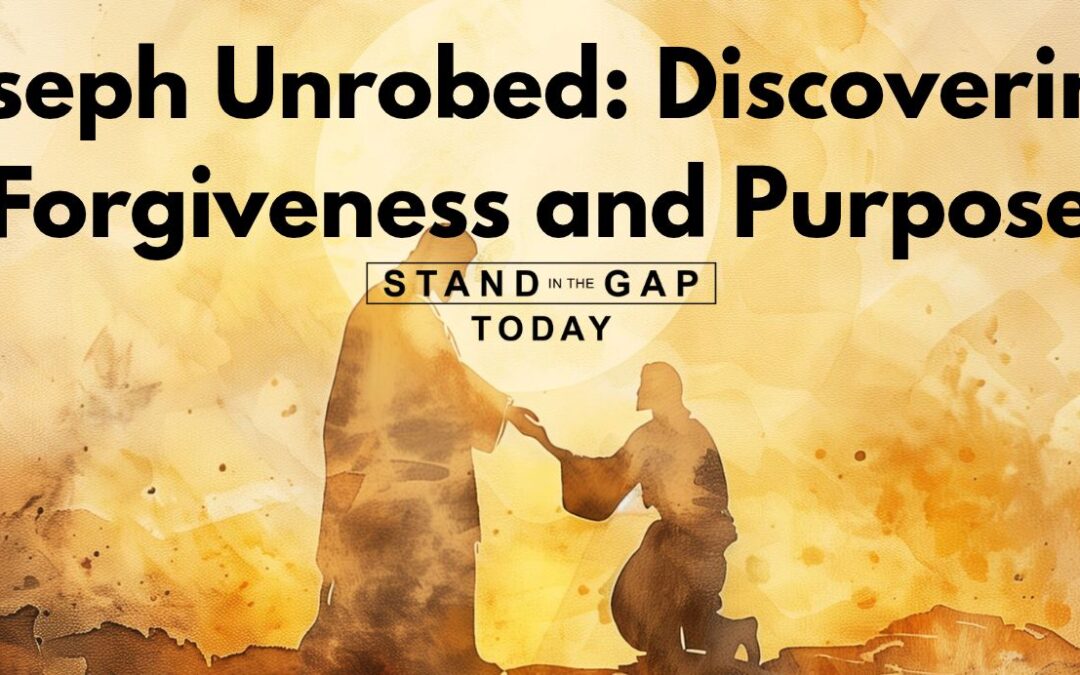

Joseph Unrobed: Discovering Forgiveness and Purpose
Nov. 17, 2026
Host: Dr. Jamie Mitchell
Guest: Mark Barnard
Note: This transcript is taken from a Stand in the Gap Today program aired on 11/17/26 To listen to the podcast, click HERE.
Disclaimer: While reasonable efforts have been made to provide an accurate transcription, the following is a representation of a mechanical transcription and as such, may not be a word for word transcript. Please listen to the audio version for any questions concerning the following dialogue.
Jamie Mitchell:
Well, good afternoon, friends and welcome. I’m your host, Jamie Mitchell, director of church culture at the American Pastors Network. I think I’ve mentioned that this past September, my son and I, we had the privilege to travel to Egypt and visit the land of the pharaohs and the pyramids and the amazing history of the Hebrew people. I say that because remember, Abraham, Joseph, Jacob, Moses all played a major part in Egyptian history and it is noted there. They speak about those Hebrew characters playing a major role. And Egypt as well shaped much of the Jewish people’s future and their story. One of the highlights of my trip was to visit a fairly secluded and somewhat dangerous site of Joseph’s storehouses. As I walked around the storehouses, that area, it was quite inspiring. My mind was filled with Joseph’s amazing story. The one word that flashed through my mind at that moment was forgiveness.
If there is ever a narrative of the scriptures that explores and puts on display how God expects his children to express and walk in forgiveness, and especially when injustice piles up on all sides, it was the Old Testament story of Joseph. And today I want to take a deep dive into Joseph’s life, consider how his life can serve and help us discover God’s purpose for our lives and how to live in victory amidst disappointment, betrayal, and a myriad of life’s twists and turns. And to help us is a return guest to stand in the gap, and that is Mark Barnard, the president of Blessing Point Ministries and the author of a book concerning today’s topic. The book title is Joseph Unrobed. I can’t wait to get into that. I’m anxious to discuss this topic. Mark, welcome back to Stand in the Gap.
Mark Barnard:
Thank you, Jamie. It’s a pleasure to be back with you.
Jamie Mitchell:
Mark, I want to get into your book and discuss Joseph’s life, but first I want you to help me if you can with this question. Why do we love Joseph and his story? I say that because of all the biblical characters that preachers could preach and teach on, I have noticed that almost every pastor, as I’m looking on church websites or on podcasts, there’s at least one series somewhere in their catalog about that subject, about Joseph. And I have noticed that congregations love looking into his life. Why is Joseph such a beloved character to us who love God’s word?
Mark Barnard:
Yeah, I think there are just a number of compelling aspects to his story. I think in general, the story has such a magnetic quality to it. You’re just drawn to the characters and to the way things unfold and the timing of events. And we love a good drama and Joseph’s story has more drama than a Hallmark movie. I mean, it’s just amazing how much drama there is. There’s injustice, there’s betrayal, there’s success in the end. And it’s really a lot of content that kind of bypasses the intellect and goes right to your emotions. It is a lot of emotional exegesis that takes place there, not just the words, but what’s really going on between the lines. And I think God really intends for us to pay attention to this story when you realize that it takes up 40% of the book of Genesis. I mean, he shares room with Noah, Abraham, Isaac, Jacob’s story, creation story, but 40% of that book of Genesis is taken up with this magnetic account of Joseph’s life.
Jamie Mitchell:
Mark, as I look at Joseph, the first thing that jumps out at me, and I have noticed that people connect with his story, is how dysfunctional his family was. I mean, talk about a crazy family and the infighting and even how Jacob is almost asleep at the switch as a dad with this whole thing. There is those family dynamics in Joseph’s stories, isn’t there?
Mark Barnard:
There really is. And you have all that in this story. And really you have four silent maternal figures, four of Jacob’s. They’re not even really mentioned in this story. So there is a ton of dysfunction. And maybe that’s one of the reasons why many people, myself included, identify with it because none of us come from perfect families. We may come from a good family, but it’s not a perfect family. And God is showing us through this account that that’s not a hindrance to his will and to his work. And I think that’s a huge encouragement to people.
Jamie Mitchell:
Mark, the other thing that for sure, and that is, you talked about it drawing us in. We so relate with him on just a hurt level. Blessing Point Ministry, as we have talked in the past, and I think you’ve shared in the past, you go in and you work with churches and hurt that has occurred in churches. I mean, throughout the Christian landscape, Mark, there are just a boatload of hurting people. And Joseph really does speak to that level, doesn’t he?
Mark Barnard:
He really does, because we do work with a lot of hurting churches and we get to see God do a lot of miraculous things, but behind those stories of pain in those churches are usually people. And we may come to know the Lord, but it takes a while to untangle our family of origin dysfunction and to get healed from that so that we bring a healthiness to the church. And so there’s a lot of folks that can relate to this because we’re living in a day when people are increasingly less emotionally healthy and there’s increasing levels of dysfunction in families and in churches. And one of the reasons I wrote this book was to help people who have a painful past in the churches that we serve, to give them a path forward, deal with their personal issues that need to be healed.
Jamie Mitchell:
Mark, one of the things, and we’re going to touch on a number of topics through today’s program, but one of the things I want people to fully understand is that we know at the end Joseph has this amazing success. He ends up being number two in the land of Egypt and he serves, I guess, four or five different kings or pharaohs, but it took a long time. It didn’t take overnight. And beloved, listen, you may be hurting. You may have experienced betrayal and injustice. You’re looking for God to fix the problem. We have to look at Joseph’s life. It took time. He went as a young man. He ended up being almost middle age, but in all of that, it’s important. I remember Dr. Lloyd Perry said this about Joseph, “He’s just like us. When we return, we will dig into Mark’s book and take a glance at Joseph’s clothing.” There’s the tip for you.
Well, thanks for staying with us. I think today will be an encouraging program as we look at the life of the Old Testament patriarch, Joseph, the 11th son of Jacob. And Mark Barnard is our guest. He’s written a book, Joseph Unrobed. Mark, you got me with the title. Joseph didn’t have a special robe and he did get it ripped off. But as I began to read through your book, there’s more than just one piece of clothing. So take some time and tell us what is behind the title and what motivated you to write about this beloved character and unpack this clothing theme.
Mark Barnard:
Well, to be fair and honest, I owe the title to my son Jesse who came up with it. I’m sure you’ve written books yourself and probably the biggest thing to struggle with is the title. So I give credit to my son for coming up with the title. But there’s a subtitle too, and it’s called Holding Onto Your Dreams When Life Seems Like a Nightmare. And I think that that is really appropriate to Joseph’s story. The theme of his clothing, I think forever, pastors have preached on that coat of many colors that really caused so much consternation in his family. But one of the things the Lord showed me as I read through this story and reread through the story was that there are a number of clothing references throughout his life. The first, of course, is the coat of many colors, but some years later he ends up being tempted to immorality by Potiphar’s wife.
And what does he leave behind, but a cloak that she grabs onto to use as evidence against him. Interestingly, the coat of many colors was also used as evidence that Joseph was killed. So you have those two references. Then you have a reference to the clothing that is stripped off of him. In the jail when he’s ushered to go and meet Pharaoh, you have the clothing and signet ring that Pharaoh places on Joseph. You have later in the story when Joseph reconciles with his brothers, what does he do but gives them gifts of clothing, which is hugely symbolic for the story. And in the end of the story, Joseph literally has nothing left to wear. And he says, “When you return to the promised land, take my bones with you.” So you have this kind of unrobing or changing of clothes that takes place throughout his story.
And I hesitated to write about it, to be honest with you, because I could see the pattern. I couldn’t understand it. I couldn’t believe that no one else had not seen the pattern and written on it already. So it took a lot of caution on my part, a lot of prayer, but I think the result is a compelling account of Joseph’s wardrobe over the years and how each article of clothing had symbolic meaning for the transition that he was facing just as we face transitions in life. And I think God’s making it obvious to all of us that he works in our lives over the long haul. I mean, you mentioned earlier, you get the beginning of the story around age 17, he lives to be 110. So you have this whole breadth of a man’s life and it helps us to see that God is working in our lives from birth to death.
Jamie Mitchell:
Mark, I want to talk about it because I want to tell you, I’ve preached on Joseph. Matter of fact, this past year, this is what enthralled me about your book, this past year, I just preached through the life of Joseph because I was getting ready to go to Egypt. And I though, listen, if I’m going to go visit this, let me go through here. And when I read your book and I began, I felt like I needed to go back and re-preach it, but I want to talk about some of those coats for a moment. When I think of the coat of many colors as both from what I read in your book and just knowing that story, here was a simple gift by his dad, but it caused such envy in his family and with his brothers. Again, you work with churches, you work with a lot of Christians.
Mark, it can’t be true. Do Christians struggle with envy?
Mark Barnard:
Envy, covetousness. I think we’re kind of touching back on why this story is so relatable. I taught a Bible class in a middle school for a year and you get to know the students and there were some students I knew you could rely on and some you weren’t so sure about and you ask one to make an errand and another student pipes up, “Why did you allow them to do that and not me?” And I foolishly said, “Because I like him better.” And the kid said, “Well, that’s obnoxious.” Well, it is obnoxious. And envy is obnoxious, favoritism is obnoxious. And in Joseph’s family, he was the youngest. All his other brothers were older than him and they’re out in the field doing the hard work and he’s like the family administrator and he’s got the favor of his dad, which means he’s probably going to inherit the whole family wealth in the future.
So it was not just a robe. It was all that the robe symbolized that caused him trouble in the family.
Jamie Mitchell:
Let’s talk about Potiphar’s wife and her grabbing his robe. But what followed was a false accusation. Mark, there are pastors today that lives have been just brought to, they’ve been brought to their knees by false accusations. That’s hard to deal with. I mean, that level of injustice can basically ruin a person, not to mention, basically start saying to themselves, where is God in all of this? I guess over the years, you have had to counsel and come around some folks who have dealt with these kinds of things.
Mark Barnard:
Well, when I talk about Ms. Potiphar in the book, the title of her section is Exploring the Nature of Evil, because she is really acting in a thoroughly evil manner. She’s incessant in her demands that Joseph lie with her. When she doesn’t get her way, she comes up with plausible lies to frame her guilt as Joseph’s. She has no regard for his life. She’s probably taking delight that she got her way and got him stuffed in prison. So pastors today encounter evil frequently. Sometimes they don’t always discern it as such. The people kind of mosey up on close to you and then before you know it, they’re your nightmare. And you do need a lot of discernment in the church as a leader to recognize and to deal with evil. I think the biggest problem we see as a ministry is that churches are not addressing the evil that they see in their church and they let it lie there and spread and that’s when it really causes problems.
Jamie Mitchell:
Mark, one of the things that I picked up reading, and this was kind of a unique thing that you talk about, and that is when he sees his brothers coming and it says he puts on a disguise. So here he is putting on clothing. Joseph is exemplary in so many ways, but I take it that Joseph is struggling at that moment, what to do. Here were these guys that had dealt such injustice, but now he was in a place of power and influence. And what is really behind that whole thing of him putting on the disguise?
Mark Barnard:
The Bible doesn’t state what his reasons were, but kind of between the lines, I think that he recognized them from afar. I think that much is clear. And I think that he wanted to deal with it in a way where he could see what was in their hearts, if they had changed or not. And what an effective tool that disguise was. And I would have loved to have seen their faces, the brothers’ faces, when they’re seated around that dinner table later on in the story and they’re seated according to birth order. I think did they not even wonder how that could be? What did they not take the clues? And there are a number of clues that show up in that part of the story that the brothers really fail to recognize.
Jamie Mitchell:
Mark, in the last minute or so, can you just take a moment and give a quick summary of Joe’s life and some of the stages that he experienced? And we’ll talk later about how this relates to us, but is there a way to simply summarize Joseph’s life?
Mark Barnard:
Yeah. I don’t know if it can be done, but he grew up in an agrarian world. There was a dad with four wives. I remember visiting Israel years ago and asking my tour director if he knew anyone that had more than one wife. He said, yes, I have a friend that has four wives and he also has four headaches. So you can imagine just that dynamic, but each one of those women had sons and they’re competing with each other for attention and possessions and rank. And that really is one of the themes of his clothing is that in each case, his clothing represents some form of standing or status. And in the first three references up until he’s stripped of clothing in the jail, he’s being stripped of that status. Things are being taken away from him until he’s really ready to put on the robes that Pharaoh gives him, same symbolic meaning status, but his heart is ready and it’s in a place where it matches his gifts and God can use him the way he wants to.
And he lives through all that. I think he’s in his mid 50s when he reconciles with his brothers and then at 110, they show him at the very end of his life and he has to reassure them even after he forgave them that they’re really forgiven. And we have that wonderful statement, you meant it for evil, but God meant it for good.
Jamie Mitchell:
Wow. Joseph’s life serves as a wonderful model of how life unfolds and how a sovereign God orchestrates every step along the way. When we return, I want Mark to unpack Joseph’s life timeline. I think you’re going to be fascinated by this. Don’t go anywhere. Stay with us here on Stand the Afternoon. Well, if you’re just joining us, you will want to go back and listen to the first half. You can always do that by going to our app on Google Phone or on your Apple phone or check out our website. And we are looking at the amazing life of the Old Testament character Joseph. I need to say that because we’re getting close to Christmas and I don’t want to be talking about Joseph and Mary. And Mark Barnard is providing us with some insights and some understanding. Mark, as I got to the end of your book, it was kind of the aha moment.
You do something that I really appreciated and that is you identified a pattern in Joseph’s life, a timeline, and then you applied it to your own life. Can you unpack some of that for our listeners and explain both what you discovered and how it helped you and can help anybody else?
Mark Barnard:
Yeah. I think there’s wonderful details throughout his story, but when we step back and kind of take the macro view of his life, you begin to see reoccurring themes that run through his story, particularly the years prior to his becoming the prime minister of Egypt. His early years, of course, he has that robe of many colors that gets stripped off of him. The robe representing his status in the family, and he betrays a little bit of arrogance in the family early on when he gives a bad report about his brothers and openly shares his dreams of their submission with them. Just typical things a young guy would do, excited about his future, but still there’s this sense of arrogance attached to the robe. And then when he is sold as a… His life is going from bad to worse. He becomes a slave. Everything’s turned upside down.
He’s given some new clothes. Those clothes also get stripped away from him. What does he say when he’s being tempted by Mrs. Potter? He will not lie with her, but he also says, “There’s no one in this house greater than I.” So you still hear some of the old strains of arrogance in his being when that crisis erupts. And then he’s cast into prison and he meets these two officials from Pharaoh’s Court and tells them the meaning of their dreams. One comes true. They both come true, but when the wine tester is restored to his position, he says, “Remember me before Pharaoh because I’ve done nothing to deserve being here and I was in fact kidnapped from the land of the Israelites.” Well, he wasn’t kidnapped. He was betrayed by his brothers. And who is going to be willing to mention a slave working in Pharaoh’s prison to Pharaoh himself?
So you have these strains of self-importance and arrogance that kind of flow through his life. And then it says the health pharaoh forgot him for two years. I think during those two years, he came to the end of himself and God was finally able to break him and get him ready for the position he had for him all along. So he had this pattern of clothing references that shows us that he was dealing with the same issue over and over again until he realized what the underlying issue was and dealt with it. And I think that happens to all of us as believers. I think we all know that if we don’t learn the lesson God is trying to teach us, he makes us learn it again and maybe a few years later, but the issue comes up again and again, he’s hoping that we’ll recognize the pattern and deal with it.
And that’s what I illustrated with his life and with my life because I came from a highly dysfunctional family as well, and I had patterns of needing to learn how to relate to authority figures in a healthy way. And I think if we’re all honest about the sanctification process that God wants to take us through, sanctification is not just a theological education. It’s really about changing and healing our hearts so that we more reflect the image of Christ. And to do that, sometimes he has to take us through repeated patterns of painful events till we get the message and can repent and move forward in his plan.
Jamie Mitchell:
Mark, I do a kind of like a mentoring group. I put material together. Man, I am probably going to add your book to one of the readings, but one of the things I have people go through, especially when they get older, when they’re in their 50s and they have a little bit of chance to go back and look, but almost everybody has some similar patterns. There’s this stage that early on that I would call the molding stage or the calling stage when God is shaping them, molding them, they’re understanding some things about themselves, but it’s really there that God begins to deal with competency and character. The things I do really good, but at the end of the day, if I don’t have the character to go with that competency, I’m going to end up with some problems. I hear that in Joseph’s life. I hear those early years was that battle of being a talented young man and a man who had some advantages and probably so had some administrative gifts.
And yet if the character wasn’t there with that, God really couldn’t use him. And that’s true with all of our lives, isn’t it, Mark?
Mark Barnard:
Absolutely true. Our gifts, our calling and our character have to find some point of convergence on the trajectory of our lives. And there are some… Well, I want to tie this to the issue of forgiveness because that was really the subject we started with. And I want to just say this very tenderly because I know that people have experienced huge amounts of pain, betrayal like we cannot imagine, dysfunction, the effects of we cannot explain. And I don’t want to be trite at all when we deal with this issue, but we have to be doing the best we can to grant forgiveness where we can and asking God to make us willing and help us to do it if we need to be. And yet that is one of the character issues that needs to play out so that we can be free from those hindering issues and move forward in his plan.
Otherwise, our character is going to limp along out of step with our abilities and our calling and we may never quite get to the place where we want to be in his plan.
Jamie Mitchell:
But then Mark, even when we get that, as Joseph did, I think you’re exactly right. I think those last two years was almost finishing school that God had to bring him through. And then he was at a place where now he was prepared and you kind of move into this next stage of both Joseph’s lives and many other lives, and that is the contributing stage of their life where they are using their gifts, they’re fruitful, they’re making a difference. However, God allows both crisis and conflict to come in that stage and really goes down to the core issues. And that is, if you’re a believer, who are you doing this for? Why are you doing this? And who are you really dependent upon? When I was reading both this chart that you’ve provided and thinking through Joseph’s life and your life and all of that, and even my life, I was saying, even though he became the prime minister, he still had to grapple with something and it was the past.
Unless the brothers had showed up looking for food, he would have never had to deal with the past. It was hanging out there and he had to deal with it. And that’s true in our lives, isn’t it? That even though God gets us ready and we’re starting to contribute and we’re being used and it seems like life is very fruitful, there’s still more work that God has to do in us.
Mark Barnard:
Yeah, you’re
Jamie Mitchell:
So
Mark Barnard:
Right. Unfortunately, we are an ongoing project and in Joseph’s life, once he had what we would call success, he’s still processing these things. He can tell by the names he gives his two sons. One means making me to forget. He’s forgetting the pain that he went through to get to that place. And then the other name means of his son means to be fruitful in the land where he exists. So he’s processing this stuff even when he’s in the success mode. And I think that that is a real gift to have enough self-awareness to be able to think about not only about what injustice occurred to you, but process why it happened, what God’s purpose may be in it and how to best respond based on that insight.
Jamie Mitchell:
Yeah. You use the word that I use, Mark, and that is at the end of our lives, probably after we’re 55, 60, we’ve had a chance to now look back. We enter into what I commonly call the convergence stage of life, and that would be Joseph’s later life. And that’s a big part of my trip to Egypt. They make a big deal that Joseph lived to 110 and he served so many pharaohs. He was the constant in Egyptian life those final years. But Mark, here’s the thing that I’ve seen with older saints and older people is either you become a mentor to others because you have grappled with these things and now you have something to pass off or you’re moaning in those lives. You’re living with regret and bitterness and unresolved issues, so you’re either mentoring And passing on life or you’re moaning and regretful of life.
And that’s the sad thing. That is the true sadness that we see and the likelihood, and we can talk a little bit about this in the next segment. We’re going to talk about forgiveness in just a moment. But you have even seen this in church lives. And we’ll talk a little bit more about that. What powerful truths, friends. Joseph is not just a great story. He is a template that we can look at his life, look at our own life. Well, we got to finish up. When we come back, I want Mark to wrap things up. I want to talk about forgiveness and I want to talk about how even these things are true in the lives of a church. Don’t go anywhere. Stay with us as we finish up today here at Standard Again. Well, this has been such a wonderful hour talking about the biblical character of Joseph, seeing how his life is like our lives.
Mark Barnard has written a wonderful book, Joseph Unrobed. Mark, how can our listeners get a copy and how they find out more about Blessing Point Ministries?
Mark Barnard:
Well, the easiest way to get a copy is simply go to Amazon and type in Joseph Unrobed by Mark Barnard and it should pop right up. If you want to learn more about Blessing Point Ministries where we work to heal churches with painful histories, simply go to blessingpoint.org. There’s some free resources there as well that hopefully you’ll find some benefit from.
Jamie Mitchell:
Mark, real quick, I wanted to ask this the last section, but I didn’t get a chance. As I look at this timeline, I know you both work with individuals at times, pastors, congregants, but a church could really take a timeline like that, both in its inception, the origin of that church, how the church develops, and then how they respond to certain things that come their way. You can take Joseph’s life and even in some respects, follow that through in a church’s life or in a congregation’s life, can’t you?
Mark Barnard:
You sure could. We do that. That’s part of the core of our ministry where we follow what Jesus said to the churches in Revelation chapters two and three and line them up according to the blessings, the challenges and the crises they’ve gone through historically and look for patterns because God is speaking to churches just as he’s speaking to individuals. We don’t often recognize how he speaks to a corporate body, but he speaks to them through their history, through the pain they’ve experienced, the challenges they’ve overcome and the blessings they’ve received. So we take churches through that process regularly. And actually this book is a derivative of that work, that model applied to an individual. But there are so many churches, and I mean so many in our country and North America that are limping along because they haven’t grasped the lessons that God has been trying to teach them and they’re locked in a state of slow decline because of it.
So our prayer is that God would restore the radiance of Christ’s pride by helping them deal with these kinds of issues before it’s too late.
Jamie Mitchell:
Yeah. You would think a church like any one of us, as we get older and get more mature, we should become mentors and blessings to others, but instead we end up moaning and as you put it, declining and decaying and just causing a lot more hurt. But Mark, one of the central themes of Joseph’s life as everyone is fully aware of is forgiveness and how he with God’s strength was able to forgive his brothers and see how God used the injustices that were hurled at him for a greater purpose. As you have studied Joseph’s life and his story, what can we take away about forgiveness and how can it help today’s believers?
Mark Barnard:
Yes. Forgiveness is one of the hallmarks of our faith. It’s one of the qualities that shows that we are believers and yet it’s one of the most difficult things to implement at times. And I think there can be pressure on believers that know they’re supposed to forgive people who have really hurt them on a deep level and that hurt has an emotional impact on them. They know that they need to forgive them and they may be able to forgive them in their head, but their heart never gets the message and there can be a disconnect there. I had to forgive some very key people in my life and as a new Christian, I though, “Well, I’ll just forgive them.” But the issues were rattling around in my heart even after I tried to forgive them with my head. And it took years of venting, of exhaling the pain that was done to me.
And so I don’t want to be trite at all about forgiveness. I think there are many injustices that truly were injustices that we need to acknowledge as such, but also acknowledge the damage they did to us and grieve that and begin to let it go before we can receive the full benefits of forgiveness. And that’s really what it helps us do is it helps us get free from those issues, which God wants us to be free from them, but it’s not easy for some folks. And you mentioned earlier about people becoming moaners. You look at people, you look at two different Christians, they both go through excruciating pain. One comes out sweet and beautiful, the other one comes out resentful and hurt. How do you explain the difference? Someone has been courageous enough to admit they’ve been hurt, to walk through the pain, to exhale that pain, to vent it in a safe way and be able to release that person from any obligation toward them.
The other has not been able to do that. And I think you have two different outcomes and unfortunately the people that don’t handle it the right way end up becoming sources of pain in the local church.
Jamie Mitchell:
Mark, as we look at Joseph’s life, this element of forgiveness and reconciliation and restoration is really not on display. And that’s the issue of being an advocate. We see that more in the book of Philemon where Paul serves as an advocate bringing people together, but it’s still around this theme of forgiveness. It’s not just enough for you to forgive somebody or somebody to express their sorrow in hurting you, but there’s a third person a lot of times, and that is the person who’s really not involved, but they’re watching this all happen, especially within the church. Speak to this issue of forgiveness and advocacy. We have a responsibility, don’t we, to help believers who are locked up and they are at an impasse find forgiveness and get brothers and sisters together because there really is something tremendously healing about having eye to eye contact, not enough just to say, “Hey, I forget that person,” but having eye to eye contact and engaging again.
And advocacy is something we just don’t do well in the church, do we?
Mark Barnard:
Not really. I think about Matthew 18 where it kind of lays out a reconciliation process and the first step is to go to someone privately. Well, that’s the first mistake we can make. And Joseph didn’t make this mistake. When he revealed himself to his brothers, he put everybody else out of the room. If he hadn’t done that, his brothers might not have been free to express themselves. He might not have been free to express himself. So Matthew 18, go privately. If the person doesn’t respond, then you take one or two others with you. And that, again, is an advocacy role in the forgiveness process. And sometimes offenses have been so serious that you really need a counselor present or a therapist present who can mitigate unhealthy expressions because you just don’t know when you confront someone with their sin, how they’re going to react. You don’t know if they’re going to get defensive, they’re going to deny everything, they’re going to say it’s your problem.
So this advocacy role is very important with an increase in severity of the offense.
Jamie Mitchell:
Yeah. Well, Mark, thank you. As always, you are a gift to our audience and friends. I want to encourage you to get the book Joseph Unrobed, but more importantly, take the time and do some deep reflection regarding your life and how God has been working to shape you and mold you into the person that Christ can use and can make a difference. I think as Mark expresses in this book, there are patterns, there are things that take place in our timeline, in our storyline. And as we look back in our lives, we surface these things. It might be scary, but it’ll take courage to do that. And that’s why I always say at the end of the programs that I host, until tomorrow, live and lead with courage because in courage, you’ll discover the purposes that God has for you. Until tomorrow, 23 hours from now, we’ll be back here for another stand in the gap today.

Recent Comments